
Virginia Museum of Transportation
On May 9, 2015, after years of restoration, the Norfolk and Western Class J Number 611 fired its boiler and rolled under its own steam for the first time since 1994. The streamlined dark red giant - one of fourteen J-class locomotives ever built, the only one to survive, hand-assembled at the Roanoke Shops in 1950 - was back. Crowds lined the tracks. People who had ridden behind 611 as children stood with their grandchildren. The locomotive lives now at the Virginia Museum of Transportation in downtown Roanoke, in the old Norfolk and Western Freight Station where the city's railroad history was first made. When 611 fires up, even people who do not normally care about trains find themselves caring.
A Rocket and a Flood
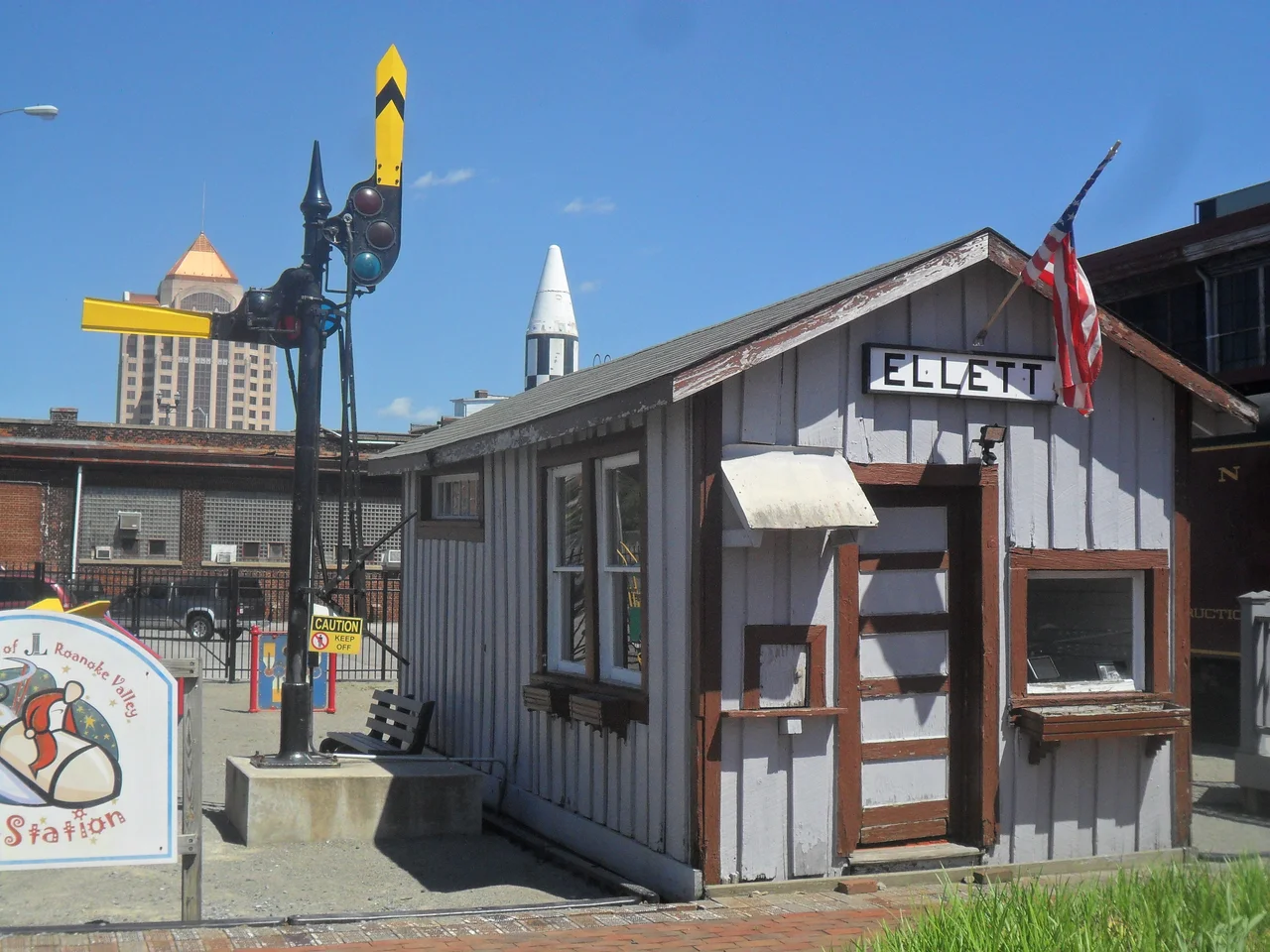
The museum began modestly. In 1963, the Roanoke Transportation Museum opened in Wasena Park, in an old Norfolk and Western freight depot on the banks of the Roanoke River. The first major pieces were eclectic: a United States Army Jupiter missile, donated by the military, and the J-class steam locomotive 611, donated by Norfolk and Western to the city where many of its engines were built. A DC Transit PCC streetcar arrived. So did a hearse, a covered wagon, a Studebaker wagon. In 1983, the Virginia General Assembly granted the institution the title Official Transportation Museum of Virginia. Then, in November 1985, a flood from Hurricane Juan hit Roanoke and inundated the riverside museum, damaging much of the collection. In April 1986, the museum reopened downtown in the historic Norfolk and Western Freight Station - safer ground, and the symbolic right one. The station itself was listed on the National Register of Historic Places in 2012.
Fifty Pieces of Rolling Iron
The collection now includes more than fifty pieces of rolling stock. The steam roster is extraordinary. The J-class 611, restored to operation. The Class A 1218, built at the Roanoke Shops in 1943 and the last surviving 2-6-6-4 articulated locomotive in the world, which ran excursions from 1987 to 1991. The Virginian Railway SA class 4, built by Baldwin in 1910 - the last steam engine left from the Virginian Railway. The Class G-1 number 6, built by Baldwin in 1897, the oldest piece in the collection and one of the oldest N&W locomotives still in existence. Electric power gets equal attention: a Pennsylvania Railroad GG1, the unmistakable lozenge-shaped icon designed for the Northeast Corridor. A Virginian Railway EL-C. A Panama Canal Mule, cosmetically restored in 2020 by the Roanoke Chapter of the National Railway Historical Society.
The People the Tracks Carried
The museum is not only an exhibit of machines. Ongoing displays tell the human stories that ran on the rails. The Claytor Brothers exhibit traces how two Virginians, Graham and Robert Claytor, helped engineer the 1982 merger of Norfolk and Western with Southern to form Norfolk Southern. The exhibit From Cotton to Silk is the result of an oral history project documenting African American railroad workers on the Norfolk and Western and Norfolk Southern lines - their voices, photographs, and artifacts, drawn from the workers and families whose contributions to the industry were rarely acknowledged in their own time. The Norfolk and Western preserved a Jim Crow car, number 1662, which is now part of the museum's collection - stored offsite, a difficult artifact of the era when Black passengers were forced into separate cars on the same trains that carried White passengers in comfort.
Wings, Wheels, and Lake Pearl
Beyond steam, the museum carries a complete cross-section of how Americans moved. An automobile gallery displays a 1913 Metz, a 1920 Buick touring car, and an armored car once used to transport the United States Bill of Rights in 1991. The Wings Over Virginia aviation gallery, rebuilt after a 2006 storm, mixes oral history, simulators, and exhibits on the women who flew and the careers that aviation built. There are Pullman sleeping cars - one named Lake Pearl - and an Illinois Terminal business car called President One. There are passenger cars from the Richmond, Fredericksburg and Potomac, an Overnite Mack truck-and-trailer, a Tucker Sno-Cat once used by the Federal Aviation Administration, and a Norfolk and Western Safety Instruction Car that screens a 1983 documentary, Going Home, about the original restoration of 611. The freight cars include three coal gondolas that exist for one purpose: feeding the boiler of 611 when she runs.
From the Air
The Virginia Museum of Transportation sits at 37.27 N, 79.95 W in downtown Roanoke at the historic Norfolk and Western Freight Station, immediately adjacent to active Norfolk Southern tracks. Cruise at 3,500 to 5,500 feet MSL. The Hotel Roanoke and the city's railroad corridor are visible to the north and east; Mill Mountain and the illuminated Roanoke Star lie south. Nearest airport is Roanoke-Blacksburg Regional (KROA), about 3 nautical miles north. The famous N&W 611 steam locomotive is sometimes run on excursions on adjacent tracks.
Nearby Stories
- Battle of Galudoghson 1.8 km away
- Franklin County, Virginia 14 km away
- Poplar Forest 17 km away
- Pulaski County, Virginia 18 km away
- Alleghany County, Virginia 18 km away
- Draper's Meadow Massacre 19 km away
- Hargrave Military Academy 29 km away
- 2020 Williamsburg Massacre 42 km away