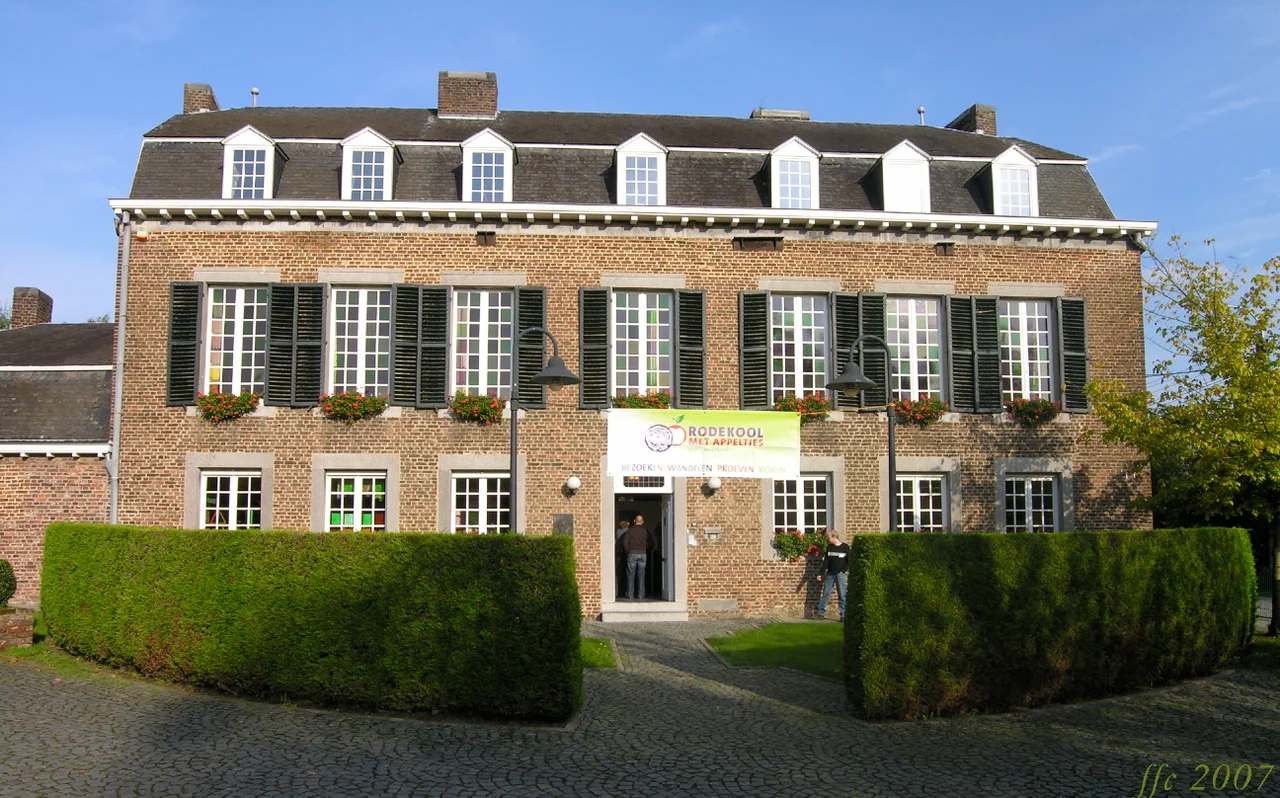

Voeren
Drive into 's-Gravenvoeren and look at the village sign. The Dutch name is painted over. The French version beneath it, Fourons-le-Comte, has been left untouched, sometimes deliberately, sometimes after a fresh layer of vandalism — depending on who passed last week with a spray can. Tens of thousands of Belgian road signs have been daubed and counter-daubed across this border country since the 1970s, but Voeren's signs are the most famous of them. They are the visible scar of a political fight so bitter that in October 1987 it brought down the national government of Wilfried Martens. The argument was about whether a man named José Happart, who refused to take a Dutch-language test, could legally serve as mayor of a Flemish village where almost everyone spoke French.
An Exclave Made by Arithmetic
Voeren is geographically marooned. Six small villages — 's-Gravenvoeren, Sint-Pieters-Voeren, Sint-Martens-Voeren, Moelingen, Teuven and Remersdaal — sit between the Dutch border to the north and the Walloon Liège Province to the south, with no land connection to the rest of Flanders. It became an exclave through political horse-trading rather than geography. In 1962, a Walloon socialist from Liège, Paul Gruselin, proposed shifting Voeren from francophone Liège into Dutch-speaking Limburg as compensation for moving the larger, francophone-leaning towns of Mouscron and Comines-Warneton from West Flanders to Wallonia. Mouscron and Comines together had 75,000 inhabitants and one extra parliamentary seat at stake. Voeren had 4,000. The arithmetic looked easy. Almost no one in Brussels asked the people of Voeren what they wanted.
Two Censuses, Two Truths
The fight rested on a census, and the census was a mess. In 1930, the official linguistic count found Voeren 81 percent Dutch-speaking. In 1947, the same count produced 57 percent French. The Flemish argued, and Belgian parliament eventually accepted, that the 1947 figures had been rigged by francophone nationalists — which is why the results were not published until 1954. By then the language border was being drawn permanently, and the question of who Voeren really belonged to had detached from any verifiable fact. The villagers themselves mostly spoke Limburgish, a dialect that slides between Dutch and German, and dealt with French through their economic life in Liège to the south. Trying to file them on one side or the other was, in the end, an act of administrative violence.
Mayor Happart
José Happart became the symbol. Put forward as mayor of the merged Voeren municipality in 1983 by the francophone Retour à Liège party, he refused to take the legally required Dutch-language test on the principle that he should not have to. He was dismissed. He appealed. He was reinstated. He was dismissed again. The case ricocheted through every level of Belgian administrative law for years. In October 1987, the dispute brought down the Martens VI government. Happart was finally forced out as mayor in 1995. Concessions were granted to the francophones, then rolled back as unconstitutional, then partially restored. The violence of the gangs daubing signs and breaking windows in the 1980s has cooled. The graffiti has not.
What Tipped the Vote
Belgian municipal politics changed at the end of the 1990s when European Union citizens were given the vote in local elections. About a fifth of Voeren's population were Dutch nationals who had drifted across the nearby border for cheaper housing and quiet villages. In 2000, with their votes in play, the Flemish-aligned Voerbelangen party — Voeren's Best Interests — won a clear majority for the first time. They won again in 2006, taking nine of fifteen council seats. The francophone movement has not reclaimed control since. In December 2006, the Flemish government quietly removed the official French translations of village names from signs and documents. The painted-over signs that travelers still photograph are now, in a strict legal sense, the only signs there are.
First into the Netherlands
There is a quieter chapter most Voerenaars would prefer to remember. On 12 September 1944, the American 30th Infantry Division crossed into Voeren and reached the Belgian-Dutch border. From the village fields, the Americans stepped across into nearby Mesch, which became the first Dutch village liberated in the Second World War. The boundary the Americans crossed that morning has been called Belgium's most contested for forty years afterward. In 1944, it was just a line to step over on the way to bigger fights ahead.
From the Air
Located at 50.75°N, 5.78°E in the Voer Valley, with the Dutch border 2 km north and the Walloon border just south. Recommended viewing altitude: 2,500-4,000 feet to see all six villages and the rolling Limburg-Liège hills. Nearest airports: Maastricht-Aachen (EHBK, 10 km north) and Liège (EBLG, 22 km southwest). The Voer river threads west to join the Meuse at Eijsden.
Nearby Stories
- Battle of Hurtgen Forest 2.5 km away
- Hoge Kempen National Park 9.7 km away
- Battle of Hannut 14 km away
- Ted Swales 15 km away
- Rheindahlen 20 km away
- Marcinelle Mining Disaster 59 km away
- Fort Jeanne d'Arc 149 km away
- Marmoutier Abbey 210 km away