.jpeg)
Waldron Island
Some of the most widely sung choral music written in America over the past thirty years was composed on an island with no electrical supply, no ferry service and no store. Morten Lauridsen bought Crum's Castle - Waldron Island's former general store, closed since 1942 - in 1975, and has been writing there ever since. O Magnum Mysterium came out of that arrangement in 1994; Lux Aeterna followed in 1997. Choirs perform them in cathedrals with enormous acoustics and full lighting rigs. The room where the notes were first set down has one county dock and a boat ride between it and the rest of the world.
Lemos, and Then Two Brothers
The Spanish got here first, in naming terms. Francisco Eliza's 1791 expedition charted the island and called it Lemos. Fifty years later the United States Exploring Expedition under Charles Wilkes worked its way through Puget Sound, and in May 1841 Lieutenant Case of the Vincennes and his party surveyed these waters. The name they attached honoured one - or possibly both - of a pair of brothers serving with the expedition: Richard Russell Waldron, purser of the Vincennes, and Thomas Westbrook Waldron, captain's clerk aboard the Porpoise. Nobody has ever fully settled which. It is a fittingly low-key origin for a place that has spent the rest of its history avoiding notice.
Stone, Coal, and a Homestead
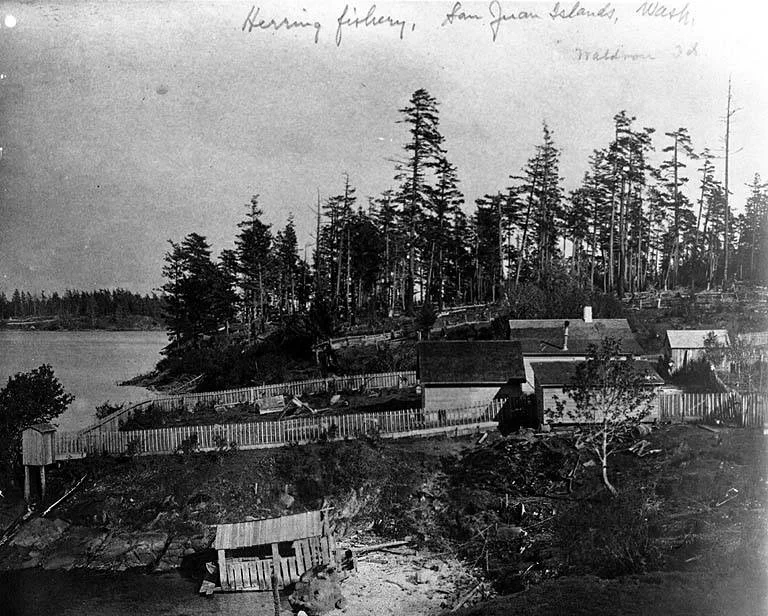
Waldron is 4.6 square miles of rock and forest, and for a while in the nineteenth century people tried to make an industrial living from it. Sandstone was quarried here and shipped out for buildings elsewhere. Coal deposits were found, though nothing on the scale that would have transformed the island. Homesteaders arrived and worked small pieces of ground, and one of their houses survives: the Krumdiack Homestead, built in 1890 and now listed on the National Register of Historic Places. The extraction stopped, the homesteads thinned out, and the island was left to the people who actually wanted to be there - which turned out to be a durable arrangement.
Living High
In 1941 a Waldron resident named June Burn published Living High: An Unconventional Autobiography, and put the island firmly in it. She described building a log cabin with her family, a life assembled largely by hand out of a place that offered very little infrastructure and a great deal of everything else. The book found readers well beyond the San Juans. Her daughter-in-law, Doris Burn, went on to write several books of her own while living on the island. That two generations of one family should produce published work from a place with a hundred residents says something about what the quiet is good for.
The Year They Chose Less
The last store closed in 1942, and no regular ferry has served the island since. What is remarkable is that Waldron then decided, formally, to keep it that way. Since 1976 it has been designated a Limited Development District. Commercial recreation facilities are prohibited. No large-scale extraction of natural resources is permitted. No large homes may be built, and no paved roads. There is no electrical supply and no water system, and access is by private boat to a single county-owned dock. Most communities spend their energy lobbying for more; Waldron went to the trouble of legislating for less, and has held the line on it for half a century.
One Hundred and Four People
The 2000 census found 104 people on Waldron, in 62 households, 27 of them families. That is the entire civic scale of the place - a number small enough that the census tract and the community are effectively the same thing. Living here requires generating your own power, collecting or drilling your own water, and organising every arrival and departure around weather and a small boat. The reward is a kind of quiet that has become almost unbuyable in the San Juans, where the neighbouring islands fill with summer traffic. Morten Lauridsen, who taught at USC's Thornton School of Music for fifty-two years and received the National Medal of Arts in 2007, has divided his life between Los Angeles and this. It is not hard to see the appeal of the second half.
From the Air
Waldron Island lies at 48.688°N, 123.036°W in the northern San Juan Islands of Washington State, roughly between Orcas Island to the east and the Canadian border to the north. It covers 4.6 square miles (11.9 km2) and is deliberately undeveloped: from 2,000-3,500 ft it reads as a solid block of dark forest with a pale sandstone shoreline, almost no visible road network, no ferry slip, and just one small county dock. That absence of infrastructure is itself the identifying feature among the San Juans, where neighbouring islands show obvious harbours and ferry terminals. Orcas Island Airport (KORS) at Eastsound is the nearest field, Friday Harbor (KFHR) lies south on San Juan Island, and Bellingham International sits east on the Washington mainland. There is no public airfield on Waldron. Treat the island as a privacy-sensitive overflight - residents chose this - and expect strong channel winds and rapid fog in the passes between islands.
Nearby Stories
- Smith Island (Washington) 3.2 km away
- Montague Harbour Marine Provincial Park 3.8 km away
- John Dean Provincial Park 3.8 km away
- Nooksack, Washington 7 km away
- Race Rocks Ecological Reserve 11 km away
- Blaine Air Force Station 11 km away
- Whatcom Trail 14 km away
- USNS Sgt. George Peterson 40 km away