
Walters Art Museum
When the Civil War broke out in 1861, William Thompson Walters left Baltimore for Paris. He was a Confederate sympathizer in a Union city, and Europe was the safer address. He spent the rest of the decade buying paintings. His son Henry kept buying after him - Renaissance bronzes, Egyptian mummies, Faberge eggs, the agate vase that once belonged to Rubens. When Henry died in 1931, he left the City of Baltimore more than 22,000 objects, the palazzo he had built to hold them, and the townhouse next door. The will specified that admission be free. Nearly a century later, it still is.
A Palazzo on Charles Street
Henry Walters did not want his collection scattered to auction houses. In 1905 he commissioned architect William Adams Delano to design a gallery on the northwest corner of North Charles and West Centre Streets, in the Mount Vernon neighborhood a block south of the family mansion. The exterior took its cues from the Renaissance-revival Hotel Pourtales in Paris. The interior copied the seventeenth-century Collegio dei Gesuiti in Genoa, built by the Balbi family for the Jesuits. Construction finished in 1909. An overhead passageway connected the gallery to Henry's townhouse across the back alley, so the family could walk from breakfast to the antiquities without crossing a street. Today the palazzo holds the Renaissance, the Baroque, the eighteenth-century French decorative arts, and the rare books. Walters did not just collect art - he built it a house in a style the art would have recognized.
Thirty Centuries Under One Roof
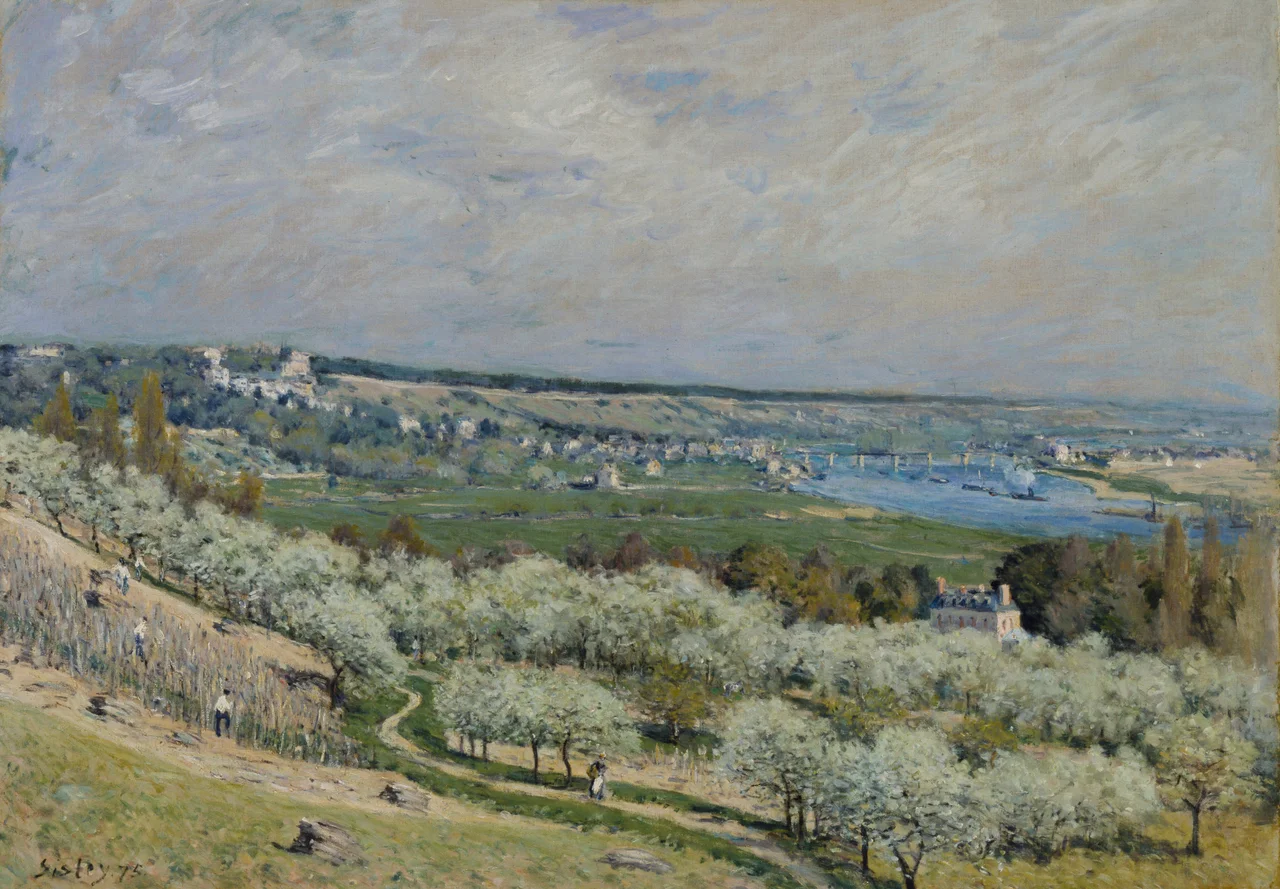
The collection spans about five thousand years and most of the inhabited world. Two three-thousand-pound statues of the Egyptian lion-headed goddess Sekhmet stand on long-term loan from the British Museum. The medieval holdings are considered among the finest in the United States, and the Ethiopian Orthodox icons form the largest such collection outside Ethiopia. There is a Cambodian bronze of an eight-armed Avalokiteshvara from the late twelfth century, and the oldest surviving Chinese wood-and-lacquer Buddha, late sixth century, displayed alone in its own gallery. Hugo van der Goes hangs near El Greco, who hangs near a Tiepolo. Monet's Springtime, Manet's Cafe Concert, and Ingres' second version of Odalisque with Slave anchor the nineteenth-century rooms. In the Treasury sit two Russian Imperial Easter eggs by the House of Faberge - the kind of object that turns ordinary museums into pilgrimage sites.
The Brutalist Behind the Palazzo
The original gallery filled up. In 1974 the museum opened a Centre Street annex designed by Shepley, Bulfinch, Richardson and Abbott of Boston, in the poured-concrete Brutalist style that dominated 1960s public architecture. The contrast with the 1909 palazzo could hardly be sharper - one building a Genoese fantasy, the other a slab of structural honesty. Between 1998 and 2001 the firm Kallmann McKinnell and Wood softened the transition with a four-story glass atrium, a suspended staircase at the junction of old and new, and a new ground-level lobby on Centre Street that finally made the museum accessible to visitors who used wheelchairs. The annex holds the ancient, Byzantine, medieval, Ethiopian, and nineteenth-century European collections. It also houses one of the oldest art conservation laboratories in the country, the workshop where the Walters' Egyptian mummies and Byzantine reliquaries are studied and stabilized.
Free Admission, Open Pixels
Henry Walters wrote 'for the benefit of the public' into his bequest, and the museum has taken the phrase further than most. Admission is free, every day. In 2012 the Walters released nearly twenty thousand images of its collections under a Creative Commons license and uploaded them to Wikimedia Commons. At the time, it was one of the largest such releases by any museum in the world. Anyone with an internet connection can now download a high-resolution image of the Rubens Vase, the Mughal miniatures from Akbar's Khamsa of Nizami, or the Sevres pot-pourri vase shaped like a ship - one of only ten such vases known to survive from the 1750s and 1760s. The museum gave its objects back to the world twice: once when it opened the doors, again when it opened the files.
Mount Vernon Around It
The Walters anchors the south side of Mount Vernon Place, Baltimore's most refined nineteenth-century square. Just to the northeast rises the Washington Monument, the marble column begun in 1815 - the first major monument to George Washington in any American city, predating the one in the District by decades. The Walters mansion stands on West Mount Vernon Place, the gallery a block south on Centre. To the west is Cathedral Hill, with the old Basilica of the Assumption. To the south is downtown Baltimore and the Inner Harbor. Mount Vernon is a neighborhood where the brownstones still have their original ironwork and the bookshops outlast the chain stores. The Walters is the kind of museum that grew out of a particular city, in a particular century, and never left.
From the Air
The Walters Art Museum sits at 39.30 degrees north, 76.62 degrees west, in Mount Vernon just north of downtown Baltimore. From the air, the palazzo and its annex form a compact block one street south of the Washington Monument's marble column - a useful landmark for orientation. Baltimore-Washington International (KBWI) is about 9 nautical miles south-southwest; Martin State Airport (KMTN) is 8 northeast. The downtown class B floor in this sector starts at 1,500 feet, so VFR transits should plan well below that. The Inner Harbor lies a mile southeast and makes a striking visual reference.
Nearby Stories
- Takoma Park, Maryland 5.2 km away
- Annapolis 5.5 km away
- Adkins Arboretum 7.8 km away
- Murders of Katherine and Sheila Lyon 28 km away
- Fort Delaware: The Island Prison Where 33,000 Confederates Waited Out the War 32 km away
- Battle of Gettysburg 35 km away
- Memorial Hall (Delaware State) 36 km away
- Three Mile Island: The Accident That Stopped Nuclear America 71 km away