
Wapping
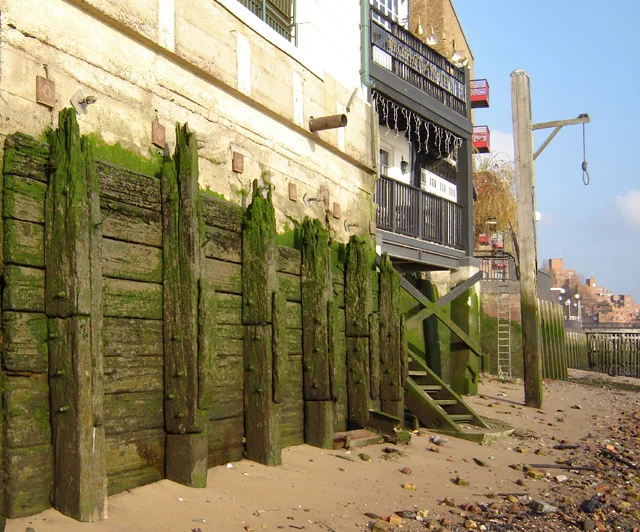
For over 400 years, until as late as 1830, the Admiralty hanged pirates at Execution Dock on the Wapping foreshore. The condemned were paraded from Marshalsea Prison, across London Bridge, past the Tower of London, and to a gibbet positioned below the low-water mark—beyond the tidal boundary where Admiralty jurisdiction applied. Their bodies were left dangling until the tide had submerged them three times. A replica of the gibbet still stands on the foreshore beside the Prospect of Whitby public house. Wapping has never been a place that forgot its past quietly.
A Marsh Made Habitable
The name Wapping probably derives from *wapol*, meaning marsh—and for centuries that is what the land was. The draining of Wapping Marsh and the consolidation of a river wall along which houses could be built was finally achieved around 1600, after earlier attempts had failed. Settlement developed along the river wall, constrained by the river to the south and the drained marsh to the north, giving the district its peculiarly narrow shape: little more than the axis of Wapping High Street and north-south side streets. The sixteenth-century historian John Stow described it as 'a continual street, or a filthy strait passage, with alleys of small tenements or cottages, built, inhabited by sailors' victuallers.' The people who lived here served the river: sailors, mastmakers, boatbuilders, blockmakers, instrument-makers, and the suppliers who kept seafarers alive and working.
A World of Arrivals
Wapping's position beside the Thames made it a point of arrival for centuries. In the fifteenth century it held seamen from the Low Countries. Irish workers established a community from the sixteenth century onwards, naming a stretch of Cable Street 'Knock Fergus'—the Irish name for Carrickfergus in County Antrim, recorded as early as 1597. By 1702 a French-speaking church at Milk Alley served seafarers from Jersey and Guernsey alongside Huguenot refugees from France. German migrants arrived from the sixteenth century, many working in the sugar industry; their quarter was called Little Germany. The late eighteenth century saw a considerable Black presence at the two parish churches, particularly at St George in the East, with many Black and mixed-race seamen being baptised there. Wapping was never a settled, homogeneous community—it was a place where the world came and went with the tides.
The Marine Police and Captain Kidd
In 1798, magistrate Patrick Colquhoun and a Master Mariner named John Harriott established the Marine Police Force in Wapping High Street—said to be England's first police force of any kind. It was created to stop theft and looting from ships anchored in the Pool of London. Its base remains in Wapping High Street today, now known as the Marine Support Unit. The Thames Police Museum, housed within the Unit's headquarters, is open by appointment. Captain William Kidd—the Scottish privateer executed in 1701 after being found guilty of murder and piracy—was hanged on the Wapping foreshore. The pub that bears his name, the Captain Kidd, stands in a seventeenth-century building on the site, though the pub itself only opened in the 1980s. The Prospect of Whitby, formerly the Devil's Tavern, claims to have an inn on its site since the reign of Henry VIII.
Fortress Wapping, 1986
In January 1986, Rupert Murdoch moved News International's printing operations to a new plant in Wapping—clandestinely equipped, and staffed with the help of a different union (the EETPU) while the traditional print unions were locked out. Around 6,000 newspaper workers went on strike. The Wapping plant was nicknamed 'Fortress Wapping.' The sacked print workers mounted round-the-clock pickets and blockades for over a year in an ultimately unsuccessful attempt to reverse the move. The dispute, alongside the miners' strike of 1984–85, is considered one of the defining moments in the history of British trade unionism and industrial relations. Tobacco Dock—a Grade I listed warehouse built around 1811—survives nearby, converted into a £47 million shopping centre in 1990 that failed commercially and has been largely empty since the mid-1990s.
From the Air
Wapping lies at 51.507°N, 0.061°W on the north bank of the Thames in the London Borough of Tower Hamlets, between Tower Bridge to the west and Limehouse to the east. The Thames is the dominant geographic feature from altitude—Wapping's narrow strip of land runs along its north bank. The distinctive curves of the river bend around the Isle of Dogs to the east make orientation straightforward. Nearest airport is London City (EGLC, about 3 miles east along the river). The nearest station is Wapping on the London Overground East London line. The area sits at approximately 5 metres elevation.
Nearby Stories
- Stevenage 5.7 km away
- Malling Abbey 5.7 km away
- 1952 Farnborough Airshow Crash 7.7 km away
- Ingatestone Hall 8.2 km away
- Hellfire Caves 9.1 km away
- The Carrington Event: The Solar Storm That Could Happen Again 9.8 km away
- Bletchley Park 16 km away
- Castle Hedingham 23 km away