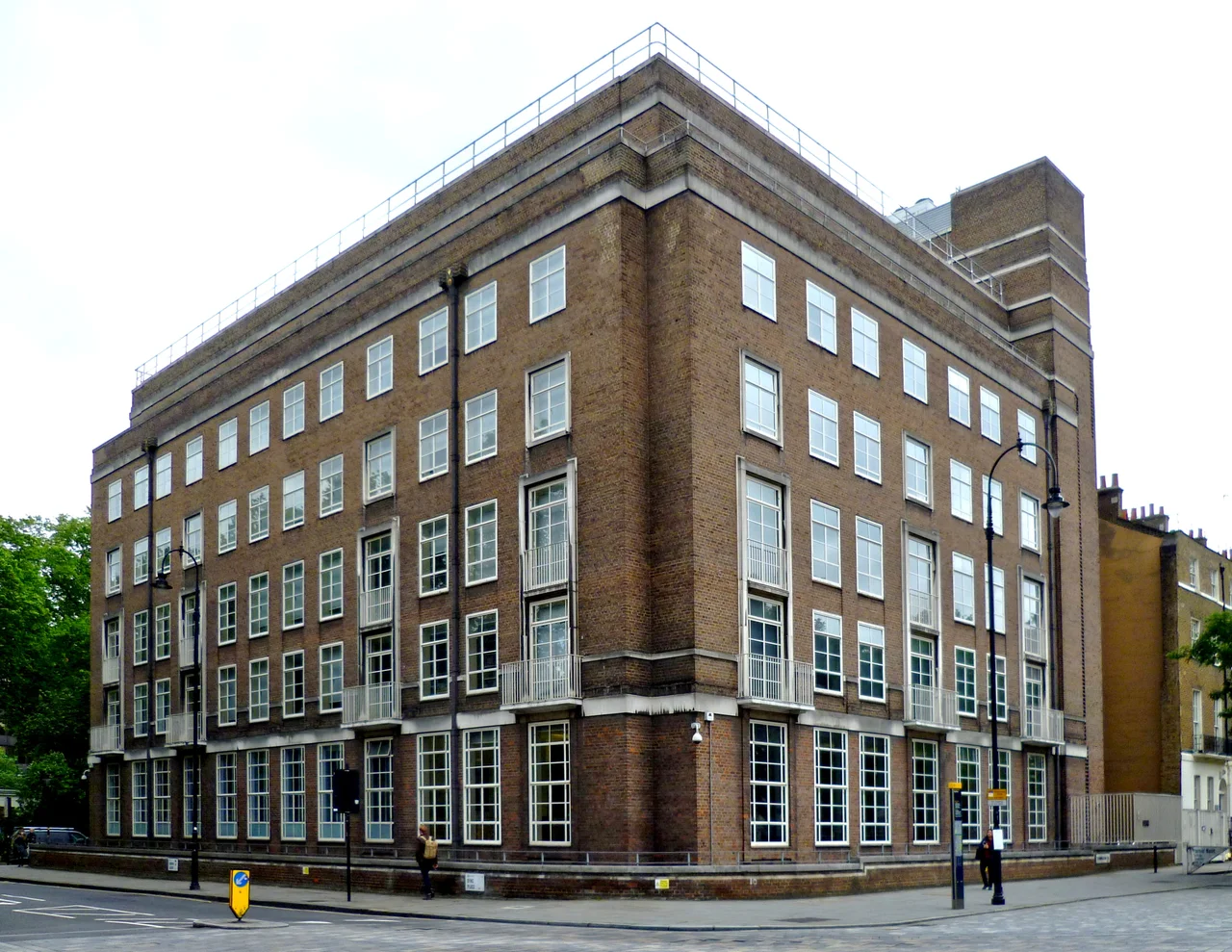

Warburg Institute
Aby Warburg had a peculiar conviction: that antiquity never ended. The gods of Greece and Rome did not disappear when Christianity spread across Europe. They went underground, re-emerging in Renaissance paintings, in astrological charts, in the gestures of figures in medieval manuscripts. Warburg spent his life tracking this 'afterlife of antiquity'—the way images and ideas from the classical world kept surfacing, transformed, in unexpected places. He began collecting books to support this research in 1886, formally established his library in Hamburg in 1909, and by 1933 had created one of the most unusual research institutions in the world. Then the Nazis came to power.
Escape from Hamburg
Aby Warburg died in 1929, four years before the threat became undeniable. His colleagues—led by Fritz Saxl, who had joined the institute in 1913 and served as its first director—made the decision to move the library to safety. In 1933, with Lord Lee of Fareham, Samuel Courtauld, and the Warburg family providing support, the collection was shipped to London and installed in Thames House. In 1934. The move preserved tens of thousands of volumes and a photographic archive of enormous scholarly value. In 1937 the institute moved to the Imperial Institute Buildings, and in 1944 it was formally incorporated into the University of London. A research institute formed around a single scholar's obsession had found institutional permanence in a country that was not its own.
The Library's Strange Architecture
The building on Woburn Square in Bloomsbury was designed by Charles Holden and built in 1957. It sits within the University of London's Bloomsbury campus, adjacent to Birkbeck College and the School of Oriental and African Studies. Inside, the library holds more than 350,000 volumes—almost all kept on open shelves, accessible without special permission. But what makes the library distinctive is not its size. It is the arrangement. Warburg devised a classification system based on his division of human history into four categories: Action, Orientation, Word, and Image. Books are shelved by subject within these categories, placed near other books with which they have unexpected affinities. The system is designed to produce the kind of accidental encounters between ideas that Warburg believed scholarship required.
The People Who Worked Here
The scholars associated with the Warburg Institute constitute a remarkable roll call of twentieth-century humanistic scholarship. Ernst Cassirer, the Neo-Kantian philosopher, used it in Hamburg. Erwin Panofsky, who transformed art history with his iconographic method, worked there. Ernst Gombrich—who directed the institute from 1959 to 1976 and wrote The Story of Art, one of the most widely read books about art ever published—was a Warburg scholar. Frances Yates, whose research into Renaissance magic and occult philosophy opened entirely new areas of historical inquiry, worked at the Warburg for decades. Rudolf Wittkower's work on architectural proportion, Edgar Wind's studies of Renaissance allegory—these foundational texts of twentieth-century art history were produced in this building on Woburn Square.
Open to the Public
For most of its London history the Warburg Institute was a specialist research institution with restricted access. In 2022, work began on a major renovation branded 'Warburg Renaissance.' The project created a new structure in the former courtyard, with a lecture theatre and improved storage for archives and special collections. The renovated building opened to the wider public in September 2024, featuring an exhibition focused on the institute's history and an installation by ceramicist Edmund de Waal called Library of Exile—a work about books that have been displaced from their places of origin. It was a fitting subject for a library that had itself been a refugee. The institute also holds 450,000 photographs of paintings, sculptures, prints, and drawings, and maintains the archive of Aby Warburg's personal papers alongside those of Henri Frankfort and Ernst Gombrich.
From the Air
The Warburg Institute stands at 51.523°N, 0.130°W on Woburn Square in the Bloomsbury district of the London Borough of Camden. The building is within the dense institutional campus of the University of London. From altitude, Bloomsbury's grid of garden squares—Russell Square, Tavistock Square, and others—is identifiable, with the university buildings filling the spaces between. Nearest airports are Heathrow (EGLL, about 14 miles west) and London City (EGLC, about 10 miles east). The nearest tube stations are Russell Square and Euston Square. The area sits at approximately 20 metres elevation.
Nearby Stories
- Stevenage 5.7 km away
- Malling Abbey 5.7 km away
- 1952 Farnborough Airshow Crash 7.7 km away
- Ingatestone Hall 8.2 km away
- Hellfire Caves 9.1 km away
- The Carrington Event: The Solar Storm That Could Happen Again 9.8 km away
- Bletchley Park 16 km away
- Castle Hedingham 23 km away