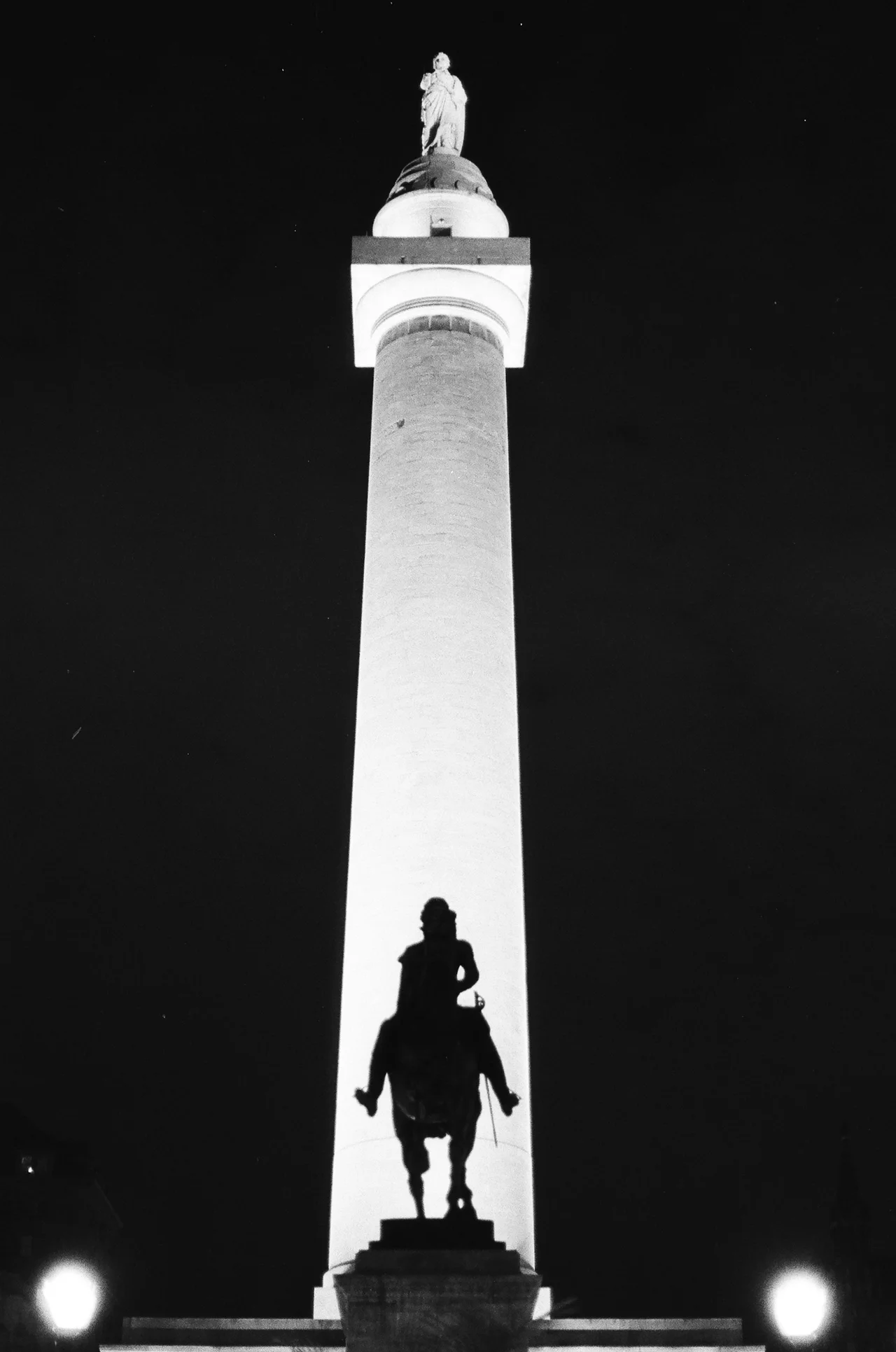

Washington Monument (Baltimore)
Ishmael, on the masthead in Moby-Dick, looks down and remembers Baltimore. 'Great Washington, too, stands high aloft on his towering main-mast in Baltimore,' Melville writes, 'and like one of Hercules' pillars, his column marks that point of human grandeur beyond which few mortals will go.' Two hundred and twenty-seven steps lead to the platform where Washington stands. He is depicted in the act of resigning his military commission - the rarest gesture in the history of generals, the one that made him worth a column in the first place.
The Column That Came Before the Obelisk
Baltimore got there first. The cornerstone was laid on Independence Day, 1815, by Governor Levin Winder in a Masonic ceremony, on land donated by Colonel John Eager Howard from his Belvidere estate north of the city. The original site, in old Courthouse Square downtown, had been abandoned after nearby residents protested they would be crushed if the column ever toppled. The architect was Robert Mills, who would later design the much taller obelisk on the National Mall - but that one was not begun until 1848 and not finished until 1885. For seven decades, then, Baltimore's column was the major Washington monument in the country. Mid-nineteenth-century maps routinely paired Mills's column with the Capitol building because the District's was still a stump in scaffolding. The Doric column rises 178 feet 8 inches, built of marble from three different Baltimore County quarries, and crowned by a standing figure of Washington carved by Italian sculptor Enrico Causici.
The Shooting Star and the Eagle
Tradition records a prodigy from the day Causici's marble Washington was hoisted to the top in 1829. A shooting star crossed the sky, and an eagle settled on the new general's head. William Rusk recorded the story in his book Art in Baltimore, and like most Founding Father lore it is impossible to verify and impossible to dismiss. The monument's iconography is specific: Washington is shown handing back his commission, an event that actually happened in the Old Senate chamber of the Maryland State House in Annapolis on December 23, 1783. The Confederation Congress was meeting there at the time, using the Maryland capitol as the temporary national capital, and they had just ratified the Treaty of Paris that ended the war. Of all the moments Mills could have chosen to memorialize - Trenton, Yorktown, the inauguration - he picked the resignation. The point of the monument is that Washington gave up power. The eagle that supposedly landed on his head agreed.
Two Time Capsules in the Cornerstone
Restoration crews began work in 2014 on a $5.5 million project run by the Mount Vernon Place Conservancy. In October of that year they discovered a sealed copper box behind a plaque inside the monument - the 1915 Centennial time capsule, forgotten by anyone still living. The next February, while digging for a sewage tank, they found something older. The original 1815 cornerstone, a granite cube with a marble lid weighing somewhere between 1,000 and 1,500 pounds, held three glass jars stuffed with newspapers from July 1 and July 3, 1815. Inside one of those papers, the Baltimore Federal Gazette, the page was folded open to a reprint of the Declaration of Independence - the last item placed in the stone before it was sealed. To the people who laid the cornerstone, the monument was not just for Washington. It was for the country he had walked away from being king of. Both capsules are now on display at the Maryland Center for History and Culture, two blocks away.
Mount Vernon Place
The monument anchors the intersection of Mount Vernon Place and Washington Place, the two perpendicular squares that give the surrounding neighborhood its name. Within a few blocks sit the Peabody Institute, the Walters Art Museum, the Central Library of the Enoch Pratt Free Library, the Basilica of the Assumption, and the Baltimore School for the Arts. The cast-iron fence around the base, designed by Mills and installed in 1838, carries symbolic references to Maryland and to the strength of the union of the original thirteen colonies. Every December since 1971, on the first Thursday of the month, the city has lit the monument with strings of holiday lights - a small ceremony that ends with fireworks and runs until Christmas. Baltimore filmmaker John Waters set the opening scene of his 1998 movie Pecker at the base of the column. He explained on the DVD commentary that the photograph the title character takes - Washington's outstretched arm framed at a certain angle - is, in his words, the oldest dirty joke in Baltimore. Even the founding father has been put to local use.
The View From the Top
The 227 steps up the interior spiral staircase open onto a platform with a view across the historic neighborhood. Looking south, downtown Baltimore stacks up toward the Inner Harbor. Looking north, the streets of the Belvedere neighborhood roll away under the brownstones. The Hampton Mansion of Charles Carnan Ridgely - whose quarry supplied the base marble - sits about six miles north in Towson. The monument was closed in 2010 after inspectors found missing mortar and rusted brackets; ten days later, a 1997 Chrysler van plowed through fifteen feet of the iron fence on the southeast corner, which did not help. The restoration reopened the column on July 4, 2015, exactly two hundred years after the cornerstone was laid. Washington still stands at the top, still handing back his commission, still doing the thing that matters more than the column.
From the Air
The Washington Monument stands at 39.30 degrees north, 76.62 degrees west, in Mount Vernon north of downtown Baltimore. At 178 feet 8 inches it is easily visible from low altitude, a slender Doric pencil at the intersection of two green squares. From the air it makes a useful landmark for downtown approaches. Baltimore-Washington International (KBWI) is about 9 nautical miles south; Martin State (KMTN) is 8 northeast. The Inner Harbor lies about a mile south-southeast. Downtown Baltimore's tall buildings cluster south of the monument, so it tends to stand isolated against the residential rooftops to the north.
Nearby Stories
- Takoma Park, Maryland 5.2 km away
- Annapolis 5.5 km away
- Adkins Arboretum 7.8 km away
- Murders of Katherine and Sheila Lyon 28 km away
- Fort Delaware: The Island Prison Where 33,000 Confederates Waited Out the War 32 km away
- Battle of Gettysburg 35 km away
- Memorial Hall (Delaware State) 36 km away
- Three Mile Island: The Accident That Stopped Nuclear America 71 km away