
Wearmouth Bridge (1796)
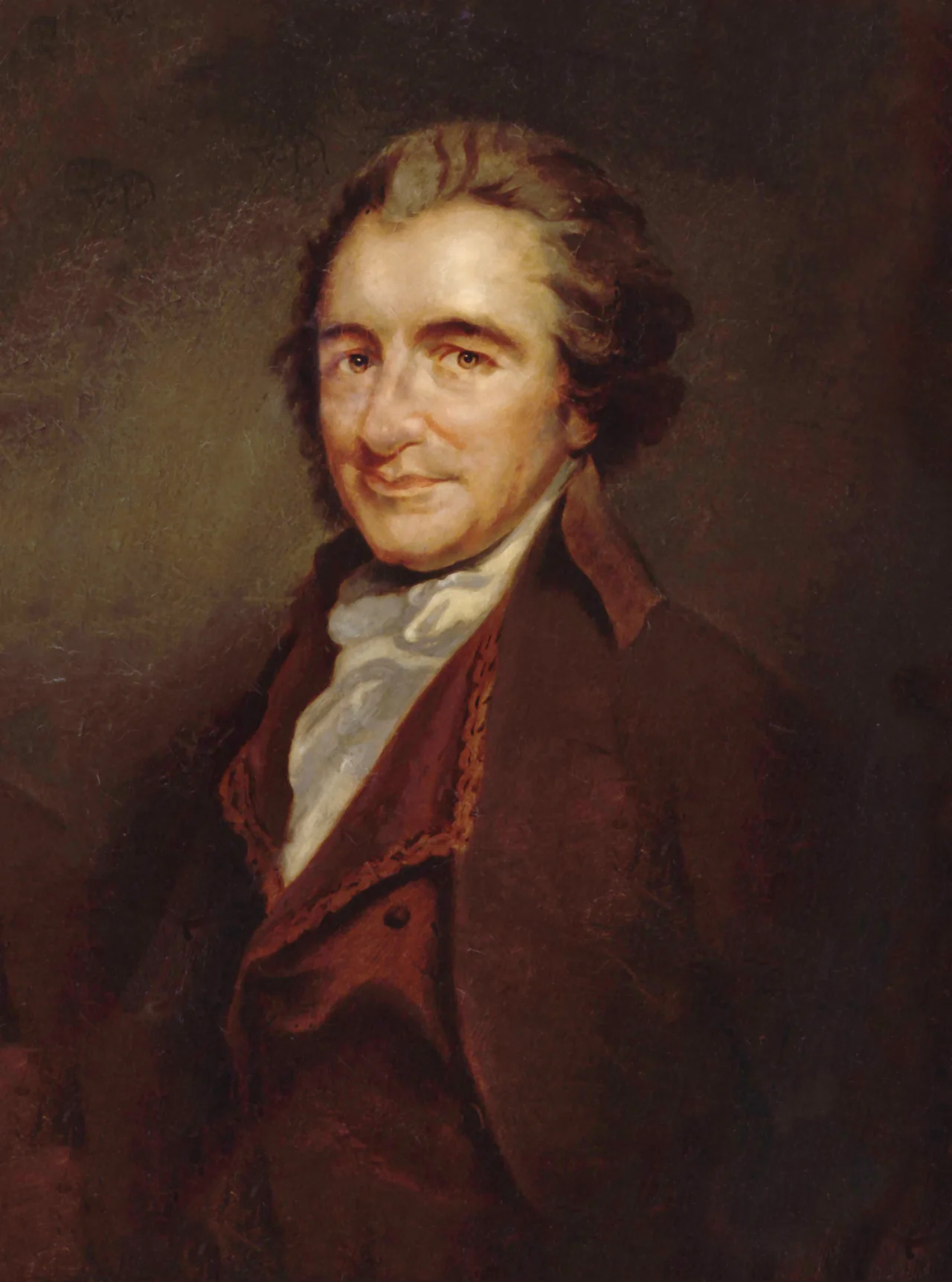
Thomas Paine, the firebrand of Common Sense and The Rights of Man, also designed cast-iron bridges. In 1789 he built a demonstration span of comparable length at the Yorkshire Stingo pub in Paddington, London - a publicity stunt for a new way of building bridges. He submitted models and designs to the planners of the Wear crossing in Sunderland. When the Wearmouth Bridge opened in 1796, it stood 72 metres across, the longest single span in the world, only the second major bridge ever built of cast iron. Two of its six ribs may have been forged from the actual ribs of Paine's prototype, sent back to the foundry in Rotherham and cast again into the structure that crossed the Wear. The pamphleteer's iron lived on in the bridge.
After The Iron Bridge
The Iron Bridge at Coalbrookdale, opened in 1779, had proved that cast iron could span a river. Its 30-metre arch was small but transformative - the first major bridge in the world made of cast iron, an icon of the early industrial revolution. The Wearmouth crossing took the idea and doubled it. Rowland Burdon, Member of Parliament for County Durham, sponsored and patented the design; the architect Thomas Wilson directed construction. The bridge spanned 240 feet - over twice as long as Coalbrookdale - and weighed only three-quarters as much. At the time of its opening it matched the collapsed Trezzo Bridge in Italy for span, but unlike Trezzo it stayed up. Nikolaus Pevsner later called it 'a triumph of the new metallurgy and engineering ingenuity, of superb elegance'.
The Paine Connection
Thomas Paine's involvement is the kind of historical thread that sounds invented but isn't. After his American adventures, Paine spent the late 1780s on cast-iron bridge schemes, partly out of engineering interest and partly because he believed iron bridges would change the world. The Paddington demonstration span - 110 feet long, exhibited from 1789 - was a proof of concept that didn't find a buyer. When Paine fled to France in 1792 amid government suspicion of his radical writings, the prototype was returned to Walker's foundry at Rotherham. The Wearmouth bridge was cast at the same foundry. The chronology and the geography fit. The conservative parliamentarian Burdon and the revolutionary Paine never met over the project; their iron met instead, melted down and re-cast into the ribs that carried Sunderland's traffic for 130 years.
Building And Catalyst
The foundation stone was laid in September 1793. Construction took three years. The bridge opened to traffic on 9 August 1796 at a total cost of about £28,000. According to the plaque on its successor, it 'proved to be a catalyst for the growth of Sunderland' - and the claim is justified. Before the bridge, Monkwearmouth on the north bank and Bishopwearmouth on the south were connected only by ferry, with the nearest road crossing 12 miles upstream at Chester-le-Street. A bridge in the middle of the town transformed everything. Tolls were charged at first - the standard model for funding privately patented infrastructure - and pedestrian tolls were abolished only in 1846. The bridge worked, beautifully, except for one problem nobody had anticipated.
Sun, Heat, And A Reconstruction
In 1805, the sun caused a problem. Heat expanded the cast-iron components unevenly, and some of the cross tubes fell out of the structure. Repairs followed. The bridge stayed in service, but its long-term durability was a concern. From 1857 to 1859 Robert Stephenson - son of George, builder of railways - stripped the bridge back to its six original iron ribs and raised the abutments to level the roadway. This second-generation Wearmouth Bridge reopened in March 1859 and remained in service until 1927, when increasing traffic forced its replacement. The current bridge, built 1927-29 around the old one to keep the road open, stands on the same site today. Two of the ribs Paine may have cast, Burdon paid for, Stephenson stripped down and Sunderland crossed for over a century are gone now. But the elegance Pevsner praised had a long innings.
From the Air
Located at 54.91°N, 1.38°W across the River Wear in central Sunderland. The current Wearmouth Bridge (1929) stands on the same site - the only bridge over the Wear at this point. Easily visible from the air as the principal crossing connecting Monkwearmouth on the north bank to the city centre on the south. Nearest airport: Newcastle (ICAO EGNT), 13 nautical miles north-northwest. Best viewed at 1,500-3,000 feet. North Sea coastal weather; haar (sea fog) common in summer.
Nearby Stories
- Seaton Carew 2.7 km away
- HMS Unity (N66) 6 km away
- George Stephenson's Birthplace 6.1 km away
- Raby Castle 9 km away
- Cragside 15 km away
- Whitby Abbey 21 km away
- German submarine U-2367 46 km away
- Alexander L. Kielland (Platform) 277 km away