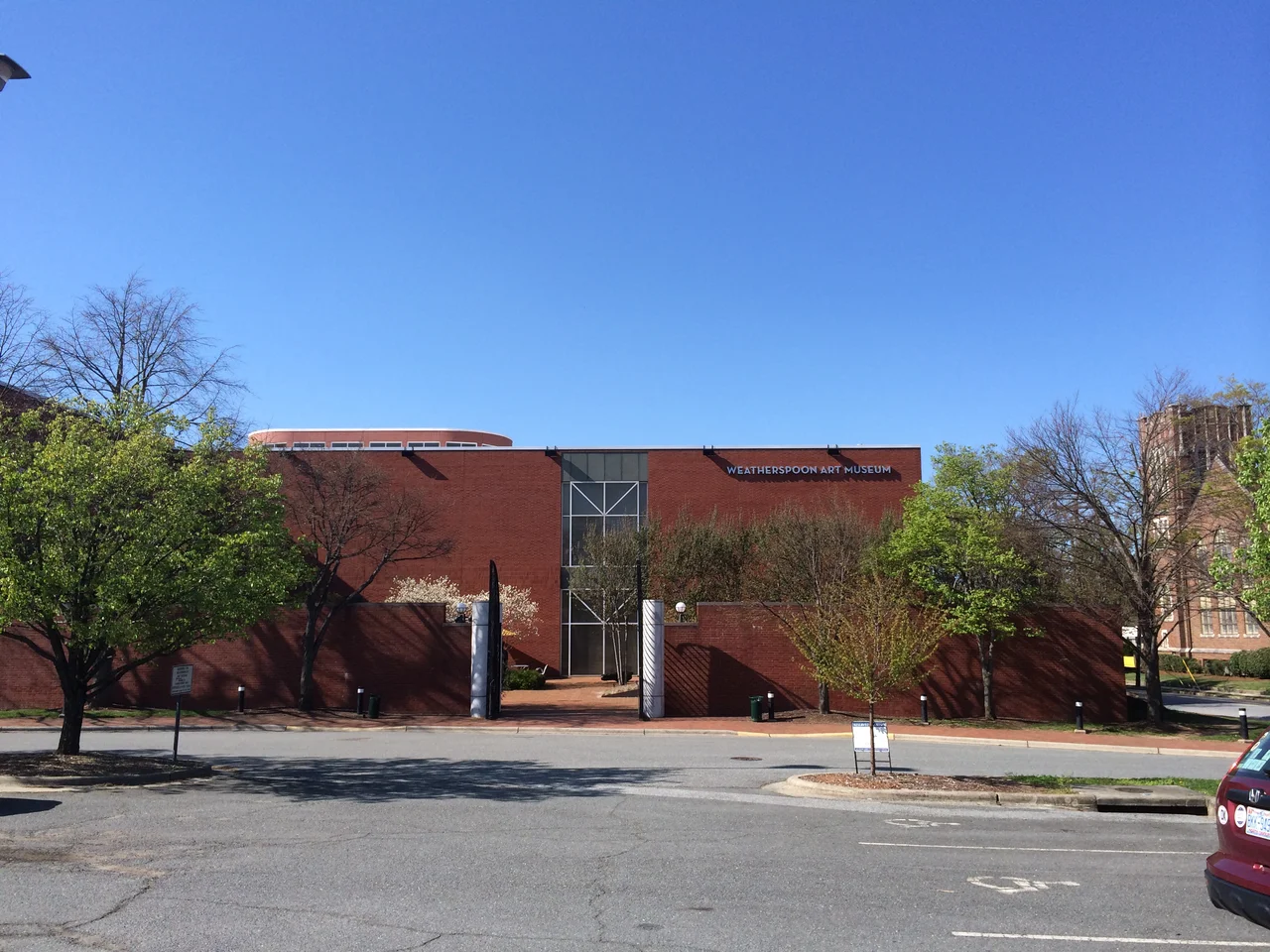

Weatherspoon Art Museum
The first gallery had no paintings yet, and the room had been a physics lab. In 1941 Gregory Ivy, the new head of the art department at Woman's College of the University of North Carolina, talked his way into a vacant space in the McIver Building and called it a gallery. Eighty-five years later, the descendant of that improvised room holds close to 6,000 works - Warhol screenprints, de Kooning canvases, Calder mobiles, Cindy Sherman photographs, Matisse bronzes - and qualifies as one of the largest collections of modern and contemporary American art in the southeast. The Weatherspoon is the rare university museum that earned its national reputation by being curatorially serious before it was institutionally rich.
Named for a Teacher
One year after the physics-lab opening, the gallery was renamed for Elizabeth McIver Weatherspoon - an art educator, a Woman's College alumna, and the sister of the late Charles Duncan McIver, who had founded the college itself fifty years earlier. The naming was not an act of vanity but of continuity: the school's intellectual project of educating women teachers had produced Elizabeth Weatherspoon, who had then spent her life teaching art, and the new gallery would carry her name down the years. In 1989 the museum got the building it deserved when the Anne and Benjamin Cone Building opened. Romaldo Giurgola of Mitchell/Giurgola Architects designed the 42,000-square-foot structure - six galleries, a sculpture garden, an atrium, an auditorium, and two storage vaults - and the Weatherspoon finally had space to match its ambitions.
The Cone Sisters' Gift
In 1950, Etta and Claribel Cone bequeathed 242 works to the Weatherspoon. The Baltimore sisters had spent decades buying art directly from Henri Matisse and Pablo Picasso, building a collection that would mostly go to the Baltimore Museum of Art - but a slice, including Matisse bronzes and prints, came to Greensboro because of family connections to North Carolina. The Cone bequest gave the young museum its first major modern holdings and a permanent line to early 20th-century European modernism: Matisse, Picasso, Raoul Dufy, John Graham. For a college gallery in the postwar South, owning a Matisse was a quiet revolution.
Art on Paper
Since 1965 the museum has hosted the Dillard Collection of Art on Paper, a biennial exhibition funded by the Dillard Paper Company. The shows feature artists working on or with paper - drawings, prints, collages, paper sculptures - and the Weatherspoon has bought from each show to build a paper collection that now exceeds 550 works. Louise Bourgeois, Brice Marden, Joan Mitchell, Robert Smithson, Frank Stella, Eva Hesse, Amy Cutler. The Lenoir C. Wright collection of more than 500 Japanese woodblock prints, built by a UNCG professor emeritus before his death in 2003, joined the paper-based holdings: Hiroshige and Hokusai, Yoshitoshi's late-Edo brilliance, accumulated quietly as teaching tools before becoming a museum collection.
Fifty States, Fifty Works
Dorothy and Herbert Vogel spent forty years collecting contemporary art on a postal-clerk salary and a librarian's wages, filling their New York apartment with 4,000 works they bought directly from artists. When the time came to disperse their collection, they did something quietly democratic: they picked one museum in each of the fifty states and gave each fifty works. The Weatherspoon was the North Carolina choice in 2008, receiving fifty works on paper that included Lynda Benglis, Stephen Antonakos, Charles Clough, Alain Kirili, Lucio Pozzi, Judy Rifka, and Richard Tuttle. The National Gallery, NEA, and Institute of Museum and Library Services helped coordinate the program. The gift fit perfectly with what the Weatherspoon had been doing all along - buying serious contemporary work on a teaching-museum budget.
Garden and Galleries
The sculpture garden carved out behind the Cone Building covers about 7,000 square feet, with native plantings winding among rotating contemporary sculptures. Inside, the six galleries cycle through fifteen or more exhibitions a year. The American Alliance of Museums first accredited the Weatherspoon in 1995 and reaffirmed accreditation in 2005. Most visitors approach across the UNCG campus, past Minerva and the Foust Building, and step into a space that thinks like a museum but functions like a teaching laboratory. Eighty-five years on, that is still the original premise: that students who walk past a Matisse on their way to class will be different students by the time they reach it.
From the Air
Coordinates 36.0661 N, 79.8058 W, elevation about 800 feet, embedded in UNCG's campus on Spring Garden Street in central Greensboro. The Cone Building's flat-roofed contemporary form contrasts with the surrounding red-brick collegiate architecture - a useful landmark from low altitude. Piedmont Triad International (KGSO/PTI) is 9 nm west and provides the primary IFR approach. Smith Reynolds (KINT) lies 23 nm west-southwest in Winston-Salem. Greensboro's regional VFR pattern altitude is typically 2,500 feet MSL. Surrounding airspace is Class C tied to PTI.
Nearby Stories
- Battle of Shallow Ford 4.9 km away
- Pyle's Massacre 8.1 km away
- Caswell County, North Carolina 9.2 km away
- Chang and Eng Bunker 13 km away
- Mebane's Bridge 23 km away
- North Carolina Aviation Museum 25 km away
- Thomas Gillespie 26 km away
- Deep River Camelback Truss Bridge 37 km away