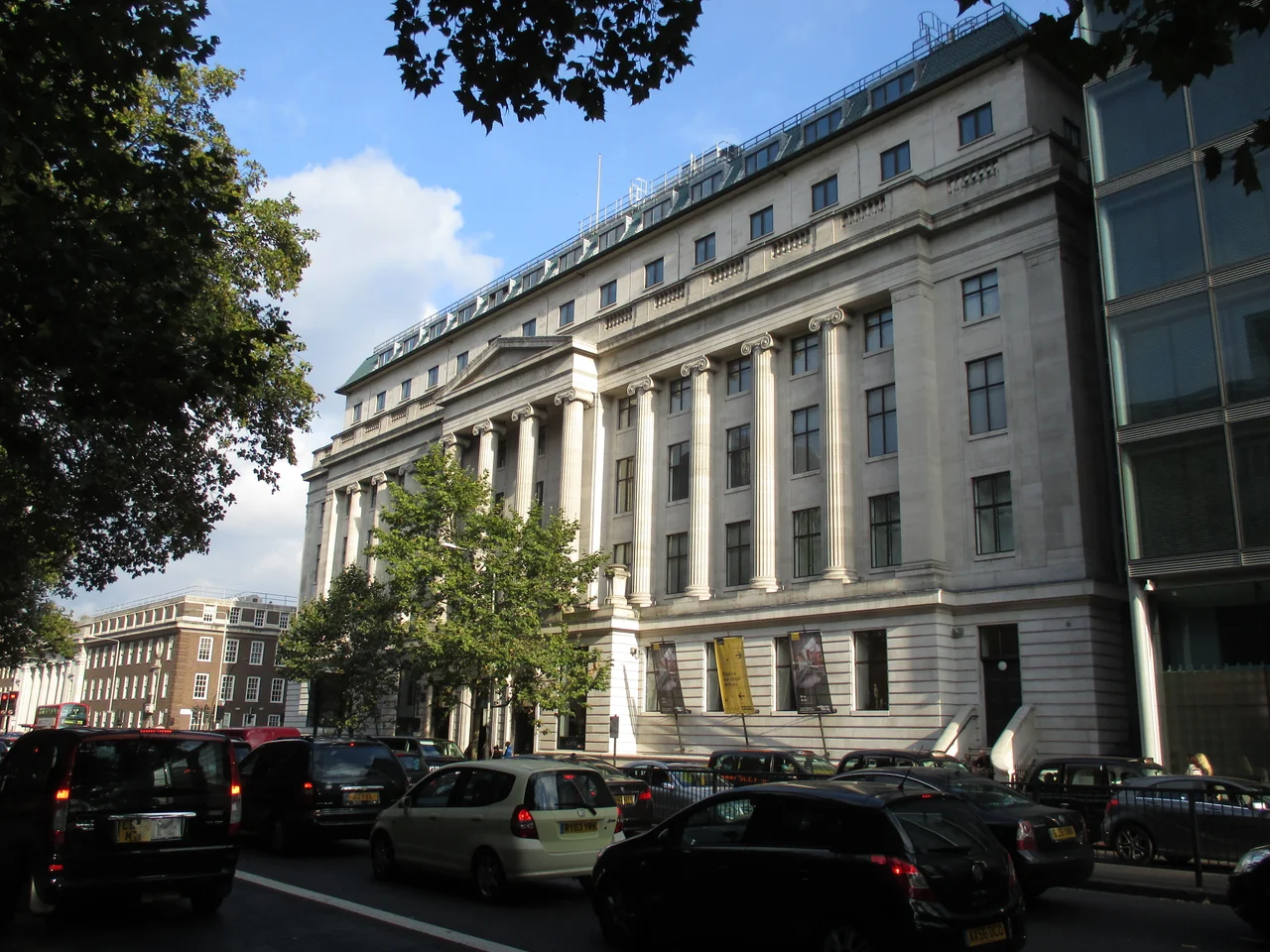

Wellcome Library
At the 1898 auction of William Morris's library, one buyer purchased a third of the entire collection in a single day. His name was Henry Wellcome, and the Morris sale was just a warm-up. For the next four decades, Wellcome deployed agents and dealers across the globe, acquiring books, manuscripts, paintings, surgical instruments, and ritual objects with the systematic intensity of someone who believed that the history of human medicine — in all its strangeness and wisdom — deserved to be gathered in one place. The result, now housed on Euston Road in central London and free to enter, is one of the most remarkable libraries in the world.
A Collector Unlike Any Other
Henry Wellcome was born in 1853 in Wisconsin, the son of a frontier preacher. He built his fortune as co-founder of Burroughs Wellcome, one of the pharmaceutical companies that would eventually become GlaxoSmithKline. But money was always a means to an obsession, not an end in itself. Wellcome's true project was to document the full breadth of medical knowledge across every culture and every era — from ancient Egypt to contemporary London, from Sanskrit herbalism to Elizabethan surgery manuals. He bought furiously and without obvious limit, acquiring the library of the Royal College of Physicians historian Joseph Frank Payne in 1911, and the Munich collection of historian Ernst Darmstaedter in 1930. By his death in 1936, the collection was one of the largest privately assembled in history.
What the Shelves Hold
The breadth is genuinely staggering. The rare books collection runs to approximately 60,000 pre-1851 volumes, including around 600 incunabula — books printed before 1501 — and 5,000 from the sixteenth century. The Asian collections alone contain 12,000 manuscripts and 4,000 printed books across 43 different languages, written on materials that include palm leaf, silk, ivory, metal, bone, bamboo and tree bark. The oldest document in the entire library is a medical prescription from ancient Egypt written on papyrus, dating to around 1100 BCE. The archives hold the personal papers of Francis Crick, co-discoverer of DNA's structure, alongside those of the psychoanalyst Melanie Klein. Over 100,000 prints, drawings, paintings and photographs span six centuries and reach from Japan to the Americas. This is not a specialist collection in any narrow sense: it is an attempt at comprehensiveness.
Open to Everyone
When Wellcome died, his estate passed to the Wellcome Trust, which today holds an endowment of £37.6 billion and ranks as the fourth wealthiest charitable foundation in the world. The Trust's primary mission is funding biomedical research, but it has also maintained its founder's commitment to keeping this extraordinary archive accessible. The library is free and open to the public. In 2007 the building on Euston Road reopened after refurbishment as the Wellcome Collection, hosting gallery exhibitions alongside the library. The galleries explore the intersections of medicine, life and art, and they too charge no admission. Wellcome's vision was not merely to accumulate but to share — to insist that the history of healing belongs to everyone.
Into the Digital Age
In January 2014, the library released nearly 100,000 images from its collection under Creative Commons licences — freely available for commercial and non-commercial use. Over 97,000 of those images were uploaded to Wikimedia Commons in a single batch, making the visual history of medicine suddenly available to anyone with an internet connection. The library has since continued to open its collections through its online catalogue at wellcomecollection.org. A Wikimedian in residence from 2016 to 2017 helped deepen ties with open knowledge communities. The name has changed many times over the decades — from the Wellcome Historical Medical Research Library to the Wellcome Institute Library to Wellcome Collection: The Library — but the ambition has not: to put the history of human health in the hands of the curious.
From the Air
The Wellcome Library is located at 51.5257°N, 0.1349°W on Euston Road in central London. At low altitude from the west, the twin buildings of the Wellcome complex — the original 1932 Portland stone Wellcome Building at 183 Euston Road and the modern Gibbs Building at 215 — are visible along the north side of Euston Road. London City Airport (EGLC) is 14 km to the east; Heathrow (EGLL) is 25 km to the west. Views of central London landmarks including St Pancras and King's Cross stations are visible nearby.
Nearby Stories
- Stevenage 5.7 km away
- Malling Abbey 5.7 km away
- 1952 Farnborough Airshow Crash 7.7 km away
- Ingatestone Hall 8.2 km away
- Hellfire Caves 9.1 km away
- The Carrington Event: The Solar Storm That Could Happen Again 9.8 km away
- Bletchley Park 16 km away
- Castle Hedingham 23 km away