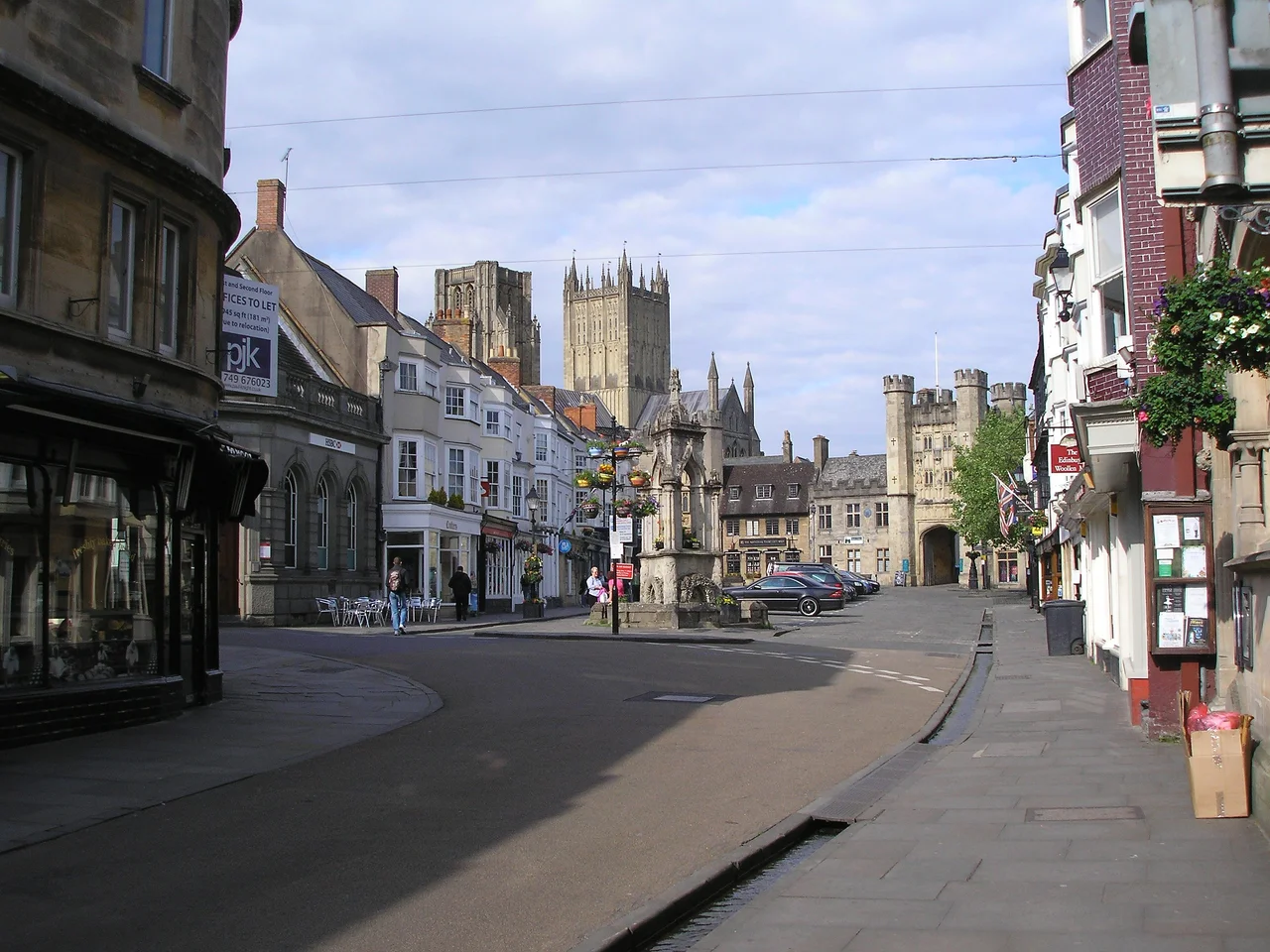

Wells, Somerset
Three springs rise inside the walled gardens of the Bishop's Palace at Wells, fill the moat that surrounds the palace, then flow on through the streets of the city as a literal water supply. They are called St Andrew's Wells. They have been running, as far as anyone can tell, for the entirety of the city's recorded history - they are why the Romans put a settlement here, why King Ine of Wessex founded a minster at this spot in 704, and why Wells is called what it is called. The city's Latin motto, taken from one of its older coats of arms, reads Hoc fonte derivata copia: 'the fullness that springs from this well.'
England's Second-Smallest City
Wells has city status, granted in medieval times because of its cathedral and most recently reconfirmed by letters patent from Queen Elizabeth II on 1 April 1974. By population (11,145 at the 2021 census) and area (3.244 square kilometres of built-up land), it is often called England's smallest city - but that title belongs to the City of London, which packs 8,000 residents into 1.12 square miles and is part of the much larger Greater London. Wells is more accurately England's second-smallest, and the smallest free-standing one. Unlike London it has no greater urban area around it; you can walk from the cathedral to open countryside in fifteen minutes in any direction. Sarah Dyke, a Liberal Democrat, represents Wells in Parliament as the MP for the Glastonbury and Somerton constituency, redrawn in 2024.
A Cathedral and a Stable
The current Wells Cathedral was begun in the early 13th century under Bishop Reginald and finished under Bishop Jocelin, a native of the city. Its west front carries one of medieval Europe's largest surviving collections of sculpted figures - around 300 pieces representing kings, saints, and biblical scenes - although many show damage that has nothing to do with weather. During the English Civil War, Parliamentary forces under Colonel William Strode took the city in 1645 and used the cathedral nave as a stable for their horses, breaking up much of the ornate sculpture for firing practice. Forty years later, during the failed Monmouth Rebellion of 1685, rebel troops attacked the cathedral in an outburst against the established church: they smashed the windows, stripped lead from the roof to make bullets, broke the organ, and damaged the west front further. The Bloody Assizes that followed the rebellion - the brutal summary trials presided over by Judge Jeffreys - held their final session in Wells on 23 September 1685. Over 500 men were tried in a single makeshift day, and most were sentenced to death.
Music Since 909
Wells Cathedral School claims a founding date of 909, when Wells became the seat of its own bishopric, which would make it one of the oldest schools in continuous operation in the world. It is one of just five established musical schools for school-age children in the United Kingdom and now teaches around 700 pupils from ages 3 to 18. The school's boarding houses line the streets at the north end of the cathedral close and the music school maintains close ties with the cathedral choir. Across the road, the state comprehensive Blue School was founded in 1641 and has had since 2004 specialist Arts College status. Between them, the two institutions mean that an unusual proportion of children growing up in Wells learn an instrument seriously. On a still evening, walk past the cathedral close and you can hear it.
Anne of Denmark's Cow Tails
On 20 August 1613, Anne of Denmark, queen consort of King James I, made a state visit to Wells. The city laid on a pageant, with the local trades and crafts performing tableaux: the blacksmiths presented Vulcan's forge; the butchers staged what they called 'old virgins' wearing attire made from cow tails, with necklaces of cow horns, drawn in a chariot pulled by men and boys dressed in ox skins. Mayor William Bull held a dinner for the queen's household, including her four maids of honour. The Venetian ambassador Antonio Foscarini, present at the festivities, recorded the queen's evident delight. The cow-tail virgins were the sort of detail that does not survive in most royal-visit accounts, and one is grateful to whoever wrote it down.
The Beeching Axe and What Remained
Wells once had three railway lines and three stations. The first opened in 1859 as a branch from Glastonbury; the second arrived in 1862 from Witham; the third was a Great Western Railway link tying the two together. The 1964 Beeching Report killed all of them. By 1964 the city had no rail connection at all, and it still doesn't - the nearest station is at Castle Cary, twelve miles away. Bus routes carry most of the connecting traffic. The economy that had grown around cloth-making in the Middle Ages, then around being the largest cheese market in the West of England by the 19th century, has settled into being a market town and a tourist destination. Wells's medieval streets and Vicar's Close, said to be the oldest continuously inhabited residential street in Europe, are heavily used by film productions: scenes from Poldark, Dunkirk, The Huntsman: Winter's War, Broadchurch, and The White Princess have all been shot here in the past decade. Look up. The west front is still there, with most of its figures, and the cathedral choir still sings evensong six days a week.
From the Air
Wells lies at 51.209 degrees north, 2.645 degrees west, at the foot of the southern escarpment of the Mendip Hills, 21 miles south-east of Weston-super-Mare and south of Bristol. From the air the city is recognisable by the cathedral - its three towers and the long nave - in the centre, with the Bishop's Palace moat visible as a square of water immediately south. The Mendip TV transmitter on Pen Hill, 2 miles north-east of the city, is another navigation reference. Nearest airports: Bristol (EGGD), 15 nm north; Exeter (EGTE), 50 nm southwest. Best viewed from 3,000-5,000 feet AGL.
Nearby Stories
- National Eisteddfod of Wales 4.9 km away
- Montacute House 6.1 km away
- Malmesbury Abbey 9 km away
- Quantock Hills 11 km away
- Severn Bridge 12 km away
- Coldharbour Mill Working Wool Museum 15 km away
- Stonehenge Cursus 21 km away
- Royal Naval Cordite Factory, Holton Heath 29 km away