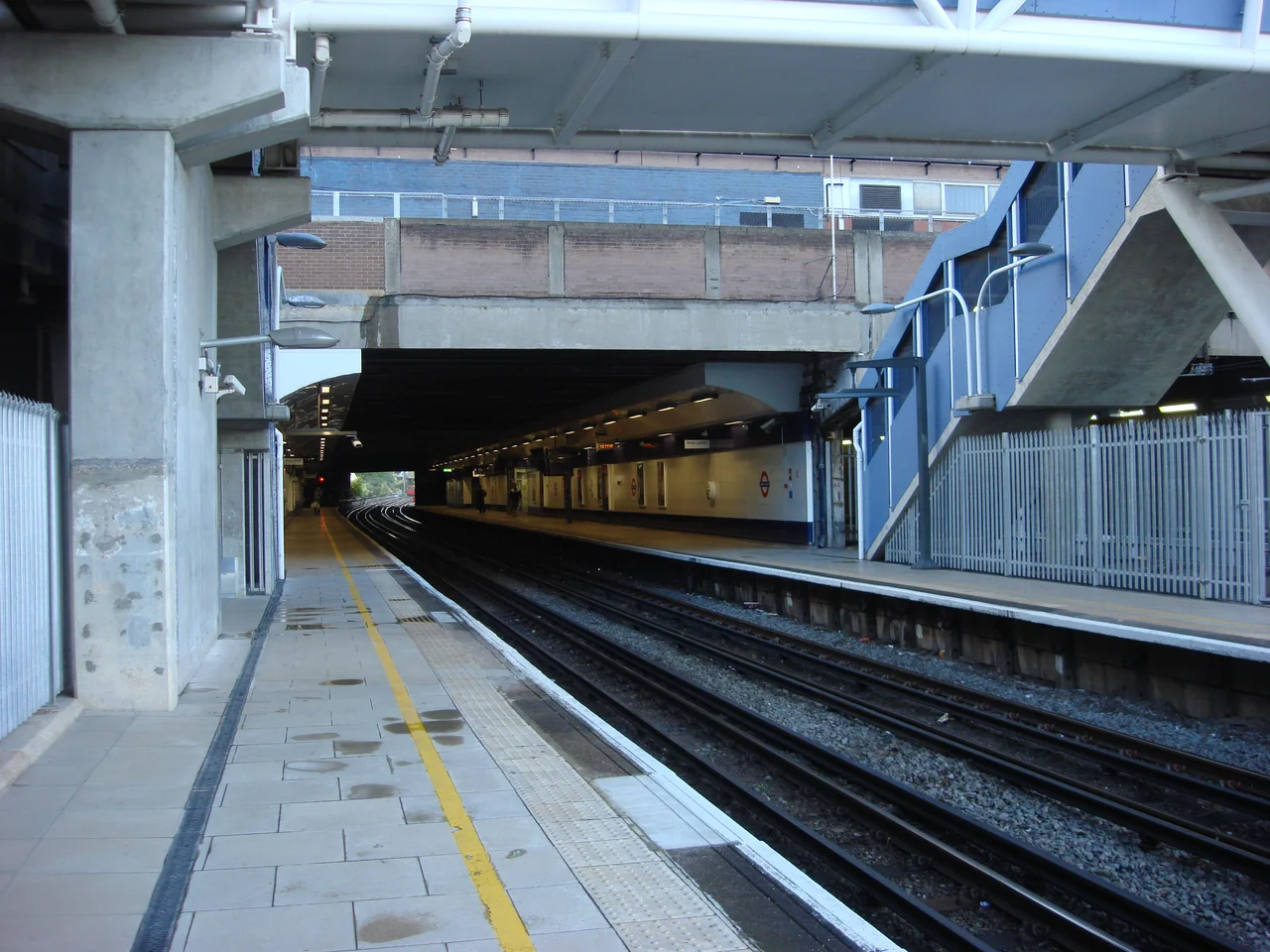

Wembley Central Rail Crash
It was just after six o'clock on a Thursday evening, 11 October 1984. The 17:54 from London Euston to Bletchley was running its usual route - an eight-car commuter train of two Class 310 electric multiple units, carrying people home from offices in central London to the towns north of the capital. South of Wembley Central station, a Freightliner train was crossing onto the slow line out of Willesden yard, hauling twenty loaded wagons to Holyhead. The commuter train hit the freight train's eleventh wagon. The first two coaches overturned onto their sides. Three passengers died. Seventeen others, including the driver, were taken to hospital. The investigation that followed found something nobody had been looking for: the driver had a medical condition no railway doctor had ever heard of.
The Collision
Just after 18:00 on 11 October 1984, Freightliner train 4D62 - hauled by two locomotives, 86006 and 85035 - was signalled from a goods line onto the Down Slow line just south of Wembley Central station. The freight train was negotiating the crossovers when its eleventh wagon was struck by the 17:54 passenger train 2A85 from Euston to Bletchley. The impact deflected the passenger train to its left toward the adjacent Fast lines. All but the rearmost coach of the eight derailed and overturned onto their sides. Emergency services reached the scene within twelve minutes. The track, signalling equipment and overhead lines were torn up; debris blocked every main line into and out of Euston station, paralysing rail traffic from London to the West Midlands and beyond. Three passengers were killed. Seventeen more, including the passenger train's driver, were taken to a nearby hospital. Two were detained - one released on 15 October, the other on 1 November. The Down Fast line was restored within 24 hours; the Up Slow line by 13 October; the Down Slow line where the collision happened was not back in service until 06:00 on 15 October.
The Question of Why
Major Rose, the Chief Inspecting Officer of Railways, opened a formal inquiry under the Regulation of Railways Act 1871. Evidence was heard publicly in London on 9 November. The initial question was whether the freight train was moving or stationary when the passenger train hit it - either way the passenger train should not have been there. The 17:54 had passed a signal at 'danger' - a Signal Passed At Danger, or SPAD, the kind of fundamental error that British Rail's safety systems were specifically designed to prevent. The Automatic Warning System (AWS) gives drivers an audible warning at every distant signal showing caution, and the driver must cancel the warning by pressing a button. If the driver does not cancel, the brakes apply automatically. The investigation discovered that the 17:54's driver had cancelled the AWS warnings at the signals approaching Wembley but had taken no action to slow or stop the train. The dead man's handle - the device that drops the brakes if the driver releases his grip - had remained held. Why?
Driver Armstrong
The driver was Ronald Armstrong, born 25 July 1921, an experienced railway employee. The investigators turned to the railway medical board, where Armstrong's file held an unusual record. For years he had reported to the board that he suffered episodes of irregular disturbed vision three or four times a year, occurring without warning. Armstrong insisted these episodes had never occurred while he was driving a train, although they had happened while he was driving his car. He had reported morning headaches dating back many years, particularly on waking, never severe but persistent and frontal. He slept well but tended to wake in the early hours. He had bouts of indigestion treated with bicarbonate of soda. He had been having panic attacks, including one before the accident. One condition had recently gone away - breathlessness - and he had lost his sense of smell eighteen months before the crash. Read together, the symptoms describe a man whose nervous system was struggling. None of them, individually, were considered sufficient reason to take him off driving duties.
Short Period Amnesia
A panel of doctors raised the possibility of a condition called Short Period Amnesia - a rare neurological event that incapacitates the patient mentally while leaving them upright and physically functional. A driver suffering from it would continue to hold the dead man's handle. He would continue to cancel AWS warnings as a reflex. He would not, however, be present in any meaningful sense - he would not register what the signals meant, would not see them, would have no memory afterwards of seeing them. The condition is brief, usually minutes, and the sufferer often does not realise it has happened. The investigators could not prove Armstrong had suffered such an episode at Wembley, but the symptoms in his medical history were consistent with it, and the pattern of cancellations without action fit the diagnostic picture exactly. The possibility was a factor in the decision not to prosecute him. He was, the investigation concluded, neither negligent nor careless - he had been, for a critical few minutes, simply not there.
The Recommendations
The inquiry's final report was clear about what had failed. Two of British Rail's safety devices - the dead man's handle and the Automatic Warning System - were both designed to detect a driver who was unable to drive the train. Both had failed at Wembley because a driver suffering from Short Period Amnesia would continue to operate both of them without conscious awareness. Major Rose recommended the adoption of a vigilance device - a system that would require active acknowledgement from the driver at intervals, not just continuous grip on a handle - and an improved form of AWS. The recommendations fed into the development of the Driver's Reminder Appliance and eventually into the Train Protection and Warning System (TPWS), rolled out across Britain in the early 2000s, which automatically applies the brakes if a train passes a signal at danger regardless of what the driver does. The Wembley Central crash killed three people, and it changed the technology of British signalling. The site sits between Wembley Stadium and London Euston, on a stretch of track that thousands of commuters cross every day. Most of them do not know it happened here.
From the Air
Wembley Central is at 51.5496°N, 0.2933°W on the West Coast Main Line in Wembley, London Borough of Brent. The crash occurred just south of the station. The wider Wembley area - the stadium, the arena, the rail lines - is best identified from altitude by Wembley Stadium's arch, with Wembley Central station and the rail corridor running through the surrounding suburbs.
Nearby Stories
- Stevenage 5.7 km away
- Malling Abbey 5.7 km away
- 1952 Farnborough Airshow Crash 7.7 km away
- Ingatestone Hall 8.2 km away
- Hellfire Caves 9.1 km away
- The Carrington Event: The Solar Storm That Could Happen Again 9.8 km away
- Bletchley Park 16 km away
- Castle Hedingham 23 km away