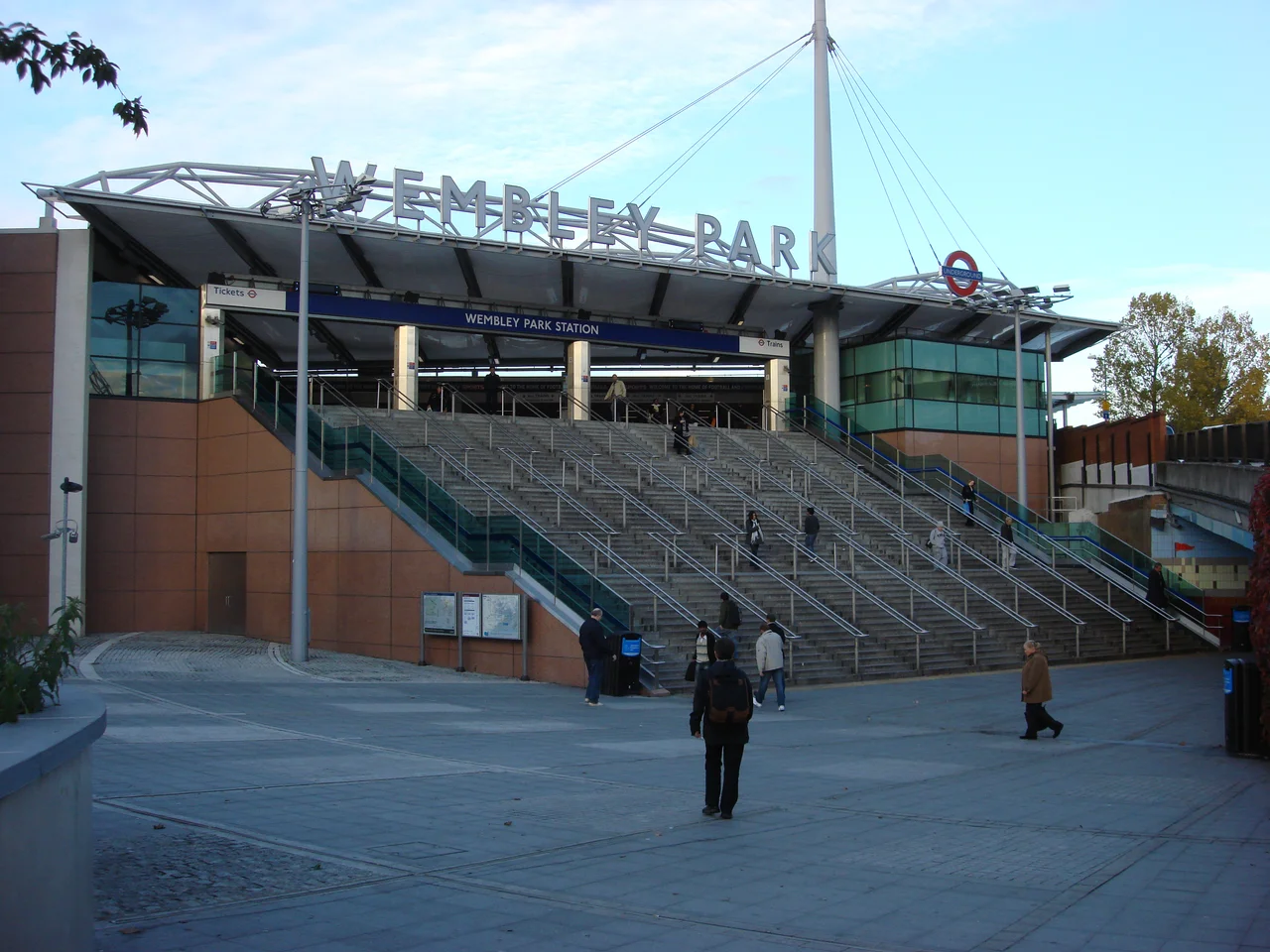

Wembley Park
In 1893, Sir Edward Watkin laid the foundations for a tower he wanted to be taller than the Eiffel. It was going to be 1,200 feet of steel rising from a north London pleasure garden, with restaurants and a Turkish bath at the lower observation stage and a winter garden near the top. Trains would carry tourists from Baker Street to admire it. Watkin's Tower opened to the public in 1896 - except by then it was only 155 feet high, one stage of eight planned. It tilted slightly. Visitors stopped coming. By 1907 the foundations had been dynamited. The crater was filled in. On the same spot, in 1923, builders set the first turf of Wembley Stadium. The hole left by Watkin's failed tower became the centre of British sport.
Humphry Repton's Quiet Park
Wembley Park was named by Humphry Repton, the landscape architect who shaped late 18th-century English country estates - usually mentioned in the same breath as Capability Brown. Repton was hired by Richard Page in 1792 to convert the farmland around the Page family's house, Wellers, into a wooded parkland. Page had inherited a Capability Brown landscape at Flambards in Harrow and lost interest in remodelling Wellers itself, but Repton's planted woods stretched across the southern slopes of Barn Hill and gave the estate a name. Repton wrote of it: "In the vicinity of the metropolis there are few places so free from interruption as the grounds at Wembly... Wembly is as quiet and retired at seven miles distance as it could be at seventy." The Page family kept Barn Hill - 91 acres - when they sold the main estate in 1802 to John Gray, a London brandy merchant, who renovated the house at a cost of £14,000. A cottage orne lodge thought to be the oldest property in Wembley still survives on Wembley Hill Road from this period.
Watkin's Folly
The Metropolitan Railway extended its line from Willesden Green to Harrow in 1880, cutting through the estate. The company's chairman, Edward Watkin, bought the whole 327 acres in 1889 for £32,500. Watkin wanted to do for London what Gustave Eiffel had done for Paris, and to use the resulting tourist traffic to fill his trains. He held a tower-design competition in March 1890, awarding 500 guineas to Stewart, MacLaren and Dunn for a 1,200-foot eight-legged steel design. Cost considerations cut it to a four-legged 1,150-foot design. Foundations were laid in 1892. The Wembley Park pleasure gardens opened in May 1894 with a running track, cricket and football pitches, a 9-hole golf course, tea pagodas, a variety theatre, a lake and a trotting ring. The tower opened in 1896, only one stage finished. Visitor numbers slumped from 100,000 in spring 1894 to 100,000 for the entire year of 1896 - and fewer than 20,000 of those paid to go up. The tower tilted. In 1902 it was closed as unsafe. Demolition began in 1904. The foundations were destroyed by explosives in 1907.
The British Empire Exhibition
The hole in the ground stayed put until 1922-23, when much of Repton's landscape was transformed for the British Empire Exhibition of 1924-25. Sir Robert McAlpine built the Empire Stadium - costing £750,000, equivalent to about £49.8 million today - in 300 days. It opened on 28 April 1923 with the FA Cup Final between Bolton Wanderers and West Ham United - the famous "White Horse Final," where Police Constable George Scorey on his horse Billy slowly pushed back a crowd estimated at well over 200,000 (official capacity was 127,000) so the match could begin only 45 minutes late. The Empire Exhibition itself drew enormous crowds but lost money. Property speculator James White bought the site afterwards, intending to demolish the buildings. Arthur Elvin, an ex-RFC officer who had run a tobacco kiosk during the exhibition, was hired to oversee the sales. After James White killed himself facing personal bankruptcy in 1927, Elvin scrambled to raise £127,000 - mostly within two weeks - by forming the Wembley Stadium and Greyhound Racecourse Company. He bought the stadium and immediately sold it back to the company in exchange for shares, becoming its largest shareholder and eventually chairman. He saved the building.
Metro-land and the Empire Pool
The Metropolitan Railway started using the term "Metro-land" in 1915 to market its surrounding suburbs. The British Empire Exhibition reinforced the message; between 1921 and 1928, season-ticket sales at Wembley Park and neighbouring Metropolitan stations rose by over 700 percent. The Chalkhill estate - 123 acres within Repton's original park - became one of the earliest Metro-land developments, with the railway company laying a siding to bring building materials in. Most of Wembley Park had been built over by 1939. Elvin added more venues. The Empire Pool, designed by Owen Williams without an architect, opened on 25 July 1934 in time for the 1934 British Empire Games swimming events. It was renamed Wembley Arena on 1 February 1978. Wembley Town Hall, built between 1937 and 1940 to designs by Clifford Strange, was praised by Pevsner as "the best of the modern town halls around London." It is now the Lycee International de Londres Winston Churchill.
The 1948 Olympics and What Came After
Britain bid for the 1948 Olympics in March 1946, just months after the war. The games would have to be done cheaply - food rationing was still in force, and medals were made from oxidised silver. Wembley Stadium hosted the opening ceremonies, the track-and-field events, the football and hockey finals, the equestrian Prix des Nations, and a demonstration of lacrosse. The Empire Pool hosted swimming, diving and boxing. A cinder track for athletics was laid inside the stadium, made from the ashes of Leicester's domestic fires. 4,104 athletes from 59 nations competed - 90 percent of them male. The most successful was Fanny Blankers-Koen of the Netherlands, the "Flying Housewife," a 30-year-old mother of three who was actually pregnant during the games. She won four golds. Germany and Japan were not invited; the Soviet Union was invited but declined. The 1966 World Cup Final was played here. Live Aid was held here on 13 July 1985 - 16 hours, 70,000 people on site, 1.9 billion watching on television, £30 million raised for famine relief. The original stadium closed in October 2000, demolition started in December 2002, the new stadium opened in 2007. Wembley Park is still becoming. A theatre opened in 2019 in the old Wembley Film Studios building. The hole Watkin left has not stopped filling.
From the Air
Wembley Park is at 51.5635°N, 0.2795°W in the London Borough of Brent, centred on Bridge Road and Empire Way. The dominant visible features from altitude are the arch of Wembley Stadium and the older Wembley Arena building immediately adjacent. The Chalkhill housing estate lies just north; Fryent Country Park further north preserves part of what was once Repton's parkland. The London Borough of Brent civic centre is also here.
Nearby Stories
- Stevenage 5.7 km away
- Malling Abbey 5.7 km away
- 1952 Farnborough Airshow Crash 7.7 km away
- Ingatestone Hall 8.2 km away
- Hellfire Caves 9.1 km away
- The Carrington Event: The Solar Storm That Could Happen Again 9.8 km away
- Bletchley Park 16 km away
- Castle Hedingham 23 km away