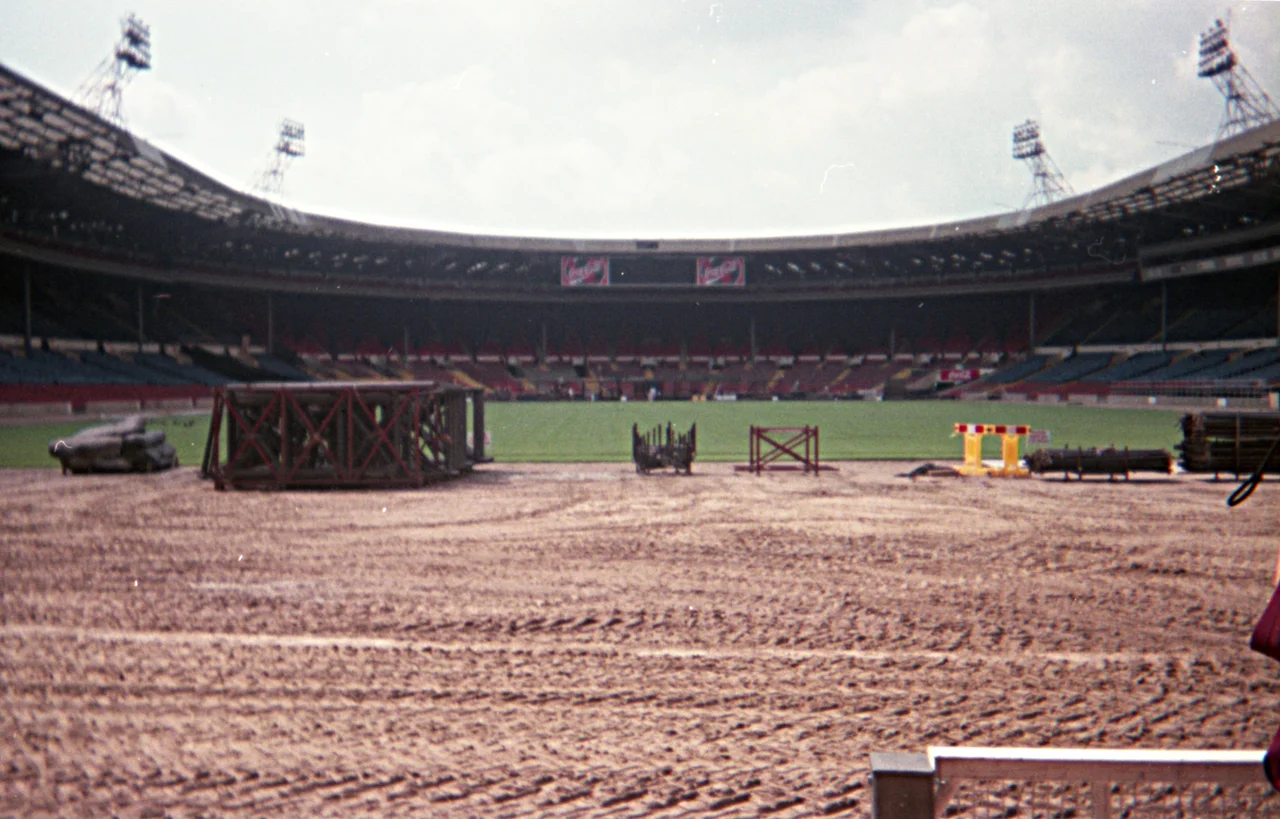

Wembley Stadium (1923)
Pele called it "the cathedral of football." George V cut the first turf with a silver spade in 1922. The Empire Stadium - later just called Wembley - opened with what should have been a disaster and instead became the building's defining story. On 28 April 1923, somewhere between 240,000 and 300,000 people poured through 104 turnstiles to watch Bolton Wanderers play West Ham in the FA Cup Final. The official capacity was 127,000. The crowd spilled out of the terraces and onto the pitch itself. The match should not have happened. Then Police Constable George Scorey rode in on a horse named Billy and, over 45 minutes, slowly walked the crowd back to the sidelines. The match kicked off. Bolton won 2-0. David Jack scored the first ever goal at Wembley. The horse was white. The footbridge outside the new Wembley is now named after Billy.
Built in 300 Days
The site of the stadium was a strange piece of property. Edward Watkin's failed attempt to build a British rival to the Eiffel Tower had left a crater of broken foundations where the Empire Stadium would rise. Architects Sir John Simpson and Maxwell Ayrton designed the structure - in particular the Twin Towers that became its defining trademark - and Sir Owen Williams, the engineer, made it stand. Sir Robert McAlpine built it in exactly 300 days, finishing four days before the 1923 FA Cup Final. The cost was £750,000, equivalent to about £49.81 million in 2023. The original intention was to demolish it after the British Empire Exhibition of 1924-25, but Sir James Stevenson, the Scottish chairman of the exhibition's organising committee, argued for keeping it. The exhibition failed financially anyway. Property speculator James White bought the site, planning to clear it. Arthur Elvin, who had run a tobacco kiosk at the exhibition, took on the clearance work. After White's suicide in 1927, Elvin formed the Wembley Stadium and Greyhound Racecourse Company to buy the stadium for £127,000, then sold it back to the company in exchange for shares, becoming the largest individual shareholder. He saved the building twice.
The Matthews Final and the 1948 Games
Stanley Matthews was 38 years old when he played in the 1953 FA Cup Final for Blackpool against Bolton - his third FA Cup Final, and as it turned out, his last chance at a winner's medal. He had lost the 1948 Final to Manchester United and the 1951 Final to Newcastle. Blackpool went 3-1 down. Matthews ran riot in the second half. The match finished 4-3 to Blackpool - the hat-trick scored by Stan Mortensen, but the credit forever attached to Matthews. The press named it "the Matthews Final." Five years earlier, in 1948, Wembley had hosted the Austerity Olympics - the first Olympics since 1936 and the first ever broadcast on BBC television. Wembley itself hosted the opening ceremony, track and field, the football and hockey finals, and the equestrian Prix des Nations. A cinder track for athletics was laid inside the stadium from the residue of Leicester's domestic fires. Fanny Blankers-Koen of the Netherlands - the "Flying Housewife," 30 years old, pregnant, a mother of three - won four golds. Emil Zatopek won the 10,000 metres.
1966
England played its first Wembley international against a non-British team in 1951. Until then, the only opponents the national team played at Wembley were Scotland. Wembley hosted nine matches at the 1966 FIFA World Cup, including the final on Saturday 30 July 1966. England wore red, having lost the toss for kit colours. Helmut Haller scored for West Germany in the 13th minute; Geoff Hurst equalised in the 19th; Martin Peters scored for England in the 78th; Wolfgang Weber equalised in the 89th minute, taking the match to extra time. In the 101st minute, Hurst hit a shot that ricocheted off the underside of the crossbar and bounced down. Was it over the line? The Soviet linesman Tofik Bakhramov said yes. The goal was given. In the 120th minute, with spectators already on the pitch, Hurst scored again - and BBC commentator Kenneth Wolstenholme said the line that became part of English sporting memory: "Some people are on the pitch... they think it's all over... it is now." 4-2. England's only senior international football trophy. Wembley hosted five European Cup Finals - 1963, 1968, 1971, 1978, 1992 - a record for the competition until the new Wembley took over.
Live Aid and the Concert Years
Wembley became a concert venue gradually. The London Rock and Roll Show in August 1972 was the first major popular music event in the stadium. Crosby, Stills, Nash and Young played in September 1974. The Who, AC/DC and the Stranglers played in August 1979 - the Who's first major concert after Keith Moon's death. The Empire Pool next door had become a serious rock venue years earlier (Led Zeppelin's Electric Magic Show in November 1971), but the stadium itself took longer. Everything changed on 13 July 1985. Live Aid - Bob Geldof and Midge Ure's transatlantic famine-relief concert - placed the Wembley half of the day at the heart of the global broadcast. 72,000 people in the stadium. 1.9 billion watching worldwide. Queen's set, with Freddie Mercury commanding the crowd, is regularly named the greatest live rock performance ever filmed. After Live Aid, every major touring act played Wembley. Michael Jackson performed 15 times - more than any other artist - and broke a Guinness World Record in 1988 with 504,000 attendees across seven sold-out Bad World Tour shows. ABBA, the Rolling Stones, Springsteen, U2, Bowie, Madonna, Genesis. The Spice Girls played to 110,000 in 1998. Bon Jovi played the last music at the original Wembley on 19 and 20 August 2000.
Demolition
The 1966 World Cup-winning captain Bobby Moore opened the doors on the last week. The stadium closed in October 2000. Chelsea won the last FA Cup Final played there on 20 May 2000, beating Aston Villa 1-0 on a goal by Roberto Di Matteo. The last competitive club match was the 2000 First Division play-off final - Ipswich beat Barnsley 4-2 - on 29 May. The last match of all was the 2000 Charity Shield, Chelsea beating Manchester United 2-0. The last international was on 7 October 2000 - Kevin Keegan's final game as England manager - a 0-1 defeat by Germany. Dietmar Hamann scored the last goal at the original Wembley. Tony Adams made his 60th Wembley appearance, a player record. Demolition started in December 2002. The Twin Towers were dismantled. The top of one tower was preserved as a memorial in a park on the north side of Overton Close in nearby Saint Raphael's Estate. A new Wembley rose on the same site, opening in 2007. Pele's cathedral was gone. The site remained sacred. Football still belongs there.
From the Air
The original Wembley Stadium stood at 51.5560°N, 0.2796°W in Wembley, London Borough of Brent. It was demolished in 2002-2003 and replaced by the current Wembley Stadium on the same site. The visible feature today is the modern arch and bowl; only the location and a preserved fragment in Saint Raphael's Estate remain of the 1923 Twin Towers.
Nearby Stories
- Stevenage 5.7 km away
- Malling Abbey 5.7 km away
- 1952 Farnborough Airshow Crash 7.7 km away
- Ingatestone Hall 8.2 km away
- Hellfire Caves 9.1 km away
- The Carrington Event: The Solar Storm That Could Happen Again 9.8 km away
- Bletchley Park 16 km away
- Castle Hedingham 23 km away