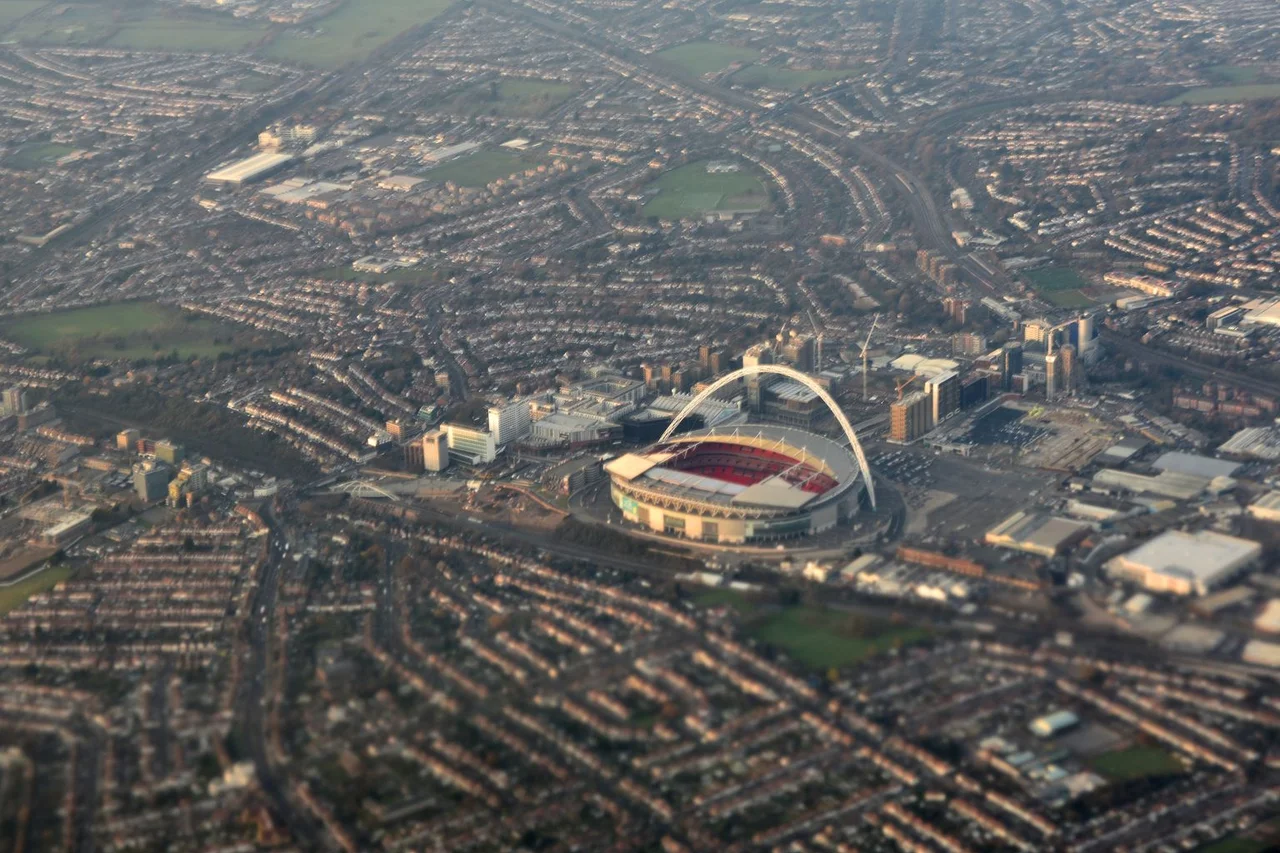

Wembley Stadium
The arch carries the building. Most stadiums need rings of internal pillars or roof trusses; Wembley uses a single steel circle. The Wembley Arch rises 133 metres above the pitch and spans 315 metres - the longest single-span roof structure on Earth - and it supports the entire weight of the north roof and 60 percent of the retractable south roof. From the M40 driving into London, from a passenger jet on final approach to Heathrow, the arch is the landmark you recognize first. It was meant to be that way. Foster + Partners and Populous designed the new Wembley specifically so London would have a building you could see from anywhere - a replacement for the Twin Towers that defined the original stadium for 80 years, with a structure that did more than just look monumental. The arch is doing work.
The Cost of Replacing the Twin Towers
Building the new Wembley took longer and cost more than anyone expected. The Australian construction firm Multiplex was hired. The original plan called for demolition before Christmas 2000 and completion by 2003. Demolition only began on 30 September 2002, with the Twin Towers coming down that December. Steel subcontractors Cleveland Bridge withdrew from the project in late 2003 over costs, and were replaced by the Dutch firm Hollandia. In March 2006 a roof rafter fell, forcing 3,000 workers to evacuate. Sewer pipes beneath the building buckled. The 2006 FA Cup Final, originally scheduled here, had to be relocated to Cardiff. Wembley was finally handed over on 9 March 2007. The official opening was the 2007 FA Cup Final on 19 May 2007 - Chelsea 1, Manchester United 0, Didier Drogba scoring. Total project cost, including infrastructure and financing, came to roughly £1 billion. The bare construction cost was £798 million. It is one of the most expensive stadiums ever built.
The Arch and the Roof
The arch was always the design centrepiece. A circular-section steel lattice, 7 metres in internal diameter and 315 metres in span, set 22 degrees off vertical and rising 133 metres above the external concourse. The arch supports all the weight of the north roof and 60 percent of the retractable south roof. The roof itself has an area of 40,000 square metres, of which 13,722 are movable. The retractable sections were designed specifically to avoid shading the pitch during matches - grass needs sunlight to grow, and a fully roofed stadium kills its own turf. The chief architect Angus Campbell aimed for the pitch to be in sunlight during matches played between 3pm and 5pm from early May to late June, the prime FA and World Cup window. Beneath the pitch, mechanical diggers found something during excavation: the buried concrete foundations of Watkin's Tower, the failed 1890s rival to the Eiffel Tower that had sat on this spot before the 1923 stadium was built. Three layers of London's sporting history compressed into one footprint.
What It Hosts
The Football Association, which owns the stadium, makes sure it earns its £1 billion. The FA Cup Final and FA Cup semi-finals come here. The Community Shield. The EFL Cup Final, EFL Trophy Final, and the National League play-off final. The promotion play-off finals for tiers two, three, four and five of English football. The Women's FA Cup Final since 2015. Two Champions League Finals (2011, 2013, with a third in 2024). Eight Euro 2020 matches, including the final and both semi-finals. The Women's Euro 2022 final, where England beat Germany 2-1 in front of 87,192 - a record for either men's or women's European Championship. The football match attendance record at the new Wembley remains 89,874, set at the 2008 FA Cup Final between Portsmouth and Cardiff. The Rugby League Challenge Cup Final returned in 2007. The 2015 Rugby World Cup put 89,267 fans in here for Ireland vs. Romania, a Rugby World Cup attendance record. The 2012 Olympic football finals were played here. So have NFL regular-season games every autumn since 2007, mostly with the Jacksonville Jaguars.
Concerts and Records
George Michael played the first concert at the new Wembley on 9 June 2007. Muse became the first band to sell it out on 16 and 17 June 2007. The 28 June 2017 Adele concert drew 98,000 fans - the stadium record for a UK music event. Taylor Swift played eight nights here on the Eras Tour in 2024 - the first female act ever to book eight shows on a single tour, breaking Michael Jackson's record for most nights at either stadium on the site. Coldplay holds the all-time record with 22 shows, ten of them in a single year (2025) as part of the Music of the Spheres tour. BTS became the first K-pop act to sell out Wembley on 1 and 2 June 2019. Oasis announced their reunion tour in August 2024 with seven Wembley dates scheduled for 2025. Live Aid happened at the original Wembley in 1985, but the new building has carried its own concert legacy - the Concert for Diana in July 2007, the Foo Fighters' Taylor Hawkins tribute concert in September 2022, and Tyson Fury knocking out Dillian Whyte in a sold-out 94,000-seat boxing card in April 2022.
Bobby Moore Looking Down Olympic Way
The bronze statue of Bobby Moore stands outside the main entrance, twice life-size, sculpted by Philip Jackson. England's 1966 World Cup-winning captain looks down Olympic Way - the wide pedestrian boulevard that connects the stadium to Wembley Park tube station and to the surrounding regeneration district. The statue was unveiled by Bobby Charlton, Moore's former teammate, on 11 May 2007. Tickets to FA Cup Finals and England internationals walk past him on the way in. After matches, when the stands empty and the lights come down, Moore is left standing alone in the cold, watching the route he never personally took - he played his Wembley games on the old pitch, before the demolition, looking up at the Twin Towers. The new arch dwarfs everything. But the statue is at human scale, and the route under it is named for the games Britain has hosted on this site since 1948. The stadium is bigger than any team or any era. The man at the gate is just a captain who held a trophy up once.
From the Air
Wembley Stadium is at 51.5560°N, 0.2796°W in Wembley, London Borough of Brent. The 133-metre arch is the dominant identifying feature from altitude - visible from much of greater London on clear days. The smaller Wembley Arena building lies just to the northwest. Nearest airports: London Heathrow (EGLL) southwest, London Luton (EGGW) north, RAF Northolt (EGWU) west.
Nearby Stories
- Stevenage 5.7 km away
- Malling Abbey 5.7 km away
- 1952 Farnborough Airshow Crash 7.7 km away
- Ingatestone Hall 8.2 km away
- Hellfire Caves 9.1 km away
- The Carrington Event: The Solar Storm That Could Happen Again 9.8 km away
- Bletchley Park 16 km away
- Castle Hedingham 23 km away