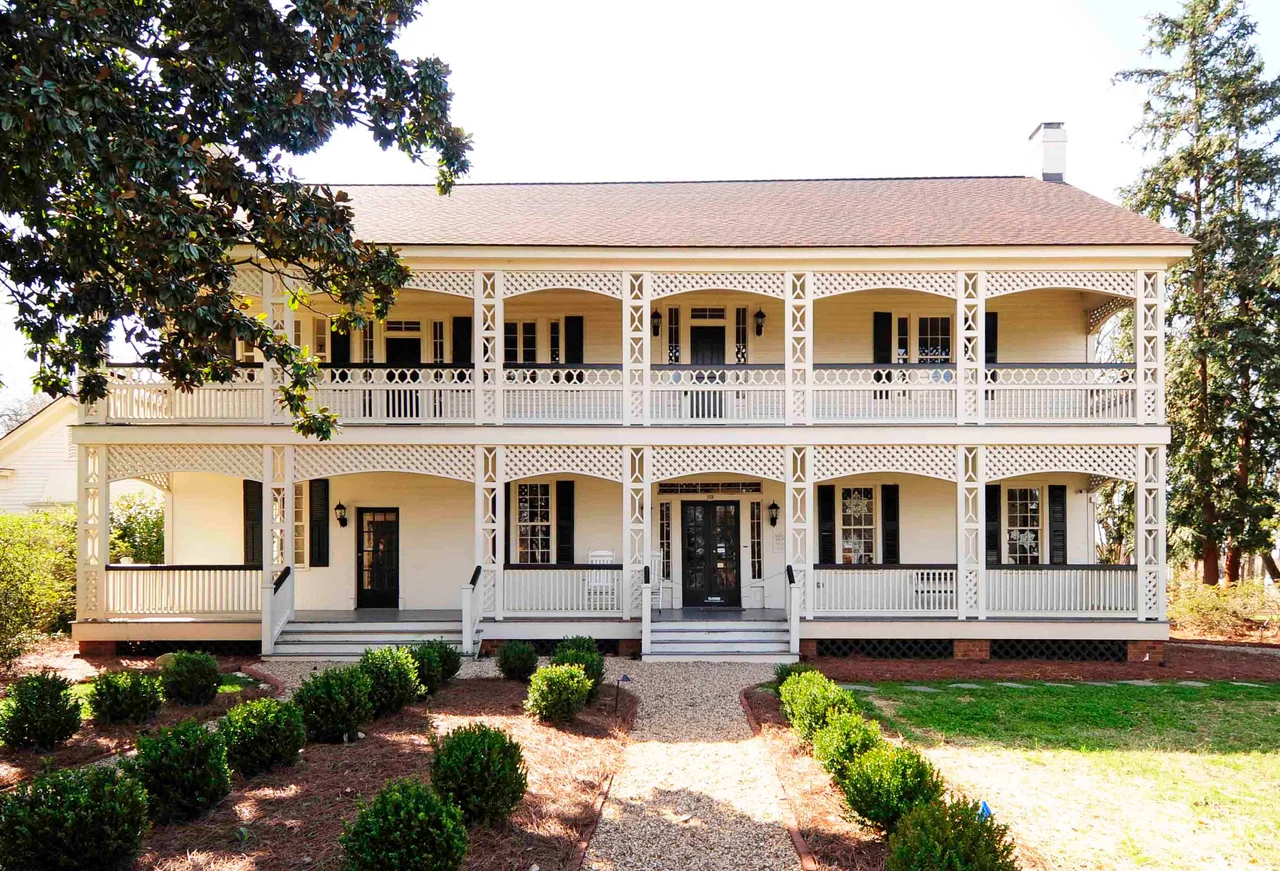

White House (Rock Hill, South Carolina)
Ann Hutchison White did not want her town to become a town. In 1870, when the residents of the Catawba River settlement that would become Rock Hill petitioned for incorporation - their third try - she signed a counter-petition with six other landowners. Together they owned four-fifths of the proposed town's land, and they did not want to pay for paving streets they were perfectly content walking through as they were. They lost. Rock Hill incorporated on February 26, 1870. Ann lived another decade in the house her husband had built her - a house that had started as a one-room cottage in 1837, had grown to eighteen rooms by the time Sherman threatened to come through, and which today, after five generations of Whites, stands as a wedding venue and a museum.
The Tailor and the Plantation Daughter
George Pendleton White was a tailor by trade. Ann Hutchison was one of sixteen children born to David Hutchison, one of the earliest white settlers to move onto Catawba Indian land along the river. They married on December 14, 1837. George built her a one-room cottage that year on a piece of land at what would later become downtown Rock Hill. He kept adding rooms as the family grew. On October 28, 1838, their first child Mary Elizabeth was born at home. In 1848 George signed a contract with the new Charlotte and South Carolina Railroad Company to grade part of the line that was being pushed south toward Columbia. He died on February 25, 1849 - of pneumonia, caught while supervising his work crew in cold rain on the railroad cut. Ann was a widow with young children. She was forty-four.
A Woman of Decisive Action
Ann had a reputation, in the words of one local history, as "a woman of strong conviction and decisive action." She ran the household and the family's affairs for the next thirty years. Her son James Spratt White went off to fight for the Confederacy in 1861. In February 1865 he wrote home in alarm: General Sherman's army was marching north out of Savannah and might come through York County. The whole county braced itself. Sherman, in the end, swung east instead, sparing Rock Hill the burning he gave to Columbia. But the war came to Ann's door anyway, in the form of refugees fleeing other shattered places. She took them in. Some left behind heavy furniture they could not travel with - dressers and tables that stayed in the White house long after their owners had gone.
Selling Off Pieces of the Town
After Appomattox, Ann needed cash. She began selling pieces of the family's land - hundreds of acres - to pay debts and keep the household going. One of her customers was Edwin Ruthven Mills, who bought parcels from her in 1872. Mills had led Rock Hill's Company E at the Battle of the Crater outside Petersburg in 1864 - that surreal underground engagement where Union miners exploded four tons of black powder beneath a Confederate fort and then bungled the assault that was supposed to follow. He came home alive and went into business. The land Ann sold him would help build the post-war Rock Hill she had voted against. She died in 1880, ten years after losing the incorporation fight, in the house her husband had started forty-three years earlier.
Preservation and Present
Five generations of Whites lived in the house between 1837 and 2005. Each added rooms and outbuildings. The cottage grew into what is now a sprawling two-story, eighteen-room structure on a block of downtown Rock Hill - the kind of accreted vernacular building that records a family's economic history in its walls. In 2005 Historic Rock Hill, a local preservation nonprofit, bought the house and spent five years restoring it. Today the organization keeps its offices on the second floor and runs the ground floor as a wedding and event venue. Self-guided tours are available by appointment. The exhibits inside tell the family's story across more than a century and a half - including, gently, Ann's losing fight to keep Rock Hill the quiet country crossroads she had married into.
From the Air
The White Home sits at 34.9258 N, 81.0217 W in central Rock Hill, South Carolina, near the corner of White Street and East Main. From the air it is a substantial two-story house in an older block of downtown, surrounded by the Old Town neighborhood and a short walk from the Civitas gateway columns. Rock Hill/York County Airport (KUZA, Bryant Field) is about 5 miles southwest; Charlotte-Douglas (KCLT) 20 nm north. Recommended viewing altitude 2,500-3,500 feet AGL. The Catawba River runs east of downtown - a useful reference for orienting the city center.
Nearby Stories
- Charlotte Douglas International Airport 11 km away
- Gardner-Webb University 14 km away
- Reed Gold Mine 15 km away
- Battle of Rocky Mount 18 km away
- Cherokee County, South Carolina 18 km away
- Battle of Musgrove Mill 27 km away
- Battle of Colson's Mill 48 km away
- Hartsville, South Carolina 49 km away