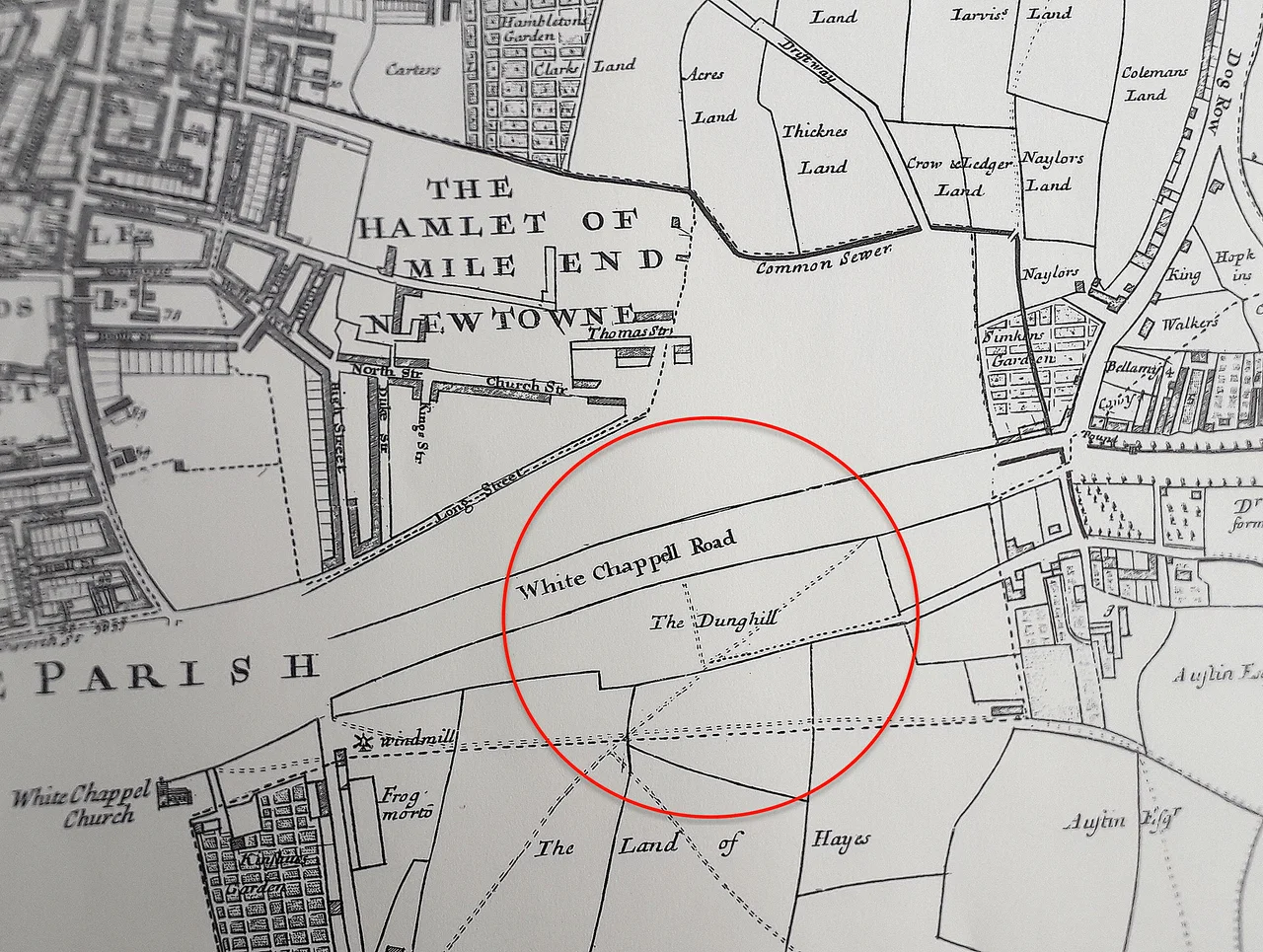

Whitechapel Mount
Imagine an artificial hill - higher than the brand-new London Hospital, longer than four hundred yards, ascendable by horse and cart - sitting beside the road that ran east out of Georgian London. People built houses on top of it. Cockney enthusiasts hunted for antiques in its soil. Highwaymen used its slopes to hide stolen goods. And nobody could quite agree on what it was. Was it a fort from the English Civil War? A plague pit covered up with rubble from the Great Fire? Or just the city's largest rubbish heap dressed up with a polite name? The strangest answer is that Whitechapel Mount was probably all of those things at once. By 1808, it was gone - sold off and pressed into bricks that still stand in buildings across the East End.
The Mud Wall Called the Fort
When Sir Christopher Wren mapped Whitechapel in 1673, he labelled the rising ground as the mud wall called the Fort. In 1643, with King Charles I's armies threatening to sack London, the city had hastily thrown up a ring of twenty-three or twenty-four earthen forts and connecting trenches. Volunteers - men too old for the regular militia, women, and children - dug eighteen miles of earthworks in a few weeks. A visiting Scotsman walked the full ring in twelve hours. Fort No. 2 commanded the Whitechapel Road: a nine-angled work, palisaded and ditched, mounted with seven brass cannon. After peace returned, the city flattened most of the forts because they ruined good farmland. Whitechapel Mount kept its scale. By 1811 the antiquarian Daniel Lysons measured it: three hundred and twenty-nine feet long, a hundred and eighty-two feet broad, and more than twenty-five feet above ground level.
Plague Rumours
In 1665, the bubonic plague killed somewhere between seventy and a hundred thousand Londoners. Aldgate, Whitechapel, and Stepney were hit hard, and the official mass graves filled faster than the gravediggers could keep up. The men driving the dead carts were, in the words of one contemporary observer, very idle base liveing men and very rude, swearing and cursing at their work. There were burial grounds across the road from the Mount, and rumour insisted the mound itself held thousands of bodies. The Great Fire of London the following year added a parallel story - that fire rubble had been dumped on top of the plague pit to cover it up. When the authorities prepared to remove the Mount in the 1800s, they pierced its sides specifically to refute the corpse story. They found no remains. Or said they did not. A hospital history meanwhile records that by 1764 the Mount Burying Ground was full - so something was buried in there.
London's Dustheap
The most likely explanation is also the least romantic. In 1671 Parliament designated seven official laystalls - sanctioned rubbish tips - for the City of London, and Whitechapel Mount was one. All the household rubbish from Portsoken, Tower, Duke's Place, and Lime Street wards came here. But a laystall was a business, not a pile. The proprietor employed gangs of men, women, and boys to sort the rubbish and recycle whatever could be sold. Most domestic waste by volume was coal ash - the dust in dustman - and ash made superb bricks. As Georgian London exploded in size, the city's brickfields could not keep up with demand. The Mount became a brick mine. An Old Bailey case from 1809 records bricks being delivered from the diminishing dunghill. Hanbury's Brewhouse - now the Black Eagle Brewery on Brick Lane - rose partly from Whitechapel's accumulated household waste.
Antique Hunters and Boar's Heads
Because Londoners believed the Great Fire theory, the dismantling of the Mount in 1807 and 1808 attracted treasure hunters. Cockney enthusiasts sifted the soil for relics of pre-Fire London. They found - or claimed to find - a silver tankard and a Roman coin. The most spectacular alleged discovery was a carved boar's head with silver tusks, identified by reputable antiquarians as a survival from the Boar's Head Inn at Eastcheap. The inn had appeared in Shakespeare as the haunt of Falstaff and Mistress Quickly, and had indeed burned in 1666. Whether the tusks were genuine no one can now say, but the story tells us something about the Mount: it functioned as London's collective memory hole, where everything dramatic that had happened to the city in the seventeenth century was assumed to have ended up.
Mount Terrace
Today the Mount survives as a street name. Walk south from the Whitechapel Road and you reach Mount Terrace, E1 - a row of bricks that may literally have been made from the hill they now name. The Royal London Hospital occupies most of the former site. Redevelopment has occasionally allowed archaeologists a glimpse beneath, but there has never been a systematic dig. A play called The Skeleton Witness, or The Murder at the Mound, used the place as a setting for a Gothic plot about a murder concealed in the soil. The phrase Whitechapel dunghill became a Cockney idiom for the far eastern edge of London. The Mount stood at the doorway of the East End for at least 160 years and probably much longer, and almost nobody now remembers it was there.
From the Air
The former Whitechapel Mount site sits at 51.52°N, 0.06°W, beneath the Royal London Hospital complex in Tower Hamlets. From the air, look for the modern hospital's distinctive blue glass towers on the south side of Whitechapel Road. London City Airport (EGLC) is about three and a half nautical miles east. Best viewed at low altitude on approach from the east.
Nearby Stories
- Stevenage 5.7 km away
- Malling Abbey 5.7 km away
- 1952 Farnborough Airshow Crash 7.7 km away
- Ingatestone Hall 8.2 km away
- Hellfire Caves 9.1 km away
- The Carrington Event: The Solar Storm That Could Happen Again 9.8 km away
- Bletchley Park 16 km away
- Castle Hedingham 23 km away