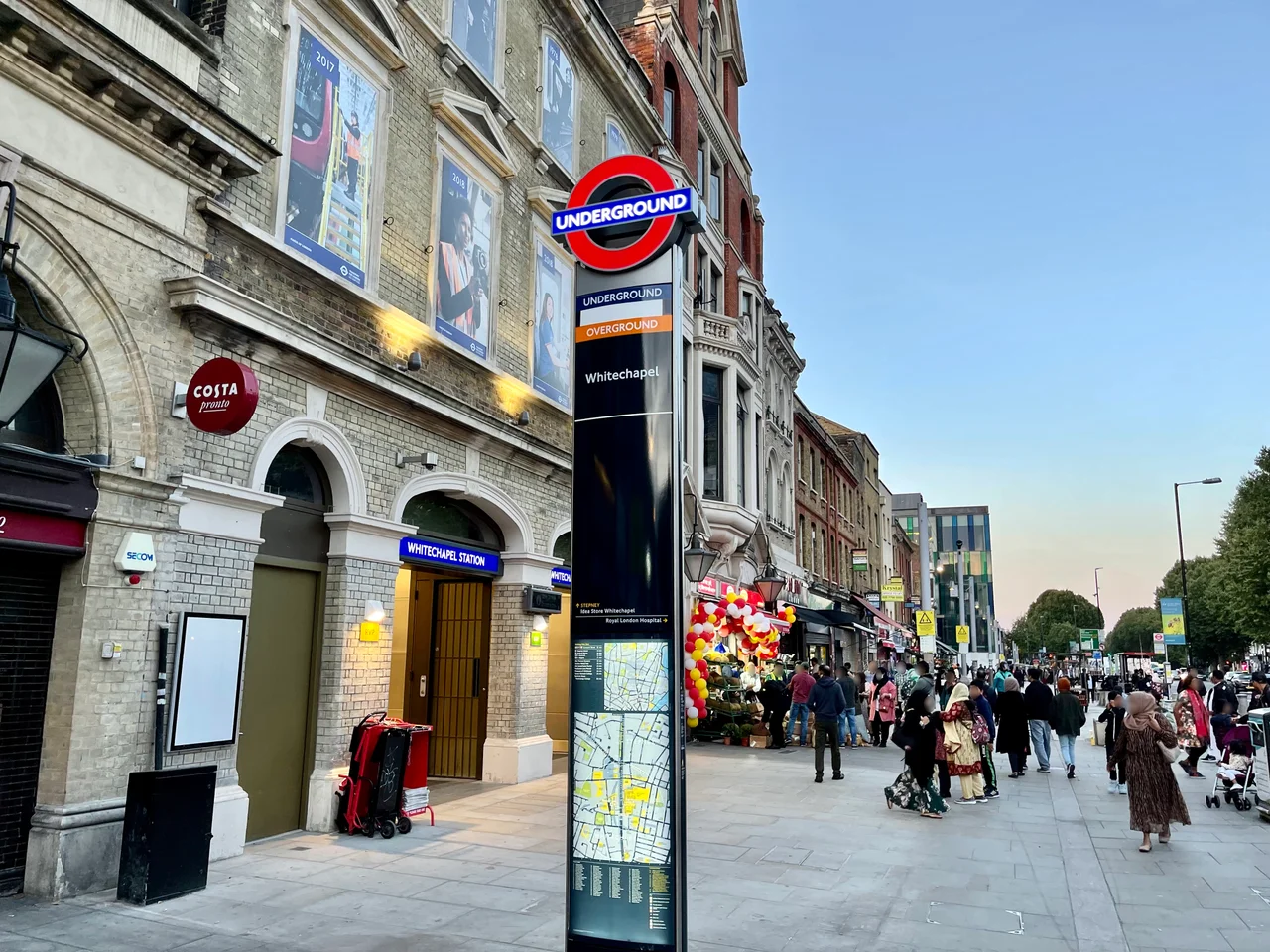

Whitechapel
Walk west to east through Whitechapel and you walk through every wave of immigration London has ever had. Huguenot silk weavers in the 1680s, Irish dockworkers in the 1840s, Ashkenazi Jews from Russia in the 1880s, Bangladeshis from Sylhet in the 1970s. Each community arrived, built their institutions, raised their children, and watched the next community move in as they moved out toward Stamford Hill or Ilford or Romford. The buildings absorbed and re-absorbed. The same Brick Lane corner has been a Huguenot chapel, then a Methodist chapel, then a synagogue, and now a mosque. Whitechapel is not a place London happened to; it is the part of London where the city's becoming has been most visibly continuous.
Why It's Called That
In the early fourteenth century, the parishioners of Stepney lived too far from their parish church for convenience, so a chapel of ease was built about a mile east of Aldgate. The stone was pale - probably Kentish ragstone, possibly limewashed - and locals called the building the white chapel. St Mary Matfelon was officially its name, but white chapel stuck and the surrounding hamlet took the same name. The original chapel survived various rebuilds until Luftwaffe bombs finished it in the Blitz. The site is now Altab Ali Park, named for a Bangladeshi worker murdered in a racist attack in 1978. Continuity in this neighbourhood often looks like a name surviving the thing it named, and then attaching itself to a new story.
Outside the Walls
Whitechapel grew up outside the eastern walls of the City of London, which meant it grew up outside the City's strict guild controls. Trades that were forbidden or constricted inside the walls - tanning, butchery, brewing, foundries, slaughterhouses - established themselves here. The Whitechapel Bell Foundry, casting bells from 1570 until 2017, was the most famous of these. Outside the walls also meant outside the laws regulating who could live and work in London. Immigrants who could not get a foothold in the City could settle in Whitechapel; the costermongers, the rag traders, the seamstresses, the dockers all squeezed into a few square miles. By 1800 the neighbourhood was crowded; by 1850 it was overcrowded; by 1880 it was the centre of London's reputation for slum poverty.
The Jewish East End
From the 1880s to the 1930s, Whitechapel was effectively a Yiddish-speaking city. Pogroms across the Russian Empire drove tens of thousands of Ashkenazi Jews to London, and most settled in the streets between Whitechapel and Spitalfields. Brick Lane was lined with beigel shops and kosher butchers. The Pavilion Theatre on Whitechapel Road staged Yiddish plays for audiences of a thousand. Petticoat Lane Market - properly Middlesex Street - became the Sunday focus for Jewish East End commerce. The community founded the Jewish Chronicle, Bevis Marks Synagogue (the oldest synagogue in the United Kingdom, just inside the City), and dozens of friendly societies. Then between the wars they began moving out: to Golders Green, Edgware, Stamford Hill. By 1939 the community had largely dispersed, leaving behind synagogues that would be repurposed by the next arrivals.
Cable Street and Brick Lane
On 4 October 1936, Oswald Mosley's British Union of Fascists tried to march through the heart of the Jewish East End. The local community, alongside Irish dockers, communists, and trade unionists, blocked their path on Cable Street. The Battle of Cable Street - mostly fought between protesters and the police trying to clear a path for the Blackshirts - became the moment fascism failed in Britain. A mural on the side of the old St George's Town Hall on Cable Street commemorates the day. Two generations later, on 17 April 1999, a nail bomb exploded outside the Admiral Duncan pub in Soho, the third of three bombs by a far-right extremist who had already targeted Brixton and Brick Lane the previous weekend. The Brick Lane bomb on 24 April injured thirteen people. The pattern repeated: a community attacked, and a community that refused to be moved.
Banglatown
From the 1970s, families from Sylhet District in north-eastern Bangladesh began arriving in the same streets the Jewish community had left behind. By 2001 the wards around Brick Lane held the highest concentration of British Bangladeshi residents in the country, and the area was officially designated Banglatown. The street signs are bilingual. Brick Lane's curry houses became famous; the East London Mosque on Whitechapel Road, opened in 1985, became one of the most important mosques in Britain; the Whitechapel Idea Store opened in 2005 as a new model of public library. The community has produced MPs (including Rushanara Ali, the first British Bangladeshi MP, in 2010), authors (Monica Ali's novel Brick Lane), and the country's most concentrated Bengali food culture outside Dhaka. Like the Huguenots and the Jews before them, they have remade the streets in their own image while preserving the buildings.
The Rest of the Story
Whitechapel also contains the Royal London Hospital (founded 1740), where Joseph Merrick - misnamed for decades as the Elephant Man, given dignity here at last - spent his final years in the 1880s under the protection of Dr Frederick Treves. It contains the site of the 1888 murders of five women whose names should be remembered: Mary Ann (Polly) Nichols, Annie Chapman, Elizabeth Stride, Catherine Eddowes, and Mary Jane Kelly. It contains the Blind Beggar pub where William Booth founded the Salvation Army in 1865 and where Ronnie Kray shot George Cornell in 1966. It contains Whitechapel Gallery, bringing world art to working-class audiences since 1901. None of this fits comfortably together. That is the point. Whitechapel has never been one thing; it has been one place that holds many things, often simultaneously.
From the Air
Whitechapel sits at 51.52°N, 0.07°W in Tower Hamlets, east of the City of London. From the air, look for the dense Victorian street grid bounded by the Tower of London to the west, Mile End to the east, and the Thames docks to the south. The Royal London Hospital's blue glass towers are the most prominent landmark. London City Airport (EGLC) is about three and a half nautical miles east. Best viewed at low altitude on approach to London City from the east.
Nearby Stories
- Stevenage 5.7 km away
- Malling Abbey 5.7 km away
- 1952 Farnborough Airshow Crash 7.7 km away
- Ingatestone Hall 8.2 km away
- Hellfire Caves 9.1 km away
- The Carrington Event: The Solar Storm That Could Happen Again 9.8 km away
- Bletchley Park 16 km away
- Castle Hedingham 23 km away