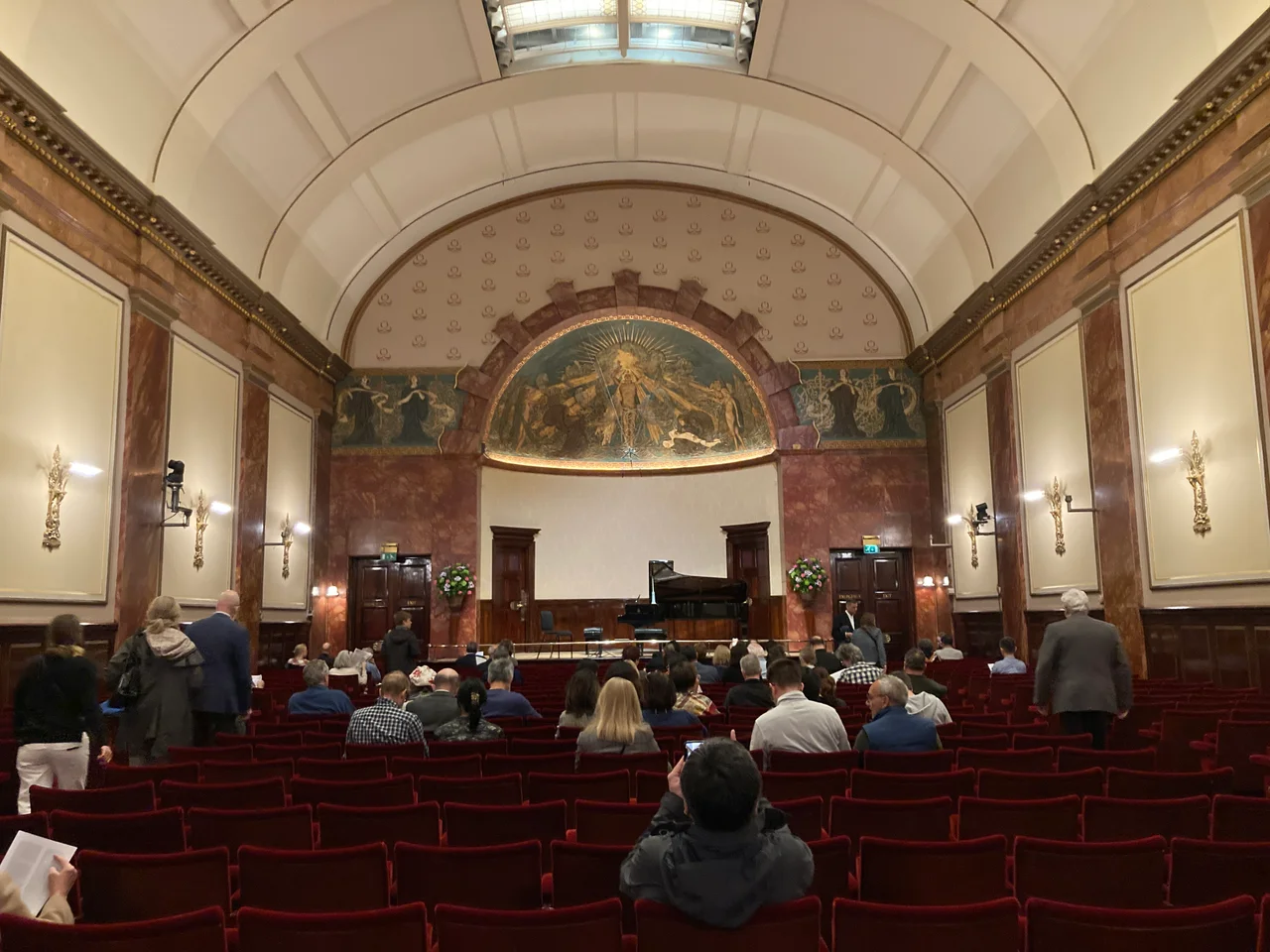

Wigmore Hall
The opening notes of Schubert's Die schoene Muellerin sound different in different rooms. They have a different colour at the Concertgebouw than at Carnegie. But musicians who have played all the great chamber halls of Europe tend, when asked, to put a small 545-seat hall behind a former piano showroom on Wigmore Street near the top of their list. The reason is the room itself. The acoustics at Wigmore Hall are - by general agreement among the people who would know - among the finest in Europe. Carl Bechstein commissioned the room in 1899 to attach his piano showroom to an event that demonstrated his instruments. The showroom is long gone. The room remains, hosting more than five hundred concerts a year and recording one Monday lunchtime concert weekly for BBC Radio 3.
A German Piano Maker's Showroom
In the late nineteenth century, the German firm of C. Bechstein Pianofortefabrik was one of the three or four greatest piano manufacturers in the world. Their London showroom on Wigmore Street needed something more than display models could provide; it needed a hall where artists could play Bechstein instruments to discerning audiences. The architect Thomas Edward Collcutt - already known for the Savoy Hotel and the Palace Theatre on Cambridge Circus - designed the room. The same pale terracotta ornamentation appears on all three Collcutt buildings. Bechstein Hall opened on 31 May 1901 with a concert featuring the pianist Ferruccio Busoni and the violinist Eugene Ysaye. For fifteen years it was the place to hear the latest from Berlin and Vienna. Then in 1916, with Britain and Germany at war, the hall was sold as enemy property at auction. Debenhams bought it for fifty-six thousand pounds - far less than the building had originally cost - and rechristened it Wigmore Hall in 1917.
The Soul of Music
Above the small stage, a cupola depicts the Soul of Music. The mural was designed by Gerald Moira, who later became principal of the Edinburgh College of Art, and executed by the sculptor Frank Lynn Jenkins. The hall itself follows a Renaissance style - alabaster and marble walls, a flat rectangular plan, a small raised stage area with a modest balcony. The proportions matter. A long thin hall with a small ceiling, a relatively low stage, and reflective surfaces produces an acoustic that is unusually warm for chamber music and unusually clear for the human voice. Wigmore's 545-seat capacity makes it intimate enough that a violinist's bow on a string is audible to anyone in the room, and a singer can shape a Schubert song with the kind of subtlety that would be lost in a larger venue. In 2005 the Wigmore Hall Trust paid 3.1 million pounds for a 300-year lease, securing the room's future in a way few cultural institutions in London can match.
Benjamin Britten's Hall
Of all the composers who shaped Wigmore Hall's twentieth-century identity, Benjamin Britten was the closest. His Serenade for Tenor, Horn and Strings premiered here. So did his Second String Quartet, The Holy Sonnets of John Donne, and the Seven Sonnets of Michelangelo. Excerpts from his opera Peter Grimes were first heard at Wigmore ahead of the work's world premiere at Sadler's Wells in June 1945. On 23 September 1942, Britten and his partner the tenor Peter Pears gave the first performance of the Michelangelo sonnets. The relationship deepened across decades. In 2012 the hall mounted a season called Before Life and After to mark the centenary of Britten's birth, with Alice Coote, Mark Padmore, Gerald Finley, and the Takacs Quartet. Britten's centenary is now twelve years past, but the connection runs through every season.
Where Careers Are Made
The list of musicians who have performed at Wigmore reads like a directory of twentieth-century chamber music. Elisabeth Schwarzkopf, Victoria de los Angeles, Sergey Prokofiev, Shura Cherkassky, Paul Hindemith, Andres Segovia, Francis Poulenc. Bartok's six string quartets all had their UK premieres here. So did Schoenberg's Second String Quartet, Debussy's Violin Sonata, and Janacek's Violin Sonata. More recently: Andras Schiff, Joshua Bell, Maxim Vengerov, Hilary Hahn, Igor Levit, Alina Ibragimova, Isabelle Faust. The hall has also become a launching pad for young artists. Singers and pianists under thirty-three from anywhere in the world can enter the Wigmore Hall Song Competition; winning here means an international career. The hall's own Wigmore Hall Live record label received Gramophone's Label of the Year award in 2011, and its releases regularly enter the classical charts.
Beyond the Concert
Since 1994 the hall has run a learning programme that hosts about six hundred events a year with nearly thirty thousand visits. It includes a partnership called Music for Life for people living with dementia, projects with hospital schools, sessions with women and children at the Cardinal Hume Centre and Solace Women's Aid, and the Bechstein Sessions showcasing emerging artists. The hall's director since 2000 is John Gilhooly, a Limerick-born classical singer who has expanded Wigmore's repertoire into jazz evenings curated by Brad Mehldau and into world music and late-night programming. Wigmore is one of the few cultural institutions in London where the same building functions equally well for a touring American jazz pianist on a Friday night, a Schubert lieder recital on a Sunday afternoon, and a workshop with babies and toddlers on a Tuesday morning. The room can hold all of it.
From the Air
Wigmore Hall sits at 51.52°N, 0.15°W on Wigmore Street in the City of Westminster, just north of Oxford Street and a short walk from Oxford Circus. From the air, look for the dense Georgian and Edwardian street grid of Marylebone. London City Airport (EGLC) is about five nautical miles east; Heathrow (EGLL) about thirteen miles west. The hall is best viewed at low altitude over central London.
Nearby Stories
- Stevenage 5.7 km away
- Malling Abbey 5.7 km away
- 1952 Farnborough Airshow Crash 7.7 km away
- Ingatestone Hall 8.2 km away
- Hellfire Caves 9.1 km away
- The Carrington Event: The Solar Storm That Could Happen Again 9.8 km away
- Bletchley Park 16 km away
- Castle Hedingham 23 km away