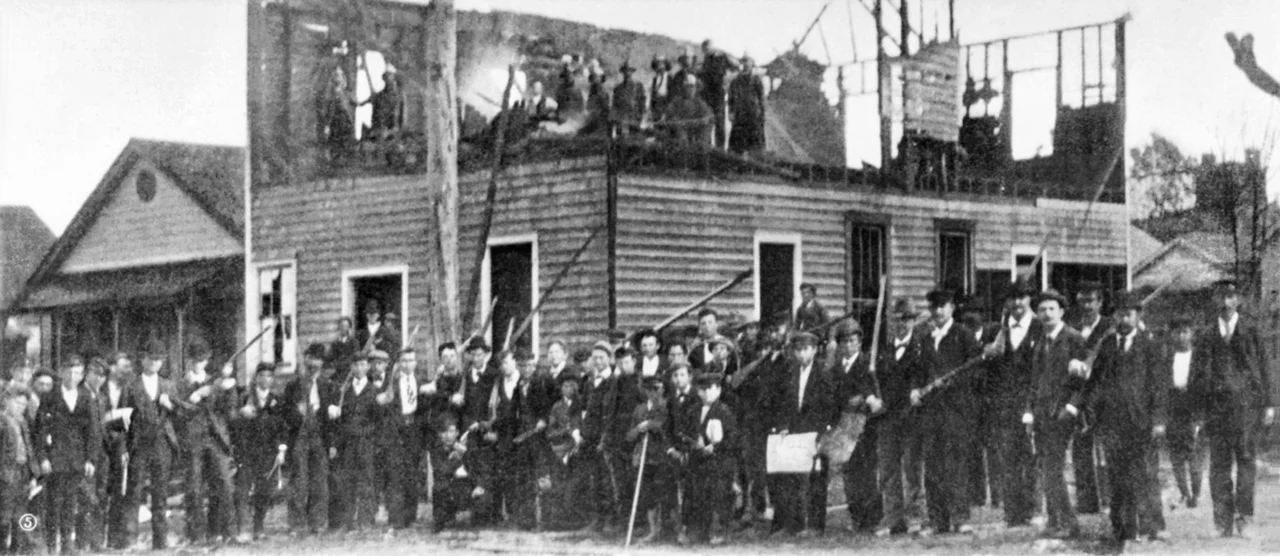

Wilmington Massacre
On November 10, 1898, in the largest city in North Carolina, a mob of roughly two thousand armed white men marched on Seventh and Nun Streets and burned the offices of the Daily Record, a Black-owned newspaper whose editor, Alex Manly, had already fled for his life. By nightfall, they had also overthrown the elected city government at gunpoint, forced the mayor and aldermen to resign, deposed the police chief, and installed their own ringleader, Alfred Moore Waddell, as mayor. Estimates of the Black citizens killed that day range from sixty to as many as three hundred. Thousands more fled into the swamps north of the city, never to return. It was the only successful coup d'etat in American history.
The City That Was
Wilmington in 1898 was unlike anywhere else in the post-Reconstruction South. Black residents made up a majority of the population, roughly 56 percent, and they had built a thriving middle class. There were Black aldermen, Black magistrates, a Black-owned barber shop chain, Black-owned restaurants, Black doctors, lawyers, and ministers. Three of the city's ten aldermen were Black. The county coroner, the city jailer, the deputy clerk of court - all Black men. A Fusionist coalition of Black Republicans and white Populists had won the 1896 elections across North Carolina and now governed Wilmington itself. To the white supremacist Democrats of the state, this was intolerable. The Raleigh News and Observer, edited by Josephus Daniels, hammered the theme for months: white rule must be restored. By any means.
Alex Manly and the Daily Record
Alex Manly was the editor of the Daily Record, the only Black-owned daily newspaper in the United States. In August 1898 he published an editorial responding to a Georgia speech by Rebecca Latimer Felton, who had called for the lynching of Black men to protect white women. Manly argued, plainly, that many of the relationships labeled assault were in fact consensual, and that white men's own conduct toward Black women rendered their outrage hypocritical. The editorial was reprinted across the South as evidence of Black insolence. Through September and October the Democratic press promised that Manly would be hanged. He left Wilmington just before the mob arrived at his pressroom on November 10 and burned the building to the ground. He survived, eventually settling in Philadelphia. His paper did not.
The Day
The morning of November 10 began with Waddell leading hundreds of men, many in the red shirts of the white supremacy campaign, from the armory at Market and Fourth Streets. They moved first to the Daily Record office and set it on fire. From there the mob fanned out into Brooklyn, the Black neighborhood north of downtown. Witnesses described bodies in the streets near North Fourth Street and at the corner of Harnett. A Black laborer named Daniel Wright was beaten and shot near the Cape Fear Lumber Company. The total number of Black citizens killed will never be known. Bodies were buried hastily, and many were never recorded. The most careful modern reckoning, in LeRae Umfleet's 2006 state report, places the deaths in the dozens but acknowledges that the true figure may be far higher. The wounded who could walk fled north into the cypress swamps along Smith Creek, some without coats, in November cold.
The Coup
By late afternoon Waddell and his lieutenants entered city hall, presented the elected officials with prepared resignation letters, and demanded signatures at gunpoint. The mayor, Silas P. Wright, signed. The police chief signed. The aldermen signed. New officers, all white Democrats, were sworn in within hours. Prominent Black citizens - ministers, businessmen, the editor of a competing paper - were rounded up and marched at bayonet point to the train station, where they were put on northbound trains and ordered never to return. Among the exiles were Thomas Miller, a Black alderman, and John Norwood, who had run a successful real estate office. They lost homes, businesses, and the city they had helped build. None of this was punished. No federal intervention came. President McKinley said nothing.
What Was Erased
In the months that followed, the new state legislature passed a constitutional amendment requiring poll taxes and literacy tests for voting. By 1900 the Black electorate of North Carolina had been almost entirely eliminated. The Republican Party in the state collapsed and would not be competitive again for nearly seventy years. Wilmington's Black population fell from a majority to a minority within a decade as families left for Washington, Philadelphia, and New York. The press of the era called what had happened a race riot, suggesting two-sided violence, and that label stuck in textbooks for almost a century. Only in 2000 did the state convene the 1898 Wilmington Race Riot Commission to investigate what had actually occurred. The 2006 report changed the language. In 2019 a state highway marker installed at Third and Princess Streets uses the word coup. David Zucchino's 2020 book Wilmington's Lie, which won the Pulitzer Prize, used the word murder. In 2024 PBS broadcast American Coup: Wilmington 1898. The naming, more than a century late, matters.
From the Air
Downtown Wilmington sits along the east bank of the Cape Fear River at 34.22N, 77.91W. The Brooklyn neighborhood where most of the killings occurred lay roughly between Fourth and Tenth Streets north of Market. Wilmington International Airport (KILM) is six miles north of downtown. Approaches from the south follow the river; the broad dark band of the Cape Fear is visible from cruise altitude. Flight visibility is generally excellent year-round; afternoon thunderstorms are common in summer.
Nearby Stories
- Ocean Isle Beach house fire 4.7 km away
- Pender County, North Carolina 6.6 km away
- Bald Head Island 13 km away
- Marine Corps Base Camp Lejeune 16 km away
- Lake Waccamaw, North Carolina 17 km away
- The Robesonian Takeover 59 km away
- Swansboro 59 km away
- Mercury-Redstone 4 726 km away