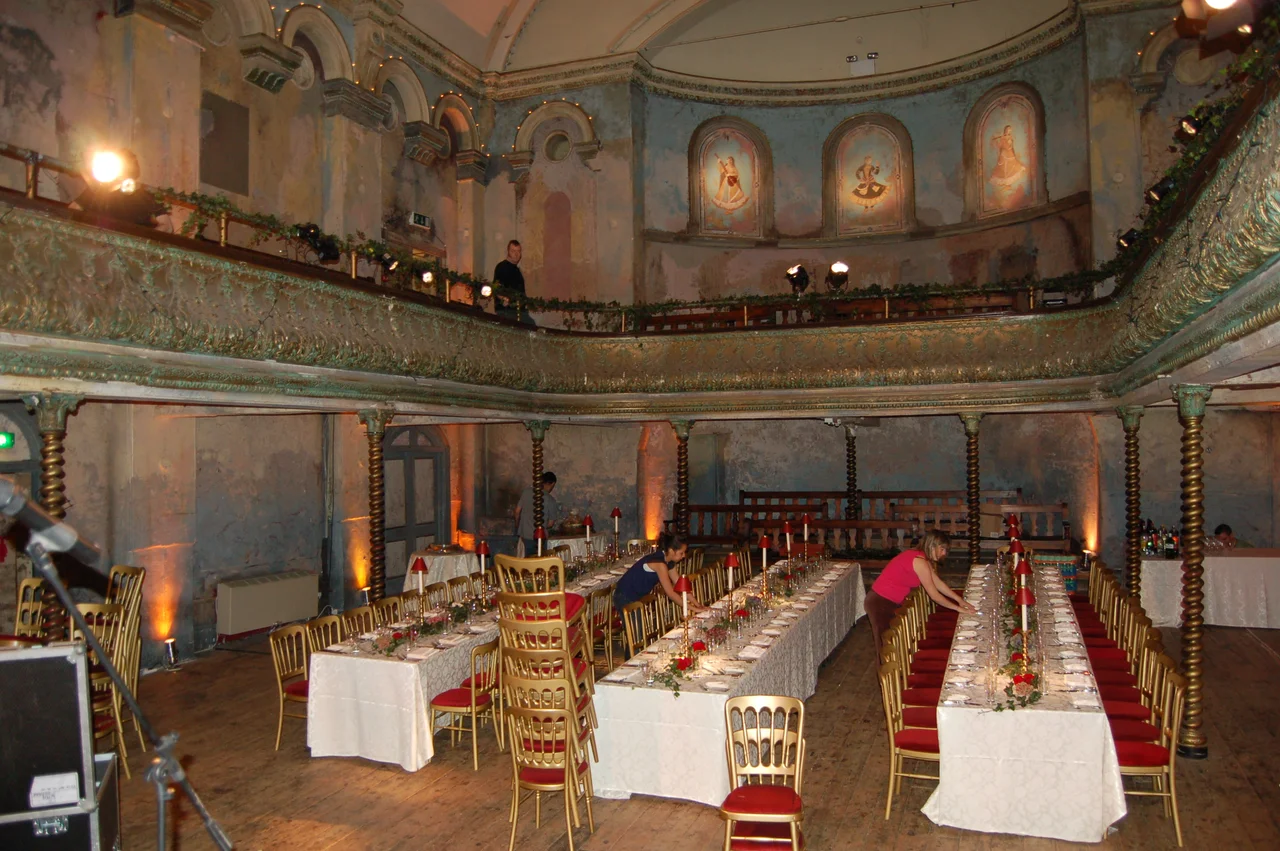

Wilton's Music Hall
In 1859, a publican named John Wilton finished building what he advertised as his Magnificent New Music Hall. It sat behind a four-room pub called the Mahogany Bar on Graces Alley, just off Cable Street, a few minutes' walk from London Docks. It could hold fifteen hundred people, most of them working dockers and their families. A sun-burner chandelier of three hundred gas jets and twenty-seven thousand cut crystals hung over a mirrored hall. The mirror walls were practical: they multiplied the gaslight, which was the only thing that could light a room of that size after dark. For thirty years East End audiences came here to hear Champagne Charlie and to eat supper at long tables while the latest songs were performed on the high stage. Of all the dozens of giant pub halls built across London in the 1850s and 1860s, this is the only one that still stands.
Before the Music Hall
The story starts earlier than 1859. The site was an alehouse by 1743, possibly serving the Scandinavian sea captains and merchants who lived in the nearby Wellclose Square. From around 1826 the place was called the Mahogany Bar, reputedly because the landlord was the first in London to install a mahogany counter and fittings. In 1839 a small concert room was built behind the pub; in 1843 it was briefly licensed as the Albion Saloon, a saloon theatre permitted to stage full-length plays. John Wilton bought the business around 1850 and enlarged the concert room. Nine years later he tore it down and replaced it with the grand hall. The pub stayed as the public entrance, which was standard practice - street frontage was expensive, but you could hide a large hall behind a small house. The hall was built by Jacob Maggs and furnished with the finest heating, lighting, and ventilation systems available.
Who Played Here
Wilton's hosted madrigals, glees, operatic excerpts, circus acts, fairground performers, and the rising stars of music hall. George Ware - who wrote The Boy I Love is Up in the Gallery - performed here. So did Arthur Lloyd and George Leybourne, the latter immortalised as Champagne Charlie, two of the first music hall stars invited to perform for royalty. The audience was East End working-class - dockers, lightermen, warehouse clerks, their wives and grown children. They came not for spectacle alone but for the particular pleasure of singing along to songs they recognised from work and the street. A music hall was the people's opera. The performers and the audience were participants in the same culture, and a song like Champagne Charlie was popular because it told the audience how to enjoy itself - cheerfully, theatrically, with a bottle of fizz that most of them would only encounter as a punchline.
Fire and Methodism
Fire destroyed the hall in 1877. An eight-year rebuild followed, and then in 1888 the Methodists of the East End Mission bought the building and converted it into a place of worship and social service. They renamed it the Mahogany Bar Mission. The East End in those years was famous across the world for the depth of its poverty - investigations by Charles Booth and William Booth (no relation) had brought conditions in Whitechapel and Wapping to national attention. During the Great Dock Strike of 1889, the Mission set up a soup kitchen here that fed a thousand meals a day to dockers' families. The Mission stayed for nearly seventy years, through the 1936 Battle of Cable Street and the Blitz, campaigning against social abuses and welcoming people of all creeds. When the church closed in 1956, the hall briefly became a rag warehouse.
Saved by the Poets
In the 1960s, the London County Council scheduled the area for slum clearance. The terrace including Wilton's was to be demolished. A campaign to save the building was led by the poet John Betjeman, with support from Peter Sellers, Spike Milligan, and others who understood what kind of survival was at stake. In April 1971 the building received Grade II* listed status. The Greater London Council bought it, then sold it on, and the campaign continued through the seventies and eighties. In 1999 the building was leased to Broomhill Opera Company; in 2001 the Wilton's Music Hall Trust was formed and took over the work of restoration. In June 2007 the World Monuments Fund added Wilton's to its list of the world's hundred most endangered sites, which embarrassed the British establishment into action. A capital campaign raised first a million pounds for the auditorium and then 2.6 million for the Georgian houses that form the front of house. The work finished in September 2015.
Conservative Repair
The restoration followed a policy called conservative repair - retaining genuine historic fabric and avoiding misleading restoration, so that future generations can interpret the building's significance for themselves. Walk in today and the hall feels old in the right way. The barley-sugar cast-iron pillars supporting the gallery are original. The proscenium arch is original. The charring on the rafters above where the sun-burner chandelier vented its heat is still there. The walls are deliberately not repainted into pristine condition; the layers of history are visible. The hall is now a producing venue, staging opera, puppetry, classical music, cabaret, dance, and magic. The Mahogany Bar is open for drinks. Films and television frequently shoot here when they need a place that looks Victorian without dressing the set. After twenty years on the Heritage at Risk register, the building was removed from the list in 2016. The oldest surviving grand music hall in the world has another century in it.
From the Air
Wilton's Music Hall sits at 51.51°N, 0.07°W on Graces Alley in Shadwell, Tower Hamlets, just south of Cable Street and a short walk from the Tower of London. From the air, look for the small Georgian terrace tucked into the dense streets between the Highway and Cable Street. London City Airport (EGLC) is about three nautical miles east. Best viewed at low altitude on approach to London City from the east.
Nearby Stories
- Stevenage 5.7 km away
- Malling Abbey 5.7 km away
- 1952 Farnborough Airshow Crash 7.7 km away
- Ingatestone Hall 8.2 km away
- Hellfire Caves 9.1 km away
- The Carrington Event: The Solar Storm That Could Happen Again 9.8 km away
- Bletchley Park 16 km away
- Castle Hedingham 23 km away