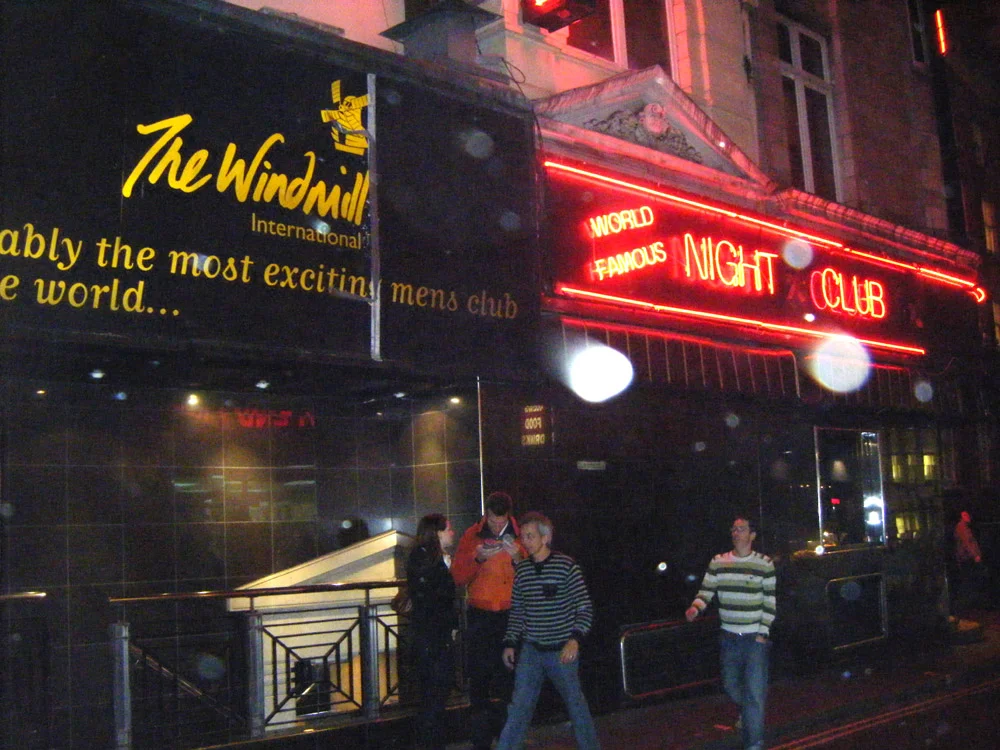

Windmill Theatre
If you move, it's rude. That ruling by the Lord Chamberlain in the 1930s was supposed to settle the question of nudity on the London stage. Living statues were already considered respectable - nobody objected to nude marble in the British Museum - so why object to a nude woman if she held perfectly still? At the Windmill Theatre on Great Windmill Street in Soho, the producer Vivian Van Damm took the ruling and built an empire on it. From 1932 until 1964, the Windmill staged tableaux vivants of motionless naked women in themed sets - mermaids, Britannia, Annie Oakley - alongside comedy acts. The theatre's motto, We Never Closed, referred to the fact that it carried on through the Blitz. The unofficial motto, We Never Clothed, did the rest of the work.
Mrs Henderson's Idea
Laura Henderson was a wealthy widow when her husband died in 1930. With time and money on her hands she bought the Palais de Luxe, a small cinema on Great Windmill Street, and hired the architect F. Edward Jones to convert it into a small 320-seat theatre. Henderson hired Vivian Van Damm to run the place. Van Damm had been to Paris, seen the Folies Bergere and Moulin Rouge, and understood the commercial logic of nudity in entertainment. The problem was the Lord Chamberlain, who in 1932 still held strict censorship powers over the London stage. Van Damm convinced Lord Cromer, then Lord Chamberlain, that motionless nudes were no different from classical statues. The ruling came down: a nude could be displayed if she did not move. The Windmill ran with it. Henderson was charming, eccentric, and unconcerned with respectability - she had survived widowhood and could survive notoriety. When she died in November 1944, aged 82, she left the theatre to Van Damm. Her story was filmed by Stephen Frears in 2005 as Mrs Henderson Presents, with Judi Dench in the title role.
The Legal Loophole
Stage performers held their poses for thirty seconds at a time, sometimes longer, with a kind of athletic stillness that required real training. The curtain rose on a nude tableau, the audience looked, and the curtain fell. Workarounds developed. In the fan dance, attendants moved fans around a stationary performer, technically allowing her to be displayed in motion without her moving herself. A nude girl might hold a spinning rope; the rope moved, she did not, and the authorities accepted it. The point was the ingenuity of the workaround as much as the nudity itself. Lord Cromer's ruling had created an art form by accident, and the Windmill perfected it through three decades. The Piccadilly and Pavilion theatres copied the format, which began to reduce the Windmill's market share - imitation as the best form of flattery and also the worst form of competition.
We Never Closed
When the Blitz began on 7 September 1940, every other London theatre closed. The Windmill stayed open. The showgirls, cast members, and crew moved into the building's two underground floors during the worst air raids, and the show continued upstairs whenever the all-clear sounded. The motto We Never Closed became a wartime point of pride - the Windmill was open when the city felt under siege, and London soldiers and American GIs on leave came through in their thousands. Princesses Helena Victoria and Marie Louise, granddaughters of Queen Victoria, attended as guests of Henderson. The Right Hon. George Lansbury, a senior Labour politician, had a permanent reservation in the Royal Box on opening nights. The pull of the place was partly the nudes, partly the war defiance, and partly Vivian Van Damm's instinct that variety entertainment - acrobats, dancers, comedians, and naked women all in the same show - was what people wanted when the world was on fire.
A Comedians' Academy
Here is the part of the Windmill story that does not get into the films. Between sets of nude tableaux, the theatre ran continuous comedy acts. Most British comedians of the 1940s and 1950s served an apprenticeship here. Jimmy Edwards, Harry Worth, Tony Hancock, Spike Milligan, Harry Secombe, Peter Sellers, Michael Bentine, George Martin, Bruce Forsyth, Arthur English, Tommy Cooper, Barry Cryer - the founding generation of British post-war comedy passed through the Windmill stage. The reason was money. Comedians needed regular paid work, and the Windmill paid. The reason it worked artistically was that the audience was almost entirely male, half-drunk, primarily interested in the next nude tableau, and emphatically not there for the jokes. A comic who could get laughs in that room could get laughs anywhere. The Goons - Milligan, Secombe, Sellers, Bentine - largely formed their voices here. So did Bruce Forsyth, who started as a juvenile performer, a status considered superior to the bottom-of-the-bill comic spot Cryer held.
After Mrs Henderson
Vivian Van Damm died on 14 December 1960. His daughter Sheila Van Damm - a former rally driver who had won the Coupe des Dames at the 1954 Monte Carlo Rally - took over. She struggled. By the early 1960s Soho had begun its long decline from respectable shopping district to seedy adult district, and the Windmill's discreet format was being undercut by frankly pornographic competitors. The Revudeville shows ran their last performance on 31 October 1964. The theatre became a cinema, then under Paul Raymond's ownership a series of adult entertainment venues, then briefly a restaurant and cabaret in 2021, and finally in 2026 the building was acquired by Spearmint Rhino and renamed Rhino Windmill. The story of one Soho address has somehow continued unbroken since 1909 across cinema, variety theatre, strip club, dining room, and back to strip club. Mrs Henderson would probably have understood.
From the Air
The Windmill Theatre sits at 51.51°N, 0.13°W on Great Windmill Street in Soho, City of Westminster, just north of Piccadilly Circus and a short walk from Shaftesbury Avenue. From the air, look for the dense theatre district between Regent Street and Charing Cross Road. London City Airport (EGLC) is about six nautical miles east. Best viewed at low altitude over the West End.
Nearby Stories
- Stevenage 5.7 km away
- Malling Abbey 5.7 km away
- 1952 Farnborough Airshow Crash 7.7 km away
- Ingatestone Hall 8.2 km away
- Hellfire Caves 9.1 km away
- The Carrington Event: The Solar Storm That Could Happen Again 9.8 km away
- Bletchley Park 16 km away
- Castle Hedingham 23 km away