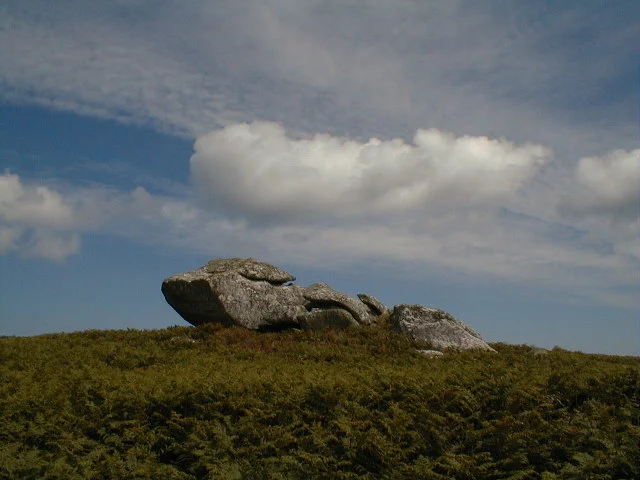

Wingletang Down
The fern in question is two centimetres tall. It comes up in winter, turns yellow, and disintegrates by early April - before most botanists are out walking. That is why it took so long for anyone to notice that the only place in Great Britain and Ireland where Ophioglossum lusitanicum grows is the wind-pruned heath at the southern end of St Agnes, on the Isles of Scilly. A young botanist named John Raven found it in March 1950. A hundred fronds, in a single square metre of heath. Above his head: 43 Bronze Age cairns, a saint's well of unknown age, and a beach where ceramic beads from a seventeenth-century Venetian shipwreck still wash ashore. Wingletang Down is small. It is also, layer for layer, one of the densest places in Britain.
The Saint Who Wished for Wrecks
On the western side of St Warna's Cove stands a stone-lined well of great age. The cove is named for a saint - Warna - whose name appears nowhere else in the Celtic calendar. She may not have been a saint at all. The name is suspected to belong, originally, to a Celtic water goddess whose worship the church absorbed and rebranded. According to local tradition, she came ashore here in a coracle from Ireland. The well is associated with her arrival. And the tradition that grew up around it tells you something true about island life: pins were dropped into the well as offerings to encourage storms to drive ships ashore. Wrecks were a vital resource for coastal communities, and Scilly was one of the last places in Britain where wrecking was openly practised. The beach at Beady Pool, just along the coast in Wingletang Bay, still scatters its evidence of one of those storms. Pilgrims and walkers find ceramic beads in the sand from a seventeenth-century wreck of a Venetian ship. Centuries of waves have polished and sorted the cargo down to the beads, working them up through the shingle, dropping them onto the strand line in slow, patient gifts.
Cairns on the Skyline
Forty-three Bronze Age cairns have been recorded on the down. Some have granite kerbstones still in place; others are linked by old hedge walls. A cairn usually marks a burial site - a heap of stones above an interred individual, sometimes more than one. In the Bronze Age, the inhabitants of St Agnes buried their dead high, where the wind would find them and the view ran out to the Atlantic. Three and a half thousand years later, those cairns are still where they were left. The wind that polishes the gorse and the bell heather has scoured them too. To walk among them is to share the prehistoric judgement that this stretch of granite, this last southern push of the island into the sea, was sacred ground.
Heath, Sand, and the Three Adder's-Tongues
The geology is austere: Hercynian granite, the same deep stone that builds the whole Scillonian archipelago, covered by thin skeletal and podzolic soils. On the higher ground, salt-laden Atlantic wind has 'waved' the maritime heath into low, sculpted cushions of western gorse, heather, and bell heather. On the deeper sandy soils nearer the sea, sand sedge and sand couch hold the dune grassland together. At Horse Point, the southernmost tip, brackish pools fill the hollows between boulders, and sea milkwort - rare in Scilly - grows along their edges. At Beady Pool, sea kale shares the strandline with yellow horned poppy and sea spurge, and a colony of six-spot burnet moths flies in summer. But the showstopper is the fern community on the higher heath. All three Ophioglossum species native to the British Isles grow here, in a single small area. Common adder's-tongue, scarce here despite being common on the mainland; small adder's-tongue, nationally rare; and least adder's-tongue, the two-centimetre winter fern that grows nowhere else in Britain. Its nearest neighbours are in Guernsey, where it was first found in 1854, and then southwest into Portugal.
The Fight to Stay Open
Wingletang Down is owned by the Duchy of Cornwall and managed by the Isles of Scilly Wildlife Trust. It sits inside both the Isles of Scilly Heritage Coast and the Area of Outstanding Natural Beauty. As of September 2009 the SSSI was classed as 'unconditional recovering' - botanist-speak for 'going in the right direction, but not yet where it should be'. The problem is that the things which used to keep the heath open are gone. Cattle no longer graze here. Rabbits, hammered by myxomatosis in the 1950s, are now too scarce to crop the heath the way they once did. Without those mouths, European gorse and bramble climb in. The two-centimetre fern, which needs bare ground and short turf to find light in winter, can be smothered in a season. So conservationists now do by hand what cows and rabbits used to do by appetite - cutting back gorse, clearing bramble, keeping the heath in the wind-pruned condition the ferns and the storm petrels and the old burial cairns all silently require.
From the Air
Wingletang Down sits at the southern tip of St Agnes, around 49.89°N, 6.34°W. From the air it shows as a tongue of low, wind-cropped heath ending at Horse Point, with the granite tumble of the Western Rocks scattered to the southwest and Bishop Rock lighthouse visible on a clear day. St Warna's Cove is the deep notch on the west side; Beady Pool sits in Wingletang Bay to the east. Nearest airport: St Mary's (EGHE), about 3 nm northeast across the inter-island channel. Land's End (EGHC) lies 28 nm east on the Cornish mainland. Recommended viewing altitude 1,000-2,500 ft AGL. Expect haze, low cloud, and frequent Atlantic squalls; the heath's wind-pruned shape is exactly the kind of texture that shows beautifully in raking afternoon light.
Nearby Stories
- Wolf Rock Lighthouse 17 km away
- The Brisons 18 km away
- SS Irma (1905) 22 km away
- HMS Brisk (1851) 31 km away
- Cape Cornwall Mine 57 km away
- SM U-27 73 km away
- Wolfpack Prien 162 km away
- Tower of Hercules 696 km away