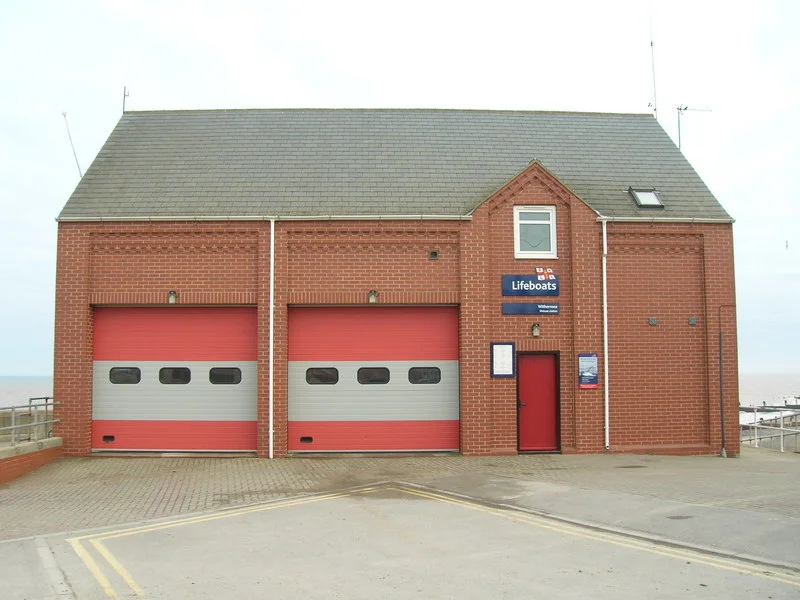

Withernsea Lifeboat Station
Eight wrecks a year. That was the number Mr R. Champney of Hull put in front of the Royal National Lifeboat Institution in 1862 - the running average of vessels lost off the low cliffs at Withernsea. The Institution sent Captain John Ward to look, Ward recommended a station, and a £300 gift from Sarah Lechmere of Hanley Castle paid for the carriage. On 20 August 1862, an estimated twenty thousand people crowded the seafront to watch the Reverend G. C. Pearce of Hull bless a thirty-four-foot pulling lifeboat christened Pelican. From that day onward, when the wind came hard out of the east and a brig started signalling distress, Withernsea's men launched.
The Brig George and the Long List After
The first rescue in the records came on 11 December 1866. The brig George of Lowestoft, bound for South Shields, foundered offshore; her crew of six had already abandoned ship by the time the Withernsea boat reached them, riding the open North Sea in a ship's boat in December weather. All six were brought ashore alive. The pattern repeated itself through the next decades - the brig Tribune in 1869, six of seven men saved; the laden smack Frank of Grimsby, run aground at Waxholme in January 1876, the lifeboat hauled two miles up the coast by carriage and launched again, all ten men rescued. The cost was kept in shillings and pence, and each entry in the ledger was a family that did not have to hold a funeral.
The Castellated Boathouse on Seaside Road
By 1877 the first Pelican was replaced by a smaller thirty-foot self-righting boat funded by London's Victoria Club and named Admiral Rous, in memory of the bluff Royal Navy admiral and turf reformer Henry John Rous (1795-1877). In 1881 the same club paid £412 17s 3d to put up a new boathouse on Seaside Road, finished in 1882 and still carrying its dedication plaque in the wall. Then the coast itself worked against the station. New groynes installed up the beach to retain sand made launching steadily harder, and the wrecks themselves were drifting south - clustering nearer Easington. In 1913, after fifty-one years of service, Withernsea closed and her last pulling lifeboat, ON 623, was sent down the coast.
Reopened, and a Minibus on the M1
Sixty-one years passed before a lifeboat returned. In 1974 the RNLI reopened Withernsea as an inshore lifeboat station, a smaller, faster boat for surf and shoreline. Then, in January 1989, the crew found themselves on the M1 motorway - travelling in a minibus that was caught up in the Kegworth air disaster, when a Boeing 737 came down short of the runway across the road. They climbed out and joined the rescue at the roadside, helping pull survivors from the wreckage of Flight 92. The Withernsea station crew were given a special framed Letter of Thanks signed by the Chairman of the Institution. They had ended up rescuing people on dry land, miles inland, in winter, but they were lifeboat crew, and they did what lifeboat crew do.
Mary Beal, Still on Station
Today the fifth boathouse stands on Seaside Road, opened in 1998. Inside sits Mary Beal, an inshore lifeboat of the D class, named after a much-loved Holderness local figure and brought into service in July 2019 after a community appeal. The lighthouse a short walk inland - octagonal, white, looming over the town's roofs - is now a small museum to the lighthouse keepers and lifeboat crews who have worked these few miles of sand and clay. Withernsea handles inshore call-outs; the all-weather work comes from the stations to the north and south. The eight-wrecks-a-year coast that prompted the founding has not gone away. It is just better watched.
From the Air
Withernsea Lifeboat Station sits on Seaside Road at 53.726 degrees north, 0.041 degrees east, on the low Holderness coast of the East Riding of Yorkshire. From cruising altitude, look for the long sandy beach running south toward Spurn Head and the white octagonal lighthouse standing well inland of the seafront. Nearest ICAO: EGNJ (Humberside), 35 km southwest across the Humber. Coastal fog forms quickly off this coast on calm spring mornings.
Nearby Stories
- Humber Bridge 6.5 km away
- MS Piłsudski 7.8 km away
- SM UC-47 17 km away
- Sledmere House 19 km away
- Alford Windmill 19 km away
- RAF Scampton 20 km away
- HMS Cobra 26 km away
- Alexander L. Kielland (Platform) 317 km away