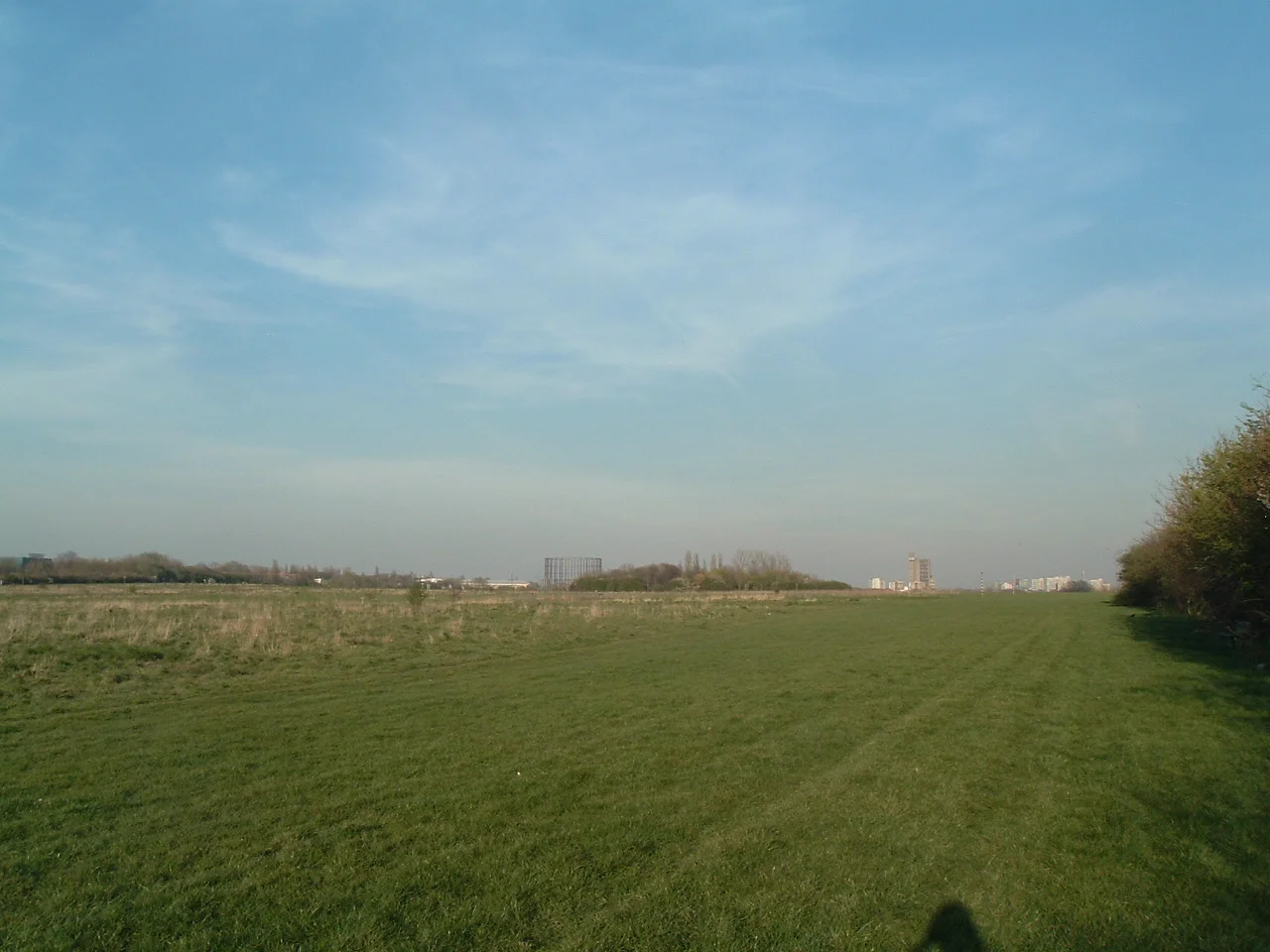

Wormwood Scrubs
The name comes from the Old English — 'worm-haunted scrubland' — and the place has always carried an edge. Medieval manors grazed their cattle here. The War Office commandeered it for emergency landings. Bletchley Park ran a covert cable-censorship operation from within its bounds during the Second World War. And on 3 October 1940, a German incendiary bomb destroyed the local railway station. Through all of it, Wormwood Scrubs has remained open to the public: 67 hectares of common land in west London that refuses to be only one thing.
Eight Centuries of Use
The Scrubs appears in records as early as 1189, when it was called Wormhold Scrubs and used for grazing the cattle and pigs of the local manor. In 1812, the War Office leased 77 hectares from the Manor of Fulham and used it as an emergency landing ground that remained active into the 1930s. The Paddington Arm of the Grand Junction Canal bisected the northern edge in 1801, physically dividing the land. Through the nineteenth century the area held on as open common while London swallowed nearly everything around it. In 1879, the Wormwood Scrubs Act formally vested the land in the Metropolitan Board of Works for public recreation, a status that has survived every subsequent reorganisation of London's government. The Act's phrase — for the 'exercise and recreation of the inhabitants of the metropolis' — still governs the Wormwood Scrubs Charitable Trust that manages it today.
Shadows on the South Edge
Standing on the open grass and looking south, the skyline is dominated by the Victorian brick battlements of HM Prison Wormwood Scrubs, built between 1875 and 1891 by convict labour. It is among the best-known prisons in Britain and sits just yards from where the Massacre of Braybrook Street took place in 1966, when three police officers were shot dead after stopping a suspicious car near the perimeter road. The prison defines how most people outside west London imagine the Scrubs. For those who actually use the common, it is more likely to be the Linford Christie Stadium, the dozens of football pitches, or the pony centre that defines the space — evidence that the open land has always served far more purposes than its most famous neighbour suggests.
A Secret War Within the Common
In 1939, as Britain mobilised for the Second World War, the Wormwood Scrubs became host to something unexpected: an outstation of the Government Code and Cypher School, the organisation that would become famous through its work at Bletchley Park. The operation here was the Chief Cable Censorship Department — monitoring and screening the communications flowing through Britain's international telegraph cables. The Scrubs was chosen for its peripheral location and available space. Anti-aircraft gun emplacements manned by Auxiliary Territorial Service women were stationed on the common during the Blitz. The railway station serving the area was hit by an incendiary bomb in October 1940 and burned to the ground. The ordinary patch of west London had become, briefly, part of the infrastructure of national survival.
Fighting for the Trees
In 1986, a local birdwatcher named Lester Holloway noticed that British Rail intended to clear the strip of woodland running along the northern edge of the Scrubs to build maintenance depots for Channel Tunnel trains. Holloway started a campaign, petitioned the House of Lords, and won concessions. The surviving woodland is now a Local Nature Reserve, and part of it bears his name: Lester's Embankment. It is the kind of story the Scrubs generates — an ordinary Londoner taking on an institution to preserve something that seemed, to the institution, like nothing at all. Common pipistrelle bats forage through the reserve. Common lizards sun themselves on the bare patches kept clear by conservation volunteers. The place persists, as it has for eight hundred years, as genuinely common ground.
From the Air
Wormwood Scrubs lies at 51.5214°N, 0.2389°W in the London Borough of Hammersmith and Fulham. From altitude, the open expanse of the common is distinctive — a large green rectangle in the densely built-up terrain of west London. HM Prison Wormwood Scrubs is visible along the southern edge. The Hammersmith Hospital campus sits immediately east of the prison. London City Airport (EGLC) is approximately 17 km to the east. Heathrow (EGLL) is 14 km to the west, with approach and departure paths occasionally crossing over this area.
Nearby Stories
- Stevenage 5.7 km away
- Malling Abbey 5.7 km away
- 1952 Farnborough Airshow Crash 7.7 km away
- Ingatestone Hall 8.2 km away
- Hellfire Caves 9.1 km away
- The Carrington Event: The Solar Storm That Could Happen Again 9.8 km away
- Bletchley Park 16 km away
- Castle Hedingham 23 km away