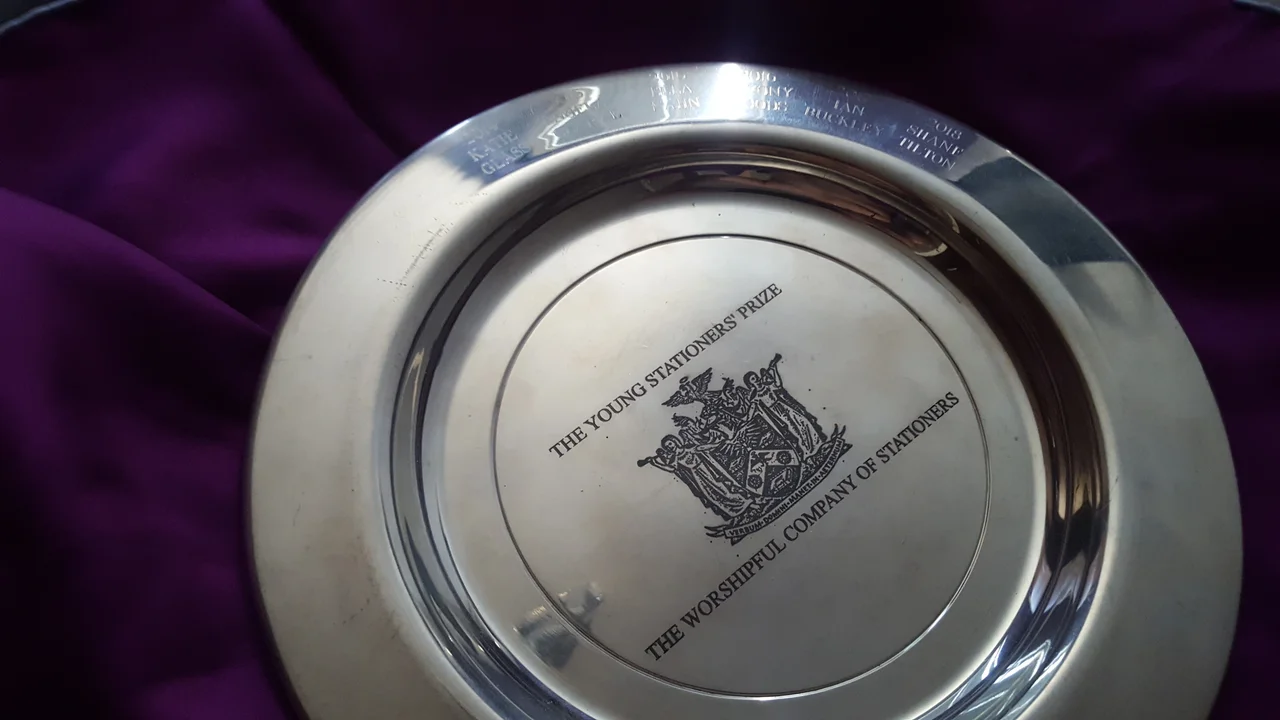

Worshipful Company of Stationers and Newspaper Makers
The word copyright was invented in a guildhall near St Paul's Cathedral some time in the late 1500s. Before then, the idea did not exist as a single word. A bookseller who had registered a text with the Stationers' Company - paid the fee, sworn the oath - had the right to copy that text. No other guild member could legally print it. The shortened form, copy right, eventually fused into the word that now appears on the back of every published book in the English-speaking world. The Worshipful Company of Stationers is the source of that word, of the ownership concept it names, and of more than five centuries of London publishing history. Its hall on Ave Maria Lane has burned down once, in the Great Fire of 1666, and has stood essentially unchanged since 1674.
How a Guild Becomes a Monopoly
In 1403, the Corporation of London approved a small guild of stationers - text writers, limners (illustrators of manuscripts), bookbinders, and booksellers who worked at fixed stalls (stationarii) beside the walls of St Paul's Cathedral. The work was almost entirely manuscript: hand-copied books, hand-illustrated psalters, parchment scrolls. Then in the 1470s William Caxton imported printing from Germany, and by 1557 - when the guild finally received its royal charter from Queen Mary and King Philip - what had begun as a guild of scribes had become a guild of printers. The charter gave them a monopoly. The Stationers were legally empowered to seize offending books that violated the standards of content set down by the Church and state, and to bring offenders before the Bishop of London or the Archbishop of Canterbury. In the turbulent decades of the Protestant Reformation, this made the Stationers an arm of state censorship. The crown had outsourced thought-policing to a guild, and the guild had been given a printing monopoly in return.
The Origin of Copyright
The genius - or trap - of the system was the Stationers' Register. A guild member who wanted to publish a book entered the title in the Register, paid the fee, and from that moment held the exclusive right to copy that text within the trade. No other Stationer could legally print it. The system enabled a working publishing industry to exist; it also gave the printers, not the authors, the ownership of literary works. Shakespeare did not own his plays. The Stationer who registered them did. The Stationers' Register thus became one of the central documents in the study of English Renaissance theatre - the only definitive record of which plays existed and when. Then in 1710 Parliament passed the Copyright Act, also called the Statute of Anne, which transferred copyright from printers to authors as a matter of statutory law. The Stationers' monopoly was broken. The word they had invented outlived their control of it.
Fire and Rebuilding
In 1611 the company bought Abergavenny House on Ave Maria Lane, just south of Paternoster Row, and moved its hall there. Fifty-five years later the Great Fire reached them. The hall burned down. Most of the records inside also burned, except for a great many that the company's clerk George Tokefeild had carried home to his suburban house. Without him, the company's pre-1666 history would be largely lost. The hall was rebuilt by 1674 in much the form it has today. The Court Room was added in 1748, the external façade was remodelled in 1800 by Robert Mylne, and on 4 January 1950 it was designated a Grade I listed building. In November 2020 the company was granted approval to modernise the interior - conference facilities, air cooling, step-free access - while preserving the historic fabric. The hall reopened in July 2022 for events, weddings, and filming. It is the only complete pre-Georgian livery hall left in the City of London.
From Printers to Tech Workers
The trades the Stationers represent have evolved. The original guild covered manuscript-makers and booksellers. The Stuart-era guild was a printers' guild. The 1937 merger with the Newspaper Makers' Company - a much younger livery company founded only six years earlier - added the Fleet Street newspaper trades. Today the modern Stationers' Company represents what it calls the content and communications industries: archiving and conservation, advertising and marketing, digital media and software, newspapers and broadcasting, packaging, paper, printing, publishing, journalism. The continuity from the 1403 guild of text writers to a 2026 livery company that includes podcast producers among its members is improbable, but it works. Helen Esmonde became the first woman elected Master in 2015, ending six centuries of male monopoly. Queen Camilla was made an Honorary Freeman and Liveryman in July 2025.
What the Word Means Now
Copyright today is enforced by international treaties and the World Intellectual Property Organization. The Stationers' Register is no longer the recording mechanism. The Copyright Act of 1911 ended formal registration in Britain in 1923, and the company began a voluntary register that printers could use as evidence of ownership in disputes. The notion that an author holds rights in what they wrote is now accepted across the world - though the digital era has reopened the question in ways the Stationers could never have foreseen. The company motto, Verbum Domini manet in aeternum (The Word of the Lord endures forever), engraved on the heraldic arms, has the air of a slogan that survived its original meaning. The Word of the Lord endures, but so does the word the Stationers themselves invented - it endures wherever a book is published, wherever a song is recorded, wherever a film credit rolls. The guild outlived its monopoly and gave the world a word that runs the modern creative economy.
From the Air
Stationers' Hall sits at 51.51°N, 0.10°W on Ave Maria Lane in the City of London, near Ludgate Hill and just west of St Paul's Cathedral. From the air, look for the Grade I listed building tucked between the cathedral and the Old Bailey. London City Airport (EGLC) is about five nautical miles east. Best viewed at low altitude over the City of London.
Nearby Stories
- Stevenage 5.7 km away
- Malling Abbey 5.7 km away
- 1952 Farnborough Airshow Crash 7.7 km away
- Ingatestone Hall 8.2 km away
- Hellfire Caves 9.1 km away
- The Carrington Event: The Solar Storm That Could Happen Again 9.8 km away
- Bletchley Park 16 km away
- Castle Hedingham 23 km away