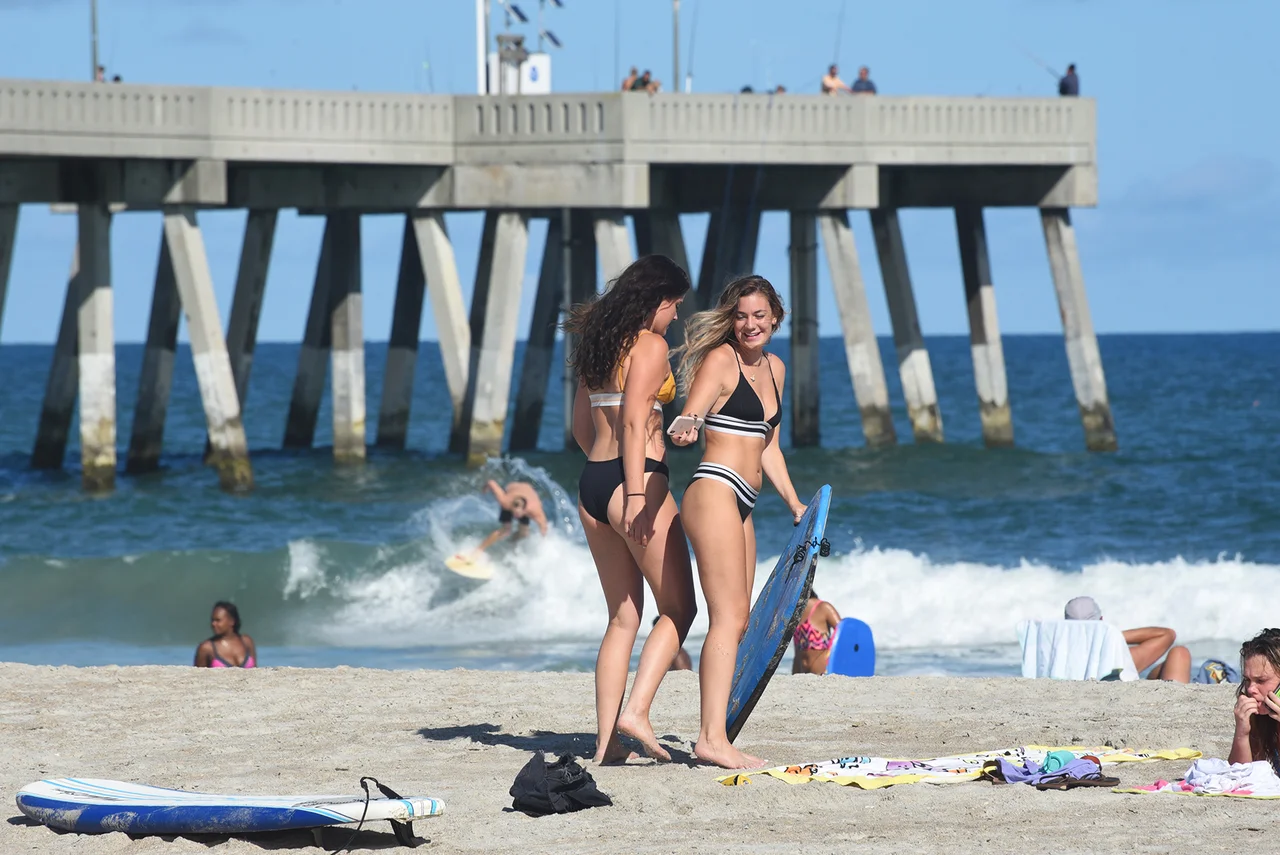

Wrightsville Beach, North Carolina
On the night of May 3, 1905, the Lumina Pavilion lit up for the first time and people in boats out on Banks Channel said they could see the glow from miles away. Six thousand exterior lights covered the building. The dance floor inside spanned twenty-five thousand square feet. You reached it by electric streetcar from downtown Wilmington, a forty-minute ride that crossed the marsh on a wooden trestle, then stopped at one of seven stations along what would become South Lumina Avenue. The Big Bands played there in the 1930s and 1940s - Glenn Miller, Tommy Dorsey, Cab Calloway when he was passing through. The Lumina is gone now, condemned in 1973, replaced by beach condominiums. The name survives - on the avenue, on the campus theater at UNCW, on the memory of an island that was once the brightest place on the Carolina coast.
Before the Bridge
The Lords Proprietors granted the first 640 acres on what would become Harbor Island to Charles Harrison in 1725. For the next 128 years almost nothing happened. The beach was accessible only by boat. In 1853 seven Wilmington men who liked to sail organized the Carolina Yacht Club, the third oldest in America and the first permanent structure on the island. The post office, called Wrightsville, opened in 1881; the road from Wilmington to the edge of the sound, called Shell Road, was completed in 1887. The town was incorporated in 1899 and took the name of Joshua G. Wright, a Wilmington realtor whose family had developed the area. There were a few cottages and a yacht club on what people called Ocean View Beach. There was, for the moment, not much else.
Hugh MacRae and the Electric Streetcar
In 1902 Hugh MacRae, a Wilmington businessman who had already built a small power company, consolidated the area's railroads and trolleys into the Consolidated Railroad, Power & Light Company. He converted the Ocean View Railroad to an electric streetcar and ran it from downtown Wilmington across the marsh to seven stations along the beach. The cars carried passengers in summer and ice in the winter - this was an era before household refrigeration, and the freight runs of ice made possible the snack stands, soda fountains, and seafood shacks that would multiply along the boardwalk over the next thirty years. The trolley monopoly lasted until 1926, when the first causeway opened and automobiles finally arrived. The last streetcar ran on April 18, 1939, piloted by W. R. Tuck Savage, who had also operated the very first.
Lumina and Shell Island
The Lumina Pavilion opened in 1905 as the centerpiece of the MacRae family's beach resort. The dance floor drew the most attention, but in 1913 the operators added a screen out in the surf and projected silent films onto it so beachgoers could watch movies while wading. Lumina ran movies, dances, and concerts through World War II. Decline came after the trolley shut down in 1940 and the postwar boom of car-accessible entertainment drew crowds elsewhere. It was a skating rink for a few years, then a bar, then closed in 1972, then condemned in 1973 and torn down. In 1923 the Home Realty Company built a beach resort on Shell Island, just north of Wrightsville, specifically for African American families excluded from the segregated white beaches. It had a pavilion, boardwalks, concessions, and bathhouses, reached by trolley to Harbor Island and ferry across the channel. In 1926 a fire burned every structure to the ground. The resort was never rebuilt. The ferry service ended. The Black families who had built and frequented Shell Island had nowhere comparable to go on the Carolina coast for a generation.
Piers, Hurricanes, and Concrete
Johnnie Mercer's Pier began life in 1937 as the Ocean View Pier, the third pier built in North Carolina. Johnnie Mercer bought it in 1939 and gave it his name. Hurricanes Hazel in 1954, Connie in 1955, Bertha and Fran in 1996 hammered it in turn; the damage from Fran was bad enough to close the pier until 2002. The current Johnnie Mercer's Pier is built of reinforced concrete, the only such pier in North Carolina, and stands today with a gift shop, ice cream bar, and rows of arcade machines. A second pier, the Mira Mar, was built in 1938 by Floyd Cox atop the wreck of the Fanny and Jenny, a Confederate blockade runner that ran aground off Wrightsville on its 1864 maiden voyage. The wreck made a natural reef. The fishing, when the pier still stood, was reportedly excellent.
The Storms Keep Coming
Wrightsville Beach has been hit by hurricanes more or less continually since the town existed. Two devastating storms made landfall in 1899 alone - the August 17 storm at Hatteras, and a second on November 1 that destroyed cottages, damaged the train trestle, and required the complete rebuilding of the Carolina Yacht Club. Hazel in October 1954, the only Category 4 hurricane ever to make landfall in North Carolina, struck just south at Holden Beach and tore up the coast. Bertha and Fran came eight weeks apart in 1996. Dennis dumped rain in 1999 and set the stage for the catastrophic flooding of Hurricane Floyd weeks later. Florence made landfall directly on Wrightsville Beach in 2018 as a Category 1 with ninety-mile-per-hour winds. After every storm the island rebuilds, the dunes get replanted, the pier reopens. The current permanent population is 2,473. The summer population, when the parking lots fill and the marsh smells of salt and coconut sunscreen, is many times that.
From the Air
Wrightsville Beach is a 4.6-mile barrier island at 34.21N, 77.80W, just east of Wilmington across the Intracoastal Waterway. The town is unmistakable from the air - a long thin strip of beach with a parallel sound, separated from the mainland by tidal marsh. Wilmington International Airport (KILM) is about ten miles west. Coastal approaches from the south follow the barrier island chain - Carolina Beach, Masonboro Island, then Wrightsville. Year-round visibility is excellent on clear days; summer thunderstorms common; tropical systems are the main seasonal hazard.
Nearby Stories
- Ocean Isle Beach house fire 4.7 km away
- Pender County, North Carolina 6.6 km away
- Bald Head Island 13 km away
- Marine Corps Base Camp Lejeune 16 km away
- Lake Waccamaw, North Carolina 17 km away
- The Robesonian Takeover 59 km away
- Swansboro 59 km away
- Mercury-Redstone 4 726 km away