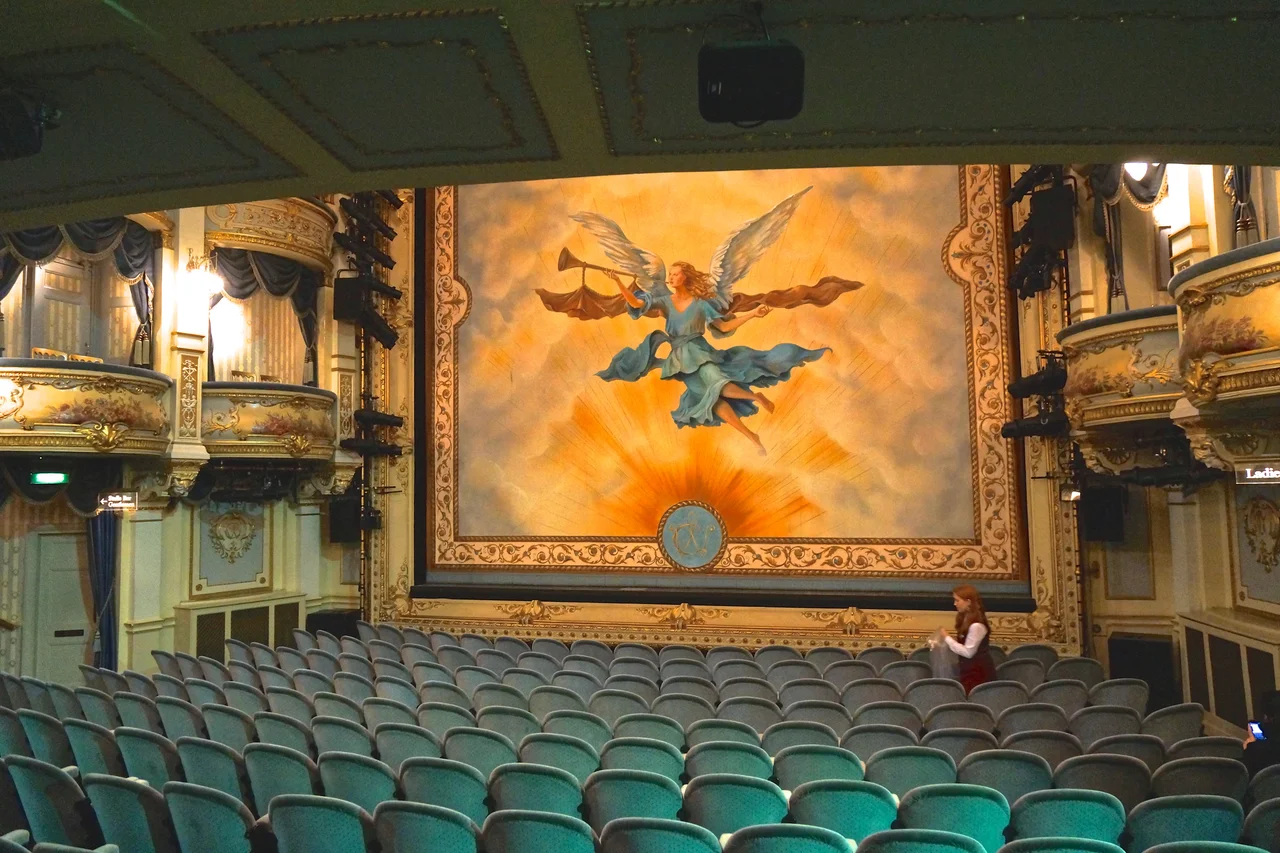

Wyndham's Theatre
On the night of 16 November 1899, the Prince of Wales arrived at the opening of a new theatre on Charing Cross Road. The actor-manager Sir Charles Wyndham had dreamed for years of owning a theatre of his own; through friends, patrons, and decades of stage success he had finally built one. The first play was a revival of T. W. Robertson's David Garrick - a sentimental Victorian piece that suited the occasion. What no one in the room could have known was that the building they were inaugurating would become one of the busiest premiere houses in London for a hundred and twenty years and counting, hosting everything from the British debut of an American teenager named Tallulah Bankhead to the world premiere of an Arthur Miller play to Phoebe Waller-Bridge in Fleabag.
The Architect Who Built Six Theatres
Wyndham's Theatre was designed around 1898 by W. G. R. Sprague, the architect who would also design the Aldwych, the Strand, the Wyndham's twin Albery (now the Noel Coward), and three others in the next eighteen years. Sprague's theatres share a particular grace: late-Victorian elegance executed with restraint, sight lines that work from every seat, and an intimacy that newer venues struggle to match. Wyndham's seats 759 patrons on three levels - a fourth was added in later refurbishment. The interior is decorated in cream and gold with delicate plasterwork. Even by 1960 the building had become so distinctively a London landmark that English Heritage Grade II*-listed it. A Grade II* listing means a building of more than special interest; not as restricted as Grade I, but unmistakably significant.
Du Maurier and the Daughter in the Wings
In 1910 the actor-manager Gerald du Maurier began a fifteen-year association with the theatre that helped define its early decades. Du Maurier was a leading West End star, and his presence anchored the house through the First World War and the early 1920s. His small daughter Daphne would often watch her father's performances from the wings. Thirty years later that same daughter - by then Daphne du Maurier, author of Rebecca and Jamaica Inn - returned with her own play, The Years Between, which opened on the same stage. The continuity reads like a novel. Another visitor in 1910 was an unknown sixteen-year-old American debutante named Tallulah Bankhead, who made her London stage debut in a du Maurier production at Wyndham's. In 1917 J. M. Barrie's Dear Brutus ran for more than three hundred and sixty performances - a long run by the standards of the day.
The Twentieth Century
In April 1953 Graham Greene's first play, The Living Room, premiered here with Dorothy Tutin in the cast. In January 1954 Sandy Wilson's musical pastiche The Boy Friend transferred from the tiny Players' Theatre and ran for 2,078 performances before moving to Broadway. Through the 1960s and early 1970s the theatre featured Alec Guinness in Wise Child, Vanessa Redgrave, Diana Rigg. In January 1972 Godspell opened with a cast that included David Essex, Marti Webb, and a twenty-three-year-old Jeremy Irons in his West End debut. It ran until October 1974 - a thirty-three-month residency that would change the careers of every cast member. In 1996 Yasmina Reza's Art opened with Albert Finney, Tom Courtenay, and Ken Stott and ran for almost exactly five years. Diana Rigg returned in the 1990s, twenty-five years after her debut at the theatre, to play Medea.
The Donmar Year
In 2008, after a temporary closure for refurbishment, Wyndham's reopened with a full twelve-month season of plays by the Donmar Warehouse - one of London's most prestigious off-West End theatres - staged at the Donmar's normal ticket prices. Kenneth Branagh starred in Tom Stoppard's new version of Chekhov's Ivanov. Derek Jacobi led Twelfth Night. Judi Dench appeared in Yukio Mishima's Madame de Sade, alongside Rosamund Pike. Jude Law played Hamlet. The arrangement was unusual: a commercial West End house giving over its stage and box office to a subsidised theatre at heavily reduced prices, while still drawing audiences who could afford the full price elsewhere. The season finished with Law's Hamlet running through summer 2009 and was widely judged a success - both artistically and as a demonstration that prestige theatre could still command West End attendance.
What Comes to Wyndham's
The pattern of what plays Wyndham's continues: serious dramatic work, often with major actors, often with limited runs. Mark Strong, Carey Mulligan, James Earl Jones, Brian Cox, Lesley Manville, Audra McDonald, Bryan Cranston, Phoebe Waller-Bridge. The house's particular gift is that it can hold an intimate two-hander - Waller-Bridge alone on stage as Fleabag - and a full Shakespearean cast - Branagh's King Lear in 2023 - with equal ease. The Delfont Mackintosh organisation, which took over the theatre's operation in May 2005, programmes a mix of star-vehicle plays, transfers from subsidised theatres, and occasional musicals. A replica of the theatre's facade was built at Universal Studios in Orlando, Florida, as part of the park's London-themed area - a strange compliment to an architectural style. The original is still on Charing Cross Road, where it has been since the night the Prince of Wales arrived.
From the Air
Wyndham's Theatre sits at 51.51°N, 0.13°W on Charing Cross Road in the City of Westminster, just north of Leicester Square. From the air, look for the theatre district between Trafalgar Square and Cambridge Circus. London City Airport (EGLC) is about six nautical miles east. Best viewed at low altitude over the West End.
Nearby Stories
- Stevenage 5.7 km away
- Malling Abbey 5.7 km away
- 1952 Farnborough Airshow Crash 7.7 km away
- Ingatestone Hall 8.2 km away
- Hellfire Caves 9.1 km away
- The Carrington Event: The Solar Storm That Could Happen Again 9.8 km away
- Bletchley Park 16 km away
- Castle Hedingham 23 km away