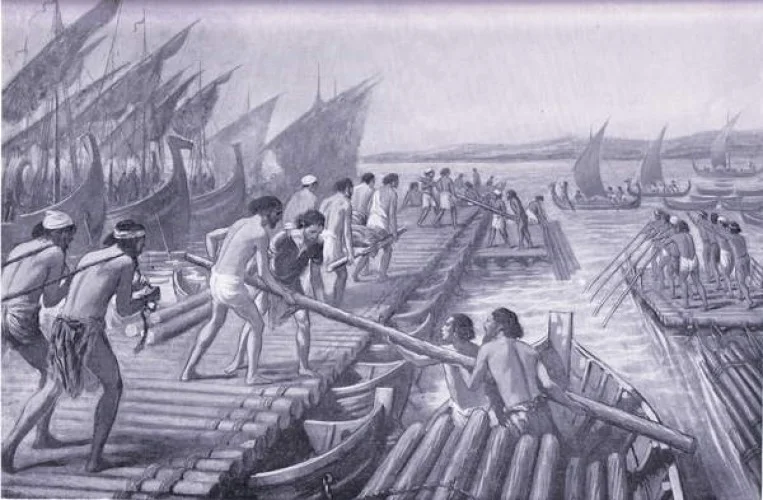

Xerxes' Pontoon Bridges
When the first set of bridges blew apart in a storm before his army arrived, Xerxes ordered the engineers responsible to be beheaded. Then, according to Herodotus, he had the strait itself whipped three hundred times with iron lashes, branded with red-hot irons, and bound in chains thrown into the water while his soldiers shouted at the waves. It is one of the most theatrical anecdotes in ancient history, and modern historians suspect Herodotus dressed it up. What is harder to dispute is what came next: a second pair of bridges, built from 674 lashed-together warships across the narrows between Abydos and Sestos, carrying the Persian army from Asia into Europe over seven days and seven nights in the spring of 480 BC.
The Engineering
The two bridges were a couple of kilometers long, threaded across one of the most current-driven straits in the known world. Three hundred and sixty ships made up the northeasterly span; another three hundred and fourteen formed the southwesterly. Mostly penteconters — fifty-oared galleys with low freeboard — with the larger triremes set at intervals to carry the bridge cables higher and let small ships pass underneath through three openings. Cables of papyrus and white flax, alternating, ran from shore to shore, lashed across the decks. Wooden planks were laid over the cables, brushwood thrown across the planks, and a layer of stamped earth packed on top to make a road wide enough for four soldiers abreast or two horsemen side by side. Tall screens of woven branches were erected along both sides so the horses would not panic at the sight of open water below them.
Who Built It
The army Herodotus describes was vast — exaggerated, almost certainly, but still huge by ancient standards. Behind that army stood another, larger group whose lives the chronicles barely mention: the rope-makers and the shipwrights and the woodcutters and the loaders, the men who hauled the flax cables and the papyrus cables, the men who tightened the great winches and dropped the anchors. Many of them were levied from the Phoenician and Egyptian coastal cities under Persian control. Many were enslaved. The first set of bridges, the ones the storm destroyed, cost the engineers their heads — Persian command made it abundantly clear what failure would mean. Modern engineers have looked at the numbers Herodotus gave for the cables and concluded that no single rope of that weight could have been handled by anyone in antiquity. Whatever was actually done, it was done by laborers whose names nobody recorded, working under threat of death.
Xerxes Wept
Herodotus tells one more story about the crossing that has lasted in the memory of readers for twenty-five centuries. Xerxes climbed a hill near Abydos and looked down at his army covering the plain — hundreds of thousands of men preparing to march into Greece. He ordered a review of the troops and the fleet. And then, according to Herodotus, he began to weep. When his uncle Artabanus asked him why, Xerxes said he was overcome by the brevity of human life. Of all these many people, he said, in a hundred years not one will be alive. Whether Xerxes ever said any such thing is impossible to know. The line has the ring of something Herodotus invented to give his Persian king a moment of unexpected interiority — a tyrant briefly aware of mortality before sending his army on to disaster at Salamis and Plataea. But the moment has stuck. It feels true even if it isn't.
What Was Left Behind
Within a year, the campaign was finished. The Persian fleet was wrecked at Salamis. The land army was broken at Plataea in 479 BC. When the survivors came back to the Hellespont to cross home, they found the bridges gone, smashed by another storm, the cables and ships scattered. They had to wait for ferries. Today the Hellespont is called the Dardanelles, and the place where the bridges stood — somewhere between modern Çanakkale and Nara Burnu — is one of the busiest shipping channels in the world. Massive container vessels and oil tankers move through the same narrow water that 674 lashed warships once spanned. The strait has not been bridged again at that exact spot, though the 1915 Çanakkale Bridge a few kilometers north now carries traffic across by the same kind of engineering principle: cables stretched between two shores, holding up a road. Two and a half thousand years on, the basic problem and the basic solution are unchanged.
From the Air
Xerxes' Pontoon Bridges (historical site): 40.1440 N, 26.3898 E, in the Dardanelles strait between modern Çanakkale and the Gallipoli (Gelibolu) peninsula in northwestern Turkey. Best viewed below 4000 feet. Nothing of the bridges remains — look instead for the narrows where the Asian and European shores come closest together, near Nara Burnu (Nara Point). The 2022 Çanakkale 1915 Bridge crosses the strait a few kilometers north and is now the dominant landmark. Çanakkale Airport (LTBH) is on the Asian shore. Class D airspace; check NOTAMs for the active commercial shipping channel and military exercises.
Nearby Stories
- Battle of Imbros 8.6 km away
- Altıkulaç Sarcophagus 10 km away
- 1912 Mürefte Earthquake 14 km away
- Bolayır 20 km away
- Mount Ida (Turkey) 33 km away
- Samothrace temple complex 42 km away
- Lyrnessus 44 km away
- Sigri (village) 78 km away