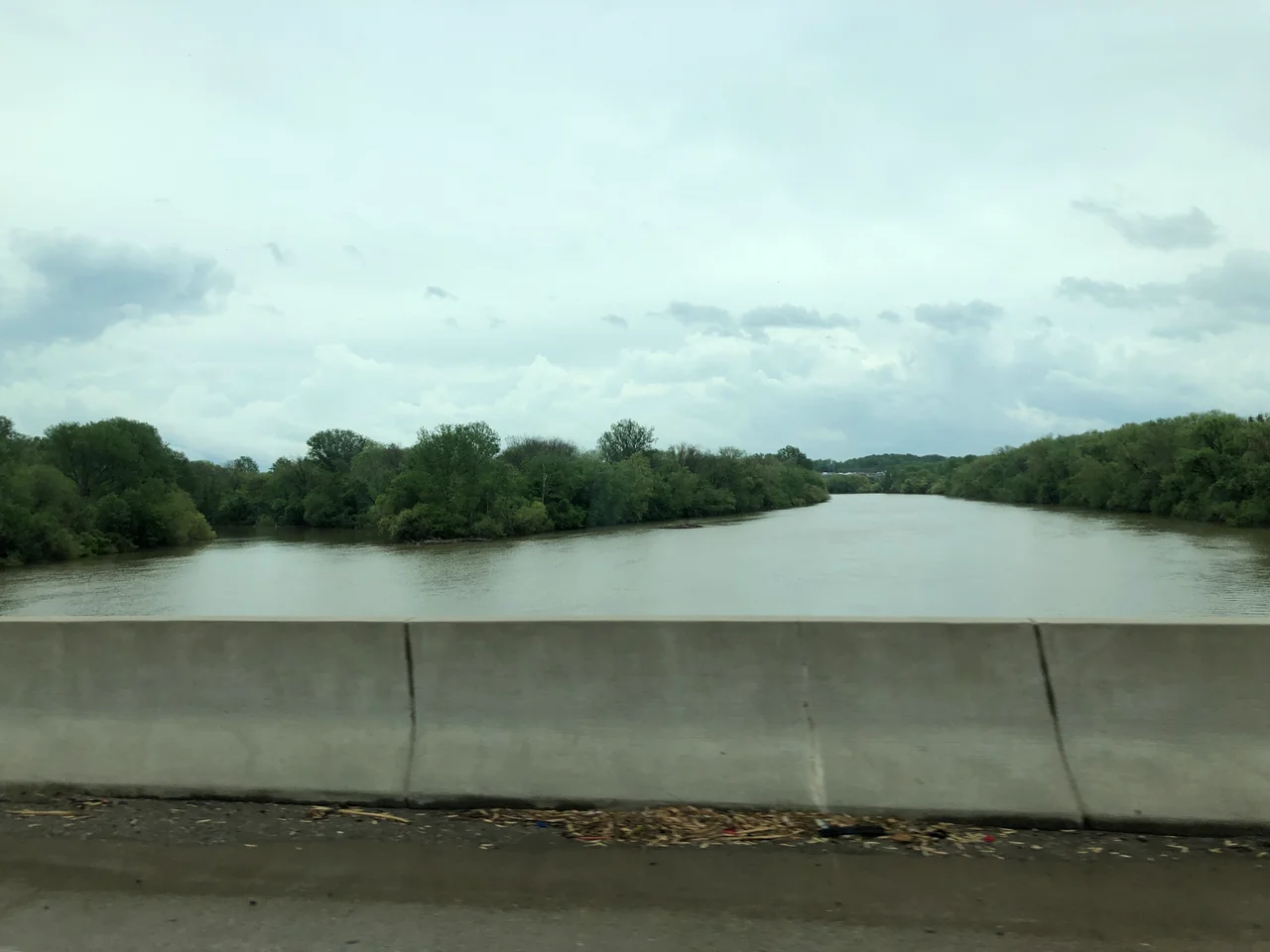

Yadkin River Veterans Memorial Bridge
After the September 11 attacks, federal and state planners began looking at infrastructure differently - not just as engineering problems but as targets. The I-85 bridges over the Yadkin River in central North Carolina made the list. The 1957 twin spans were carrying more than 70,000 vehicles a day along one of the most heavily trafficked corridors on the East Coast, narrow and aging, separated by less than a thousand feet. A successful attack on those bridges would sever a critical artery between Atlanta and the Northeast. The decision to replace them eventually produced something larger than a security upgrade: a $136 million design-build project that included new I-85 lanes, a new U.S. 29-70 bridge, two new railroad overpasses, an interchange redesign, and three miles of widened and relocated highway.
From Counterterrorism to Construction
The original budget hit $147 million, with right-of-way acquisition planned for 2003 through 2005 and construction starting by 2007 or 2008. Then concerns about damaging the Trading Ford Native American cultural site delayed bidding for two years. The state considered tolls and rejected them. Funding eventually came from a $10 million TIGER grant, $20 million from the state's Transportation Improvement Program, and GARVEE bonds paid back over twelve years. NCDOT awarded the contract to Flatiron-Lane in April 2010 for $136 million - $44 million less than the original estimate. The state and federal departments of transportation approved the design July 6, 2010. Officials held the groundbreaking ceremony on the Davidson County side on September 29, 2010. By October 9, twenty acres had been cleared.
A Bridge to Build a Bridge
Building a bridge over a river requires getting workers and equipment to the work site. Crews spent five months constructing a half-mile-long, 38-foot-wide temporary steel bridge for that purpose alone. The temporary bridge stayed in place from July 2011 until October 2012, and it had to support as many as six 230-ton cranes at once. The actual permanent bridge rose on its concrete foundations through the back half of 2011. The northbound span foundation was complete by December 2011. The northbound span opened to traffic at 1:15 a.m. on May 5, 2012. On August 2, 2012, southbound traffic shifted onto the same northbound span as crews demolished the old twin bridges. The southbound permanent span finished construction in October 2012 and opened to traffic on March 9, 2013.
Named for the Veterans
On May 11, 2011, while the bridge was still under construction, the North Carolina House passed legislation naming the new structure the Yadkin River Veterans Memorial Bridge. It was a deliberate choice in a region heavy with veteran families - the W.G. Bill Hefner VA Medical Center sits just a few miles south in Salisbury, and Rowan County has long had one of the highest concentrations of veterans in the state. The official dedication marking the bridge's completion and naming was held November 8, 2013, three days before Veterans Day. The 1957 bridges had carried no name, just route numbers. The replacement carries something more deliberate: an acknowledgment that the people driving across it every day include the families of men and women who served.
The Yadkin Corridor
The Yadkin Veterans Memorial Bridge is one of five bridges visible at the crossing, a remarkable concentration of infrastructure in a half-mile stretch of river. Two Warren deck-truss bridges carry the North Carolina Railroad and Norfolk Southern. One bridge carries U.S. 29, U.S. 70, and NC 150. The historic concrete arch Wil-Cox Bridge, built in 1924, runs alongside as a pedestrian crossing. The new Yadkin River Veterans Memorial Bridge towers above all of them. Together they span almost two centuries of American transportation engineering: a former trading ford, an 1818 toll bridge, an 1899 toll bridge, the 1906 and 1919 railroad bridges, the 1924 Wil-Cox, the 1957 I-85 twins, and finally the 2012-2013 replacement. The Yadkin keeps flowing south under all of them, on its way to the Atlantic via the Pee Dee River.
The Trading Ford Below
The Native American cultural site that delayed the project for two years deserves its own respect. The Trading Ford was a major Catawba and Saponi crossing point, used for centuries before colonial wagon roads adopted the same crossing. Archaeological work in the area has identified artifacts and habitation sites that predate European contact by hundreds of years. When the state and federal governments paused the bridge project to address those concerns, it was a small institutional acknowledgment that the river crossing carries a much longer history than the bridges themselves. Today the Trading Ford Historic Preservation Association works to protect those sites alongside the recreational greenway system that has grown up around the Wil-Cox Bridge. The Veterans Memorial Bridge passes above all of it, eight lanes wide, the latest chapter in a story that started long before anyone counted in mile markers.
From the Air
The Yadkin River Veterans Memorial Bridge sits at 35.72 N, 80.39 W carrying I-85 and US 52 across the Yadkin River between Rowan and Davidson counties. From the air, look for the broad eight-lane concrete spans paralleled by railroad bridges and the older Wil-Cox arches. Mid-Carolina Regional Airport (KRUQ) is about 5 miles west in Salisbury. Davidson County Airport (KEXX) lies to the east. Recommended viewing altitude 2,000 to 4,000 feet AGL.
Nearby Stories
- Greensboro, North Carolina 4.1 km away
- 2025 North Carolina Cessna Citation II Crash 7.2 km away
- R. J. Reynolds Memorial Auditorium 9.5 km away
- Battle of Cowan's Ford 12 km away
- North Wilkesboro Speedway 23 km away
- Concord, North Carolina 27 km away
- Tobacco Road 30 km away
- Carthage Nursing Home Shooting 40 km away