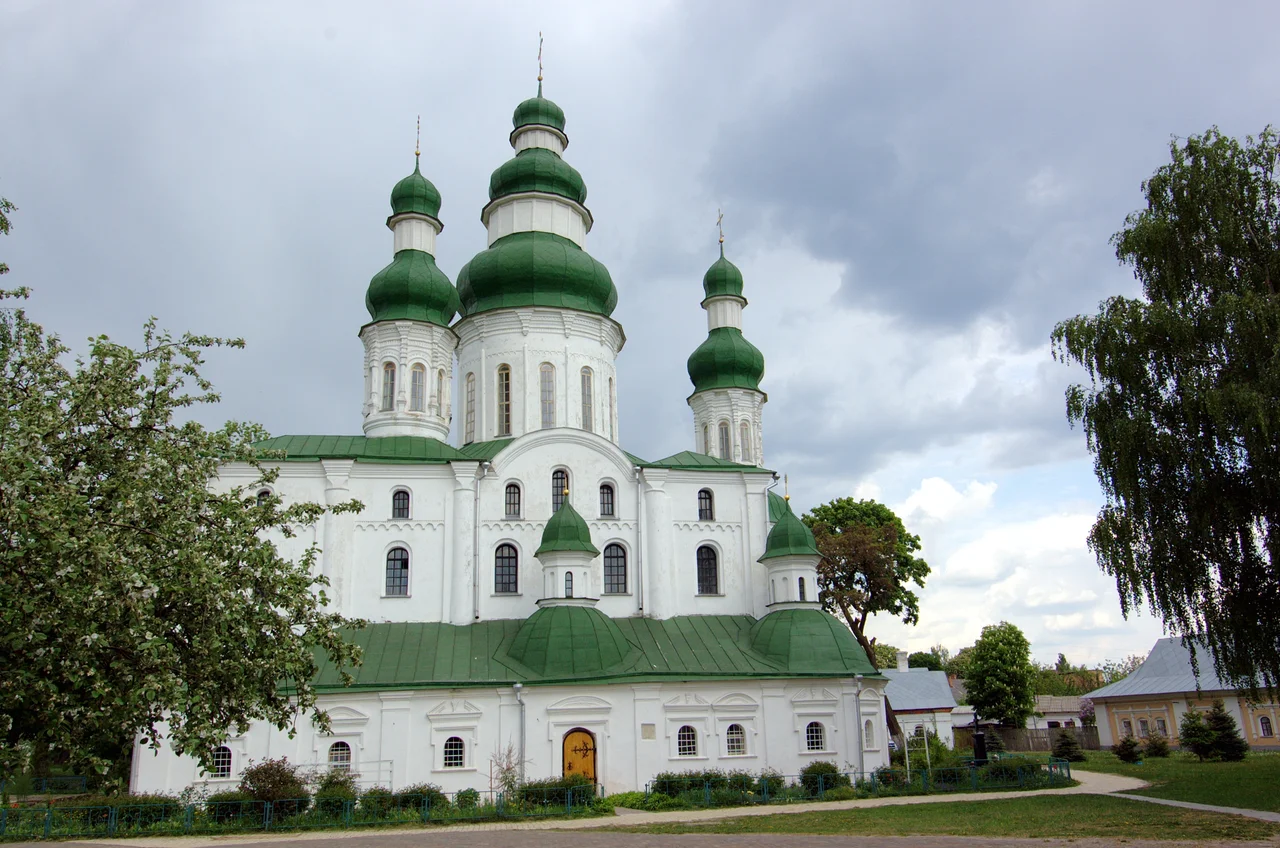

Yeletskyi Dormition Monastery
According to the legend told in Chernihiv for nearly a thousand years, a monk once glimpsed an icon of the Mother of God shining in the branches of a fir tree on the wooded slopes above the Desna. Where the fir stood, a monastery rose - and from the Slavic word for fir, yalyna, it took the name Yeletskyi. That was in 1060. In the ten centuries since, the monastery has been burned by Mongols, emptied by sieges, closed by Soviets, and struck by Russian shells, and it is still there on the high right bank of the river, one of the oldest religious houses in all of Ukraine.
The Icon in the Fir Tree
Prince Sviatoslav II of Kiev founded the monastery on the slopes of the Boldyni Hory, the hills that have held Chernihiv's dead and holy since pagan times. The founding story - the miraculous icon appearing in the tree - gave the place both its name and its purpose, and for two centuries it flourished as a centre of Rus' monastic life. Then, in 1239, the Mongol invasion destroyed it and plunged the whole region into nearly two hundred years of decline. Only under Prince Ivan Mozhaisky did revival come, when the Dormition Cathedral was renovated, new cells were built, and a great bell was hung between two pillars. The monastery had begun the pattern it would follow ever after: ruin, silence, and slow return.
A Book, a Bell Tower, and a Baroque Rebirth
The 17th century remade Yeletskyi. In 1611, when the Polish captured Chernihiv, the holy place stood empty again and part of the Dormition Cathedral's main dome collapsed, and the ancient Yeletskyi icon was lost. During a Polish period the monastery passed to the Eastern Catholic Churches, and in 1646 the first book ever printed in Chernihiv, The Pearl of Great Price, came off a press here. After the Khmelnytsky Uprising the Orthodox reclaimed it, and between 1669 and 1688, under Archimandrite Ioanikiy Galyatovsky, it was rebuilt in full Ukrainian Baroque. From those years survive the oldest brick residential building in Left-Bank Ukraine, the tomb church of the Lyzohub family, and the gate bell tower of 1670 to 1675 - at thirty-six metres, the oldest high-rise in Chernihiv.
The Saddest Page, and the Newest Wound
The 20th century opened what the monastery's own chroniclers call the saddest page in its history. In 1921 the Soviet authorities closed it, and the buildings that had sheltered monks for nine centuries were handed to state institutions; from 1944 to 1964 part of the complex housed the regional philharmonic. The revered Yeletskyi icon of the Mother of God, credited with miracles recorded through the 19th century, survived it all and passed to the city's historical museum in 1999. Then in the spring of 2022, Russia bombed Chernihiv, and the monastery was hit - its walls, its 17th-century gate and bell tower, and the ancient dome drums damaged in an afternoon. A thousand years on, Yeletskyi bears the fresh scars of the same story it has always told, and endures.
From the Air
The monastery stands at 51.4855 N, 31.2949 E on the elevated right bank of the Desna River in Chernihiv, west of Dytynets Park. From 2,500 to 4,000 feet, look for its tall white bell tower and cluster of domes on the wooded Boldyni Hory bluff above the river. Nearest airport is Chernihiv Shestovytsia (UKRR) to the southwest; Kyiv Boryspil (UKBB) lies about 130 km south.
Nearby Stories
- Principality of Chernigov 9.4 km away
- Battle of Listven 10 km away
- Kruty Heroes Memorial 14 km away
- Slavutych 17 km away
- Liubech 19 km away
- Oster 23 km away
- Nizhyn 31 km away
- Mezine 76 km away