.jpg)
Yersin Museum
He discovered the bacterium that causes bubonic plague in a makeshift hut in Hong Kong in 1894, then went back to Nha Trang and spent the next fifty years growing coffee and rubber, running a laboratory, and providing free medical care to the Vietnamese villagers who were, he said, his family. Alexandre Yersin is one of the stranger figures in the history of tropical medicine: a man who made a discovery that changed the world, then quietly went home to a coastal town in Indochina and stayed there until he died.
The Man in the Hut
Born in Switzerland in 1863 and trained in Paris and Berlin, Yersin worked under Émile Roux at the Pasteur Institute, where in 1888 he and Roux isolated the toxin secreted by the diphtheria bacillus — demonstrating that the toxin, not the bacterium itself, produces the disease's symptoms. By 1890 he had left Europe entirely, signing on as a ship's physician on steamship routes along the Indochina coast. When a plague epidemic struck Hong Kong in 1894, French colonial health authorities dispatched him to investigate. British authorities did not permit him access to the hospital where patients were being studied; he set up in a small hut and worked with minimal equipment. On 20 June 1894, he identified the bacillus responsible for bubonic plague. The organism now bears his name: Yersinia pestis.
A Laboratory by the Sea
Yersin's connection to Nha Trang predates the plague discovery. In the early 1890s, while sailing the coast, he had begun exploring the Vietnamese interior — mapping rivers, traversing the Lam Vien Plateau, and recommending a site in the highlands where he thought a town should be built. That recommendation eventually produced Dalat. He returned to Nha Trang and established a laboratory there; in 1903 it was designated the Pasteur Institute of Nha Trang. To fund the research, he turned to agriculture, cultivating maize, rice, and coffee on land he had cleared himself. He introduced the rubber tree to Indochina — Hevea brasiliensis, which would become one of the region's defining commercial crops. The laboratory studied plague, tetanus, cholera, and smallpox, producing serums for both humans and cattle.
What the Museum Holds
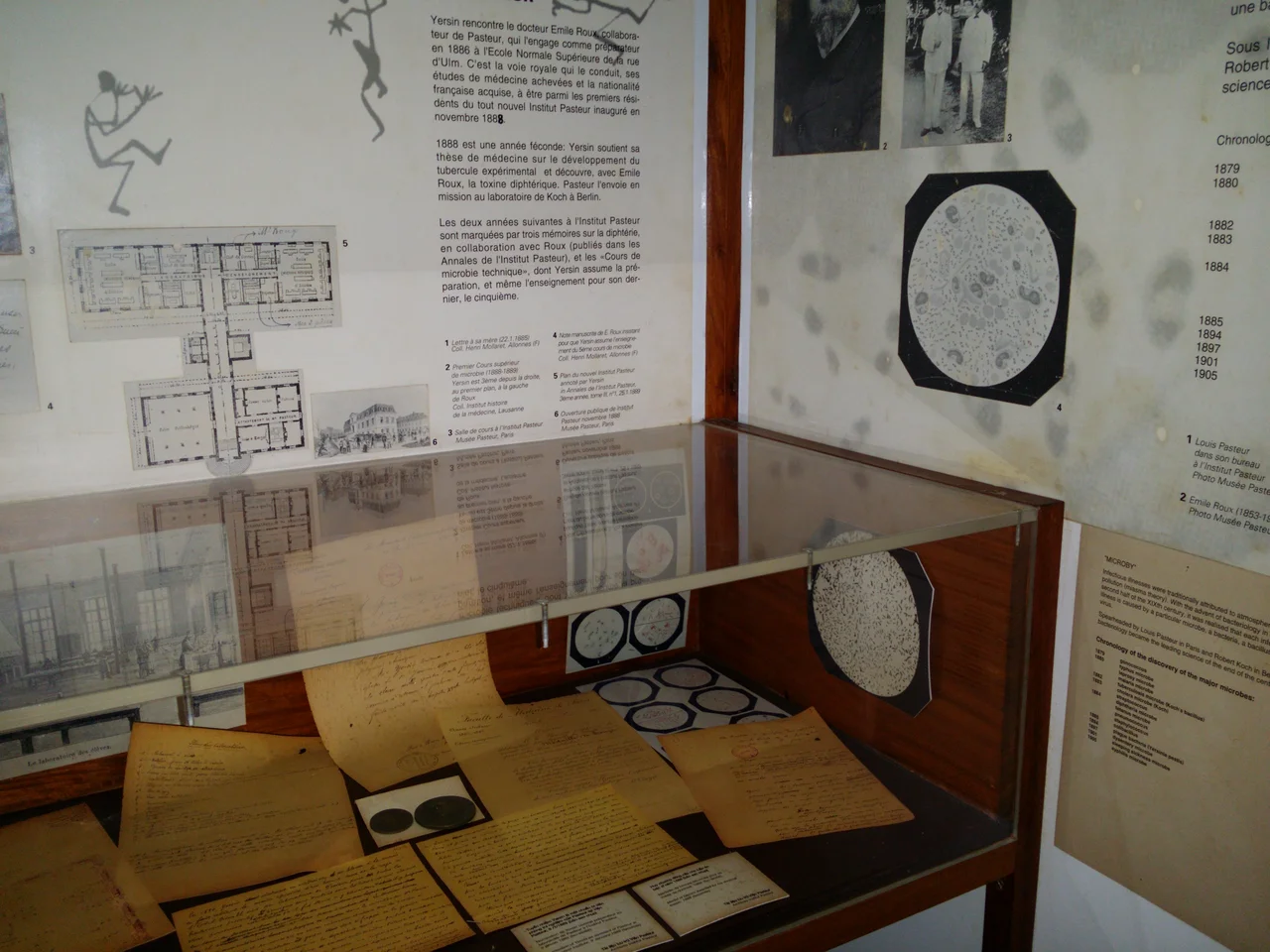
The Yersin Museum occupies a building at 8–10 Tran Phu Boulevard, within the compound of the Pasteur Institute he founded — the same grounds where Yersin lived and worked for decades until his death in Nha Trang on 1 March 1943. The museum contains a collection of his research equipment, his letters, and documentation of his scientific contributions. Captions are in French, with English and Vietnamese translations. The collection is modest in scale and significant in density: microscopes, notebooks, the instruments of late-nineteenth-century bacteriology. Each object was used by the man who identified Yersinia pestis, managed a farm, explored unmapped rivers, and gave free consultations to people who could not pay. The museum opens on weekday mornings and afternoons, and also Saturday mornings; it is closed on Sundays.
A Life Between Two Worlds
Yersin never married. When asked why he stayed in Vietnam, he described the Vietnamese villagers around him as his family. He learned the language, understood the landscape, and by all accounts preferred Nha Trang to Paris or Lausanne. His body is buried near the laboratory he built. French in his training and Swiss by birth, he became something harder to categorize in the decades he spent on the coast of Indochina — a figure who moved between worlds and chose, in the end, to remain in one of them. The museum on Tran Phu Boulevard is a quiet place on a busy street. Outside, the traffic of a beach resort city moves past continuously. Inside, the instruments and letters of a nineteenth-century bacteriologist wait in their cases, belonging to Nha Trang in a way that the plaques and captions cannot fully explain.
From the Air
The Yersin Museum is located at approximately 12.252°N, 109.196°E on Tran Phu Boulevard, the main seafront avenue of Nha Trang, Khánh Hòa Province. The Pasteur Institute compound is a short distance from the beach, within the city's main hotel and commercial strip. At 1,000 feet AGL the tree-lined boulevard is clearly visible running north-south along the seafront. Cam Ranh International Airport (VVCR) lies approximately 30 km south-southeast. Nha Trang Air Base (VVNT) is approximately 1 km to the south-southwest. The crescent bay of Nha Trang provides the primary visual reference from above — the museum sits near the northern end of the beachfront strip.
Nearby Stories
- Cam Ranh 5.1 km away
- Linh Phước Temple 15 km away
- Đà Lạt Plateau 25 km away
- Chư Yang Sin National Park 49 km away
- Vũng Rô Bay 52 km away
- South-East Asian Theatre of World War II 220 km away
- Kashmir Princess 361 km away
- Battle of the Paracel Islands 494 km away