
Yowah
You cannot tell which stones are worth a fortune just by looking at them. That is the whole game in Yowah. Scattered across the red dirt of this speck of a town in far southwestern Queensland are thousands of small, round ironstone nodules, plain as river pebbles. The locals call them nuts. Crack the right one open and a vein of precious opal flares out of the rusty stone, a sliver of blue and green fire that has been waiting in the dark for millions of years. Crack the wrong one, and you have a rock. Roughly one nut in ten thousand carries the colour. Generations of miners have spent their lives learning to read the difference.
The Nut That Made the Town
The Yowah nut is found almost nowhere else on Earth. It forms as a small concretion within the ironstone, an ellipsoidal lump usually an inch or three across, and the opal grows as a kernel sealed inside. The first claim here, the Southern Cross Mine, was registered in 1884, and a hard-scrabble field grew up around it. The work has stayed small and stubbornly hands-on ever since. There are no giant industrial pits here, just independent miners, family claims, and the patient art of knowing where to dig. You can buy the results straight from the people who pulled them out of the ground, in any state you like: rough nuts still wrapped in their ironstone, polished stones, or finished jewellery. You can also pay a small fee to have a nut of your own cut. Whether it holds anything is anyone's guess until the saw goes through.
A Town the Size of a Footnote
About 126 people live in Yowah, give or take whoever is in residence on their claim that season. There is no pub. There is no bottle shop. The nearest cold beer waits in Eulo down the road, or 135 kilometres north at Toompine, a settlement whose population is two: the publican and his wife. On a holiday weekend, a good slice of Yowah simply drives to Eulo for a drink and drives home. A single caravan park with six cabins handles visitors. Telstra reaches the town and no other network does, so there is still a public phone bolted to the landscape for everyone else. Once a year, on the third weekend of July, the whole calculus changes. The Yowah Opal Festival fills the local hall with museum-grade stones, and miners and collectors from around the world descend on this dot in the mulga to buy and trade the gems the place is famous for.
Getting In, and the Dummy Fireman
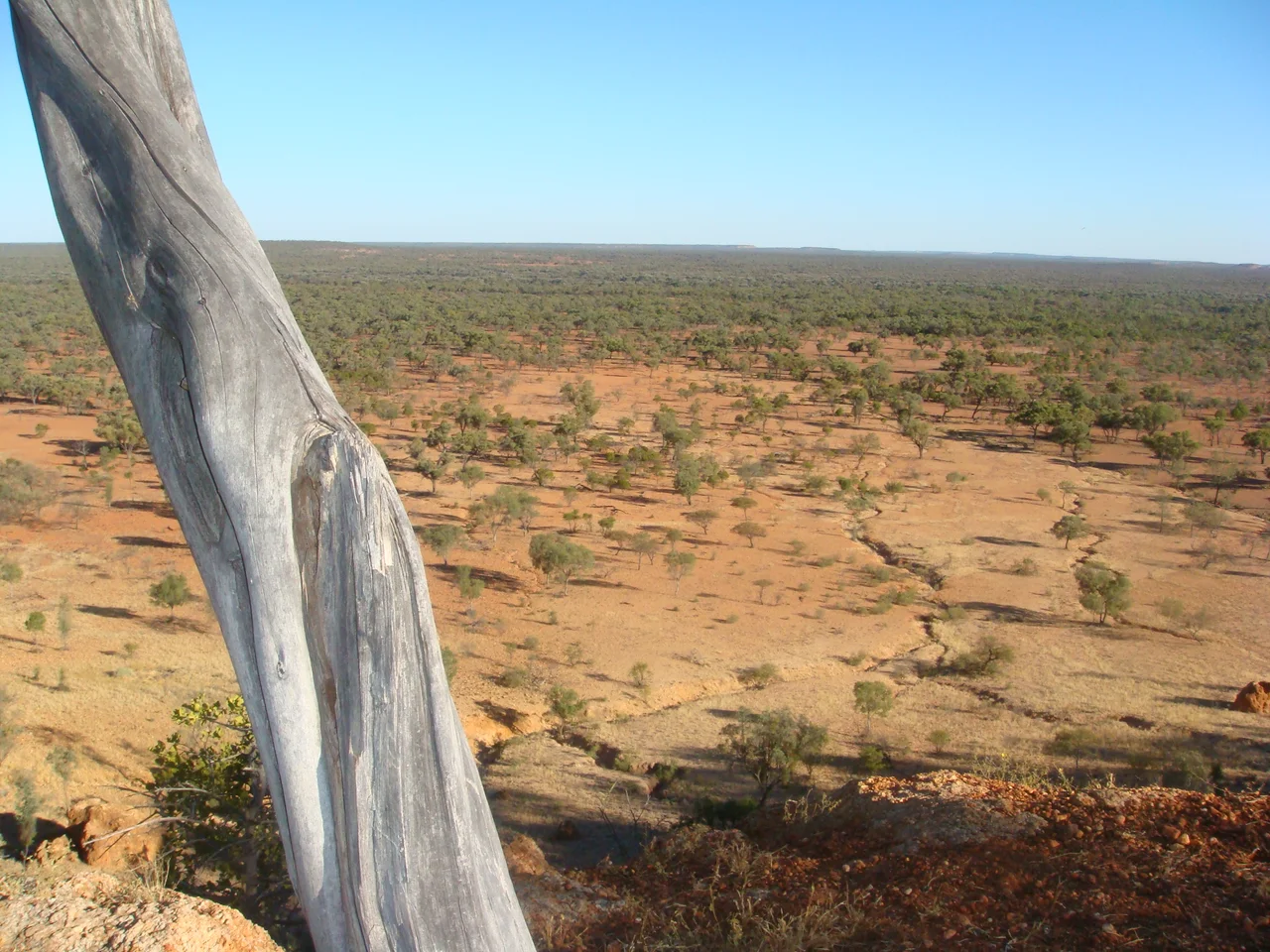
Yowah sits at the end of 60 kilometres of sealed road that branches off the Bulloo Developmental Road, signposted hopefully as the Adventure Way, just outside Eulo. There is also a 23-kilometre unsealed four-wheel-drive track that takes about as long but can shave time if you are bound for Thargomindah. Once you arrive you will want a car simply to move between the claims and the bluff at the edge of town, where a lookout gives a view that locals only half-jokingly call the end of the world: flat red country running clean to the horizon under an enormous sky. Directions out of Yowah include one of outback Australia's better landmarks. To leave by the Black Gate Road, you turn left off the main road just past town, next to the dummy fireman, a roadside figure that has become the kind of navigational waypoint only a tiny place could invent.
Why Anyone Stays
Opal towns are built on a particular kind of optimism. Every nut on the ground might be the one, and that maybe is enough to keep people out here in heat and isolation that would empty most places. Yowah has weathered the boom-and-bust rhythm of the gem trade for well over a century without ever quite growing up into a city, and that is precisely its charm. The reward is not just the stone. It is the silence at night so complete you can hear the dirt tick as it cools, the stars uninterrupted by a single competing light, and the strange intimacy of a town where everyone knows which claim is yours. The opal is the reason people came. The country is the reason a few of them never leave.
From the Air
Yowah lies at roughly 27.97 degrees south, 144.64 degrees east, on a flat stretch of mulga and red ironstone country in far southwestern Queensland. From the air the town reads as a small grid of roofs surrounded by the pale scars of opal diggings, with the low bluff at the edge of town the only relief in otherwise table-flat terrain. The nearest sealed strip is Cunnamulla Airport (YCMU) about 135 kilometres east-southeast; Charleville (YBCV) and Quilpie (YQLP) lie further north for fuel and services. Expect excellent visibility and few obstacles in dry weather, but watch for heat haze and thermals over the bare ground in the warmer months, and note that there is no tower, no services, and minimal traffic in this remote corner of the outback.
Nearby Stories
- Koroit opal field 26 km away
- Thargomindah 32 km away
- The Robbers Tree 48 km away
- Currawinya National Park 57 km away
- Quandamooka People 70 km away
- Zero Obelisk 90 km away
- Dr Ludwig Becker's Grave 100 km away
- Cheepie, Queensland 132 km away