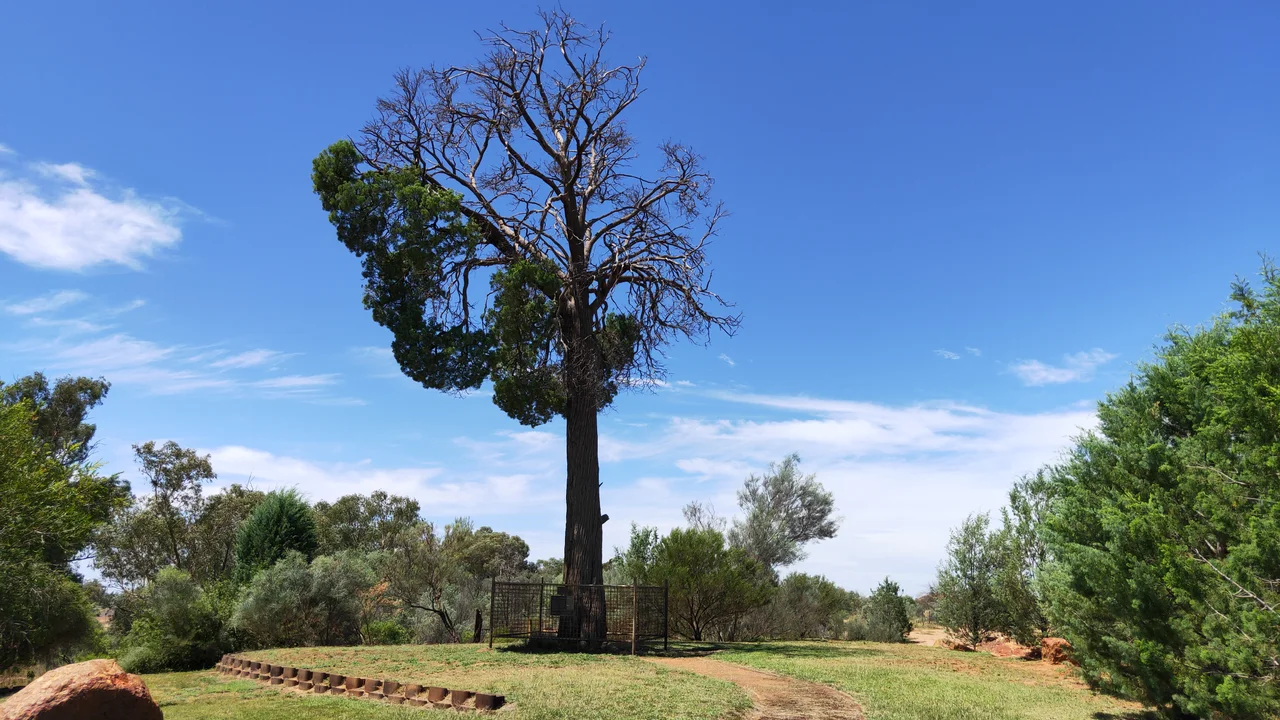

The Robbers Tree
It was a dog that gave him away. On 16 January 1880, Joseph Wells walked into the Queensland National Bank at Cunnamulla with a revolver, and within minutes his plan had unravelled into farce and tragedy: a wounded storekeeper, a bridle that snapped as he tried to mount his horse, and a frantic dash on foot into the scrub at the edge of town. Wells scrambled up a cypress pine and froze, hoping the bush would swallow him. But a sheepdog had trailed his scent and sat beneath the tree, barking, until the trackers arrived. More than a century later that tree still stands on a low sand ridge at the southern end of Stockyard Street - fenced, signposted, and known to everyone in Cunnamulla simply as the Robbers Tree.
A Robbery Gone Wrong
Wells was a station hand, not a hardened bushranger, and his hold-up went sideways almost at once. As he moved to leave the bank, William Murphy, a storekeeper from next door, tried to grab him; in the struggle Murphy was shot in the shoulder - by most accounts accidentally. The alarm went up. Wells bolted for his horse, only for the bridle to break in his hands, and he was left running through the streets with townspeople in pursuit. Two men carrying unloaded guns gave chase until Wells rounded on them, threatening to shoot if they came closer, and vanished into the bush. It was a clumsy, panicked crime - and it would cost a man his life and leave a wounded one behind.
The Tree on the Sand Ridge
The hiding place that betrayed him is a mature cypress pine, Callitris cupressiformis, an Australian native well suited to dry, sandy ground and found across the eastern and southern states. By 1979 the tree stood about fifteen metres tall on its low ridge near the corner of Bedford Street, on the outskirts of town. Today a simple fence of metal posts and wire rings the trunk, marking it out from the scrub around it. There is nothing grand about it - no plaque-worthy architecture, no sweeping view - just a working outback tree that happened to shelter a fugitive for a few desperate hours and so earned itself a name and a legend.
A Death That Changed the Law
Wells was tried at Toowoomba for armed robbery with wounding, found guilty, and sentenced to death. Despite public debate in the Queensland press about whether the penalty fit the crime - Murphy had survived, after all - the sentence stood. Wells was executed on 22 March 1880 and buried in Brisbane's Toowong Cemetery. His case did not end there. One of those troubled by it, Arthur Rutledge, later became Queensland's Attorney-General, and during his term he moved to strike armed robbery from the colony's list of capital offences. Wells is remembered as the last man hanged in Queensland for armed robbery with wounding - not the last execution in the colony, but the last for that particular crime, his death a turning point others would not have to share.
Why a Town Keeps a Tree
Heritage-listed on the Queensland Heritage Register on 21 October 1992, the Robbers Tree is valued less for botany than for memory. It survives because a community decided the story was worth keeping: a single afternoon in 1880 when a small Warrego River town caught its own would-be robber, and a quirk of local history hardened into legend. For travellers passing through Cunnamulla on the long road between Bourke and Charleville, the tree is a reason to stop - a chance to stand where a barking dog once decided a man's fate, and to consider how thin the line ran between a botched robbery and a change in the law.
From the Air
The Robbers Tree stands on the southern edge of Cunnamulla in southwest Queensland, at roughly 28.07°S, 145.68°E, on a low sand ridge near the end of Stockyard Street. From the air the tree itself is far too small to pick out, but the town is an easy target: a compact grid on the west bank of the Warrego River, surrounded by flat red mulga plains and threaded by the Mitchell Highway running north toward Charleville and south toward Bourke and the NSW border. Cunnamulla Airport (YCMU) lies just west of town, making it straightforward to overfly or land for a closer look on the ground. The Warrego River, often a chain of waterholes rather than a continuous flow, is the most reliable landmark. Conditions are usually clear and bright in the dry season; expect strong thermals and dust over the bare ground in the heat of the day, and watch for isolated, vigorous storm cells in summer - Cunnamulla has weathered some memorable ones.
Nearby Stories
- Eulo 20 km away
- Koroit opal field 41 km away
- Zero Obelisk 78 km away
- Currawinya National Park 88 km away
- Cheepie, Queensland 129 km away
- Carnarvon Gorge 361 km away
- Hornet Bank Massacre 403 km away
- Warialda 442 km away