
Zipaquirá
The cathedral is inside the mountain. Not beneath it, not beside it - inside it, carved directly out of the rock salt of an ancient seabed that the Andes folded up 180 meters overhead. You walk down a ramp, pass fourteen cross-shaped chambers cut along the way for the Stations of the Cross, and enter an underground nave where colored lights illuminate salt walls the pale blue of frozen seawater. Zipaquirá, on the high savanna north of Bogotá, is a working salt town that has been mining this deposit since before the Spanish arrived. The Salt Cathedral is not a tourist gimmick layered on top. It is the next chapter in a story the Muisca started telling here more than 2,000 years ago.
The Zipa and His Quira
The name is indigenous. In Chibcha - the language of the Muisca people who occupied the Altiplano Cundiboyacense before Spanish contact - Zipaquirá means the Land of the Zipa, or according to another reading, City of Our Father. The Zipa was the ruler of the southern Muisca confederation, centered at Bacatá (modern Bogotá). His wife held the title Quira, and the town name fuses them: Zipa-Quirá. Human presence here is far older than the Muisca. In the Abra Valley between Zipaquirá and Tocancipá, archaeologists found lithic tools and charcoal fragments carbon-dated to roughly 12,500 years - the oldest confirmed human settlement on the high plateau, and among the oldest in South America.
Salt That Built an Economy
The Muisca figured out how to boil brine into salt cakes long before Europeans arrived, and that salt became the foundation of their trade network. Canoes reached Chicaquicha - the pre-Hispanic name - from Nemocón, Gachancipá, and Tocancipá through a system of lakes and canals that once covered the Bogotá savanna. Muisca merchants traded salt across the Andean region: to the Panche and Pantágora in what is now Tolima, to the Muzo emerald miners in Boyacá. When Spanish chroniclers arrived in 1537 they described 'a few hundred dwellings with a population of 12,000 people' at Puebla Viejo - the old town - which sat about 200 meters above the present city. The salt trade survived the conquest and kept going, and by 1778 the Viceroy Manuel Antonio Flórez had forcibly relocated the remaining indigenous inhabitants to Nemocón to stop what he called 'constant rebellions' by the original owners of the mines.
A Martyr Square and a Writer's Schoolyard
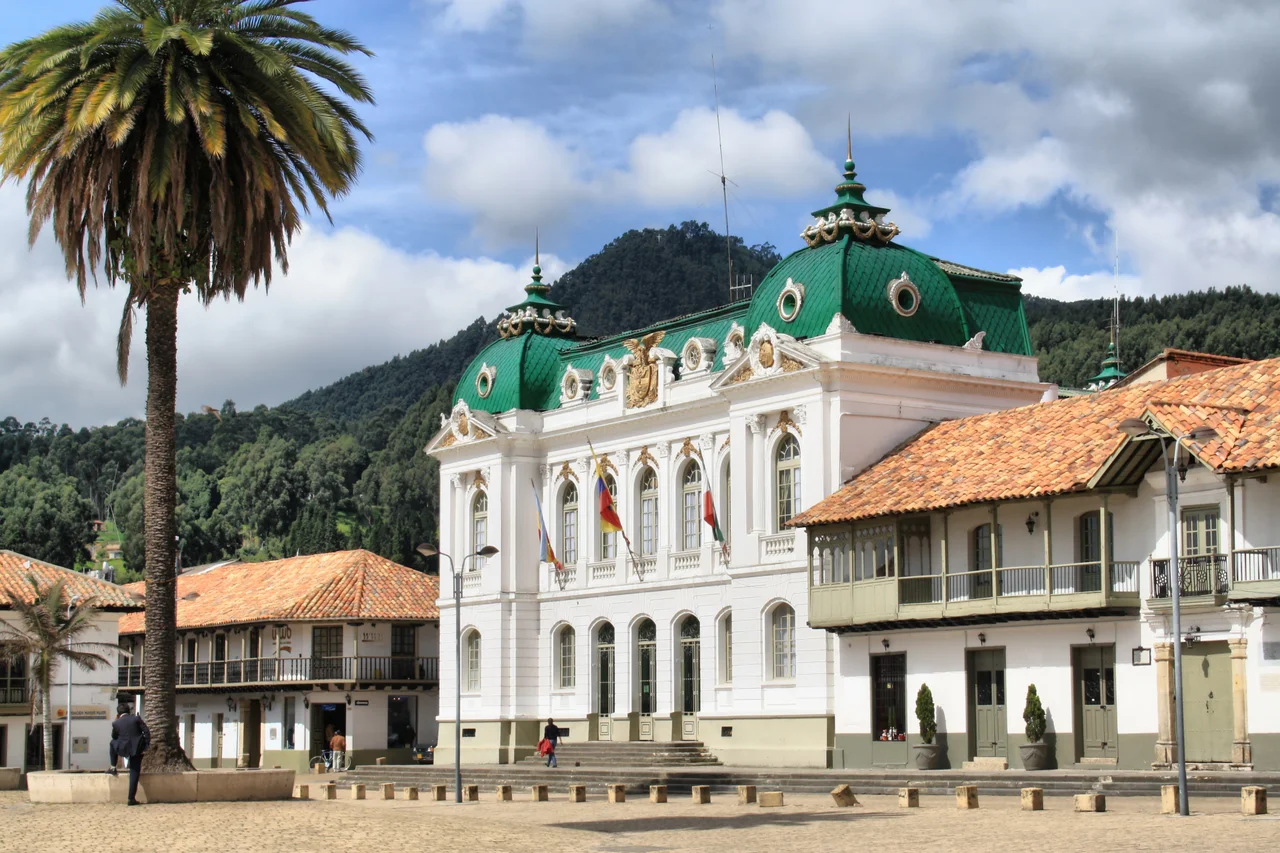
The colonial plaza, the Plaza de los Comuneros, is bordered by buildings that still carry 18th- and 19th-century facades. The cathedral on one side was built between 1760 and 1870 - a project that took more than a century and spans the entire colonial-to-republican transition. On August 3, 1816, Spanish troops executed the Zipaquirá Martyrs here during the reconquest after Colombia's first independence attempt. A century later a teenager named Gabriel García Márquez attended secondary school at the Liceo Nacional in this town. He later wrote that the cold, gray climate of Zipaquirá and the long afternoons walking its streets shaped the melancholy atmosphere that would run through his fiction. He won the Nobel Prize for Literature in 1982.
Descending Into the Mountain
The current Salt Cathedral opened in 1995, replacing an earlier version from 1954 that had become structurally unsafe. Visitors enter through a main tunnel and descend past fourteen niches, each a Station of the Cross carved from the living salt - some subtle, just a cross cut into the wall, others elaborate enough to hold their own full scenes. The main nave, 180 meters below the surface, includes a central cross 16 meters high, cut in relief from a single salt block and lit from behind so the stone glows faintly blue-white. Side chapels branch off. The salt itself is soft enough to scratch with a fingernail but strong enough to hold the cathedral's 75-meter span. Salt mining continues in adjacent galleries - this is a working mine that happens to contain a working church.
The Cycling Town
Colombia loves its cyclists, and Zipaquirá loves them especially. Egan Bernal, born in Bogotá but raised here, won the 2019 Tour de France - the first Colombian and the first Latin American ever to do so. His training routes ran through the surrounding hills of Cundinamarca, and the thin air at 2,650 meters gave him the kind of altitude advantage European racers have to train for. Before Bernal, Efraín Forero won the first Vuelta a Colombia in 1951. Brandon Rivera rides now for INEOS Grenadiers. The former president Gustavo Petro - once a member of the M-19 guerrilla movement, later mayor of Bogotá and president of Colombia from 2022 - also grew up here. Small towns produce outsized people. Zipaquirá seems to specialize in it.
From the Air
Coordinates 5.02°N, 74.00°W. Zipaquirá sits on the Altiplano Cundiboyacense at approximately 2,650 m elevation, 49 km north of Bogotá. El Dorado International (SKBO) at Bogotá is the primary airfield reference. From the air, the Sabana de Bogotá is unmistakable - a flat high plateau ringed by Andean ridges. The Bogotá-Chía-Cajicá-Zipaquirá highway forms a clear north-south corridor. The salt mine complex and associated infrastructure are visible on the western flank of the town. The whole region lies within the Eastern Cordillera of the Andes.
Nearby Stories
- La Calera, Cundinamarca 4.8 km away
- Magdalena Valley montane forests 29 km away
- Tunja 32 km away
- Hacienda Napoles 76 km away
- Battle of Vargas Swamp 92 km away
- Valle de Cocora 104 km away
- Manizales 109 km away
- Operation Jaque 315 km away