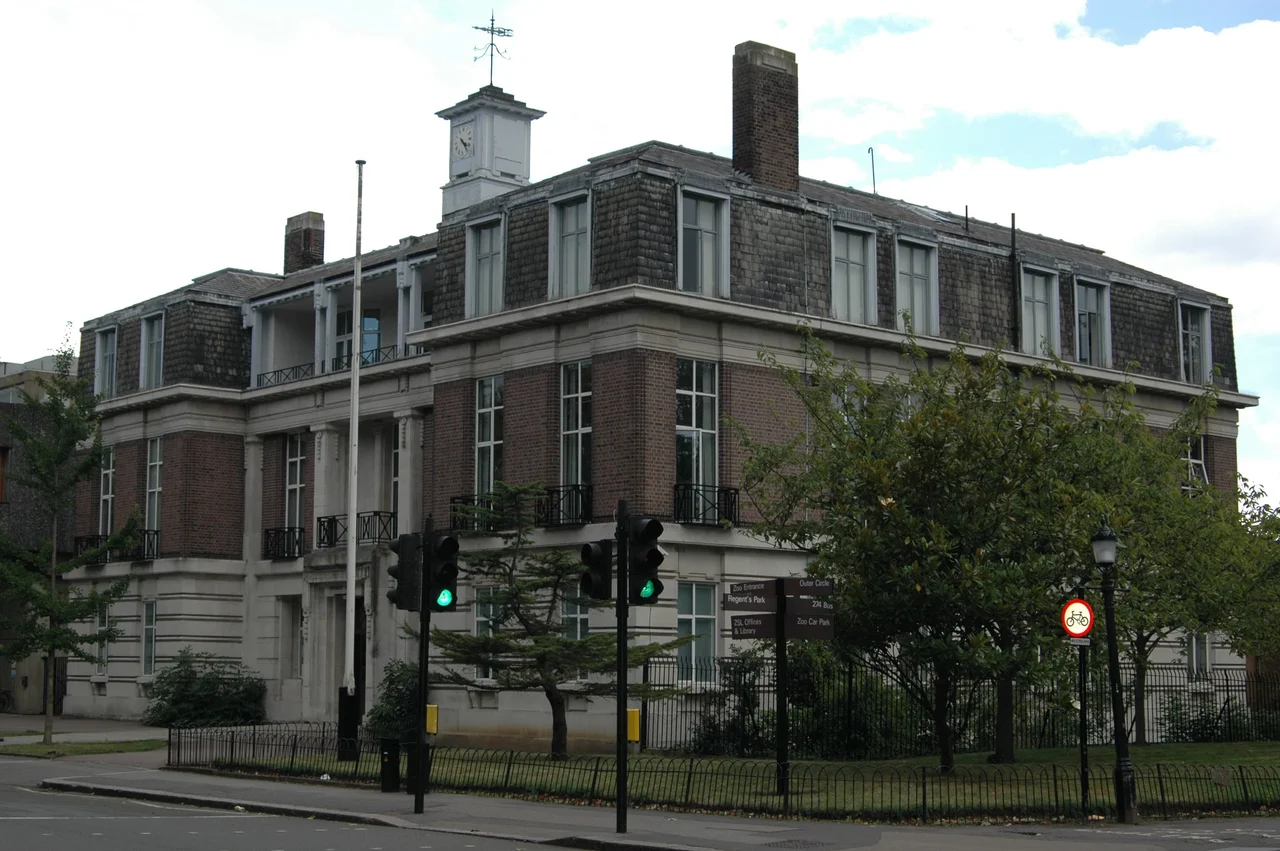

Zoological Society of London
On 29 November 1822 - the birthday of the seventeenth-century naturalist John Ray, often called the father of modern zoology - a meeting was held at the Linnean Society's rooms in Soho Square. The Reverend William Kirby chaired. The resolution was to form a Zoological Club of the Linnean Society of London. From that small meeting of natural-history enthusiasts emerged, four years later, the Zoological Society of London. Its founder was Sir Stamford Raffles - colonial administrator, founder of modern Singapore, naturalist - who served as the first president for only a few months before dying in July 1826. He had wanted London to have something like the Jardin des Plantes in Paris, where a zoological collection would interest and amuse the public. Two centuries on, the society runs London Zoo, Whipsnade Zoo, and an Institute of Zoology that publishes original scientific research, and remains a registered charity with about thirty thousand members.
Building the First Zoo
After Raffles' death, the third Marquess of Lansdowne took over as president and supervised the building of the first animal houses. A parcel of land in Regent's Park had already been obtained from the Crown at the inaugural meeting in 1826. The site was at the north end of the park, where the regular London street grid gave way to landscaped greenery designed by John Nash. The first animals arrived in 1828, including a llama, kangaroos, an Indian elephant, monkeys, eagles, and tortoises. The zoo received its royal charter from George IV on 27 March 1829. Initially admission was restricted to society fellows; the public was admitted later. The architecture of the zoo would become one of its hidden treasures - the 1934 Penguin Pool by Berthold Lubetkin (now restored but not used for penguins, as it was bad for their feet), the 1965 Snowdon Aviary by Anthony Armstrong-Jones and Cedric Price (which housed flightless birds for a while after the avian flu scare), the Grade I-listed Mappin Terraces designed in 1913 by John Belcher and John James Joass.
Whipsnade
By the early twentieth century, the society's secretary Peter Chalmers Mitchell could see that large animals needed more space than Regent's Park could give them. He looked for a site within seventy miles of London - close enough that members could visit, far enough that animals could roam. In 1926, taking advantage of the agricultural depression, he bought Hall Farm near Whipsnade village on the Chiltern Hills for 13,480 pounds and tenpence ha'penny. The farm was derelict and ran to almost six hundred acres. The first animals arrived in 1928 - two Amherst pheasants, a golden pheasant, and five red jungle fowl. Muntjac deer, llamas, wombats, and skunks followed. In 1931 Whipsnade opened to the public as the world's first open zoological park. Animals had grass paddocks instead of cages. Visitors took a small narrow-gauge train through the grounds. The whole place felt closer to a Victorian country estate than a city zoo. Whipsnade now covers 600 acres and houses giraffes, elephants, white rhinos, and one of Britain's most successful chimpanzee groups.
The Institute of Zoology
In 1960 and 1961, Lord Zuckerman - then secretary of ZSL - persuaded two medical foundations to fund a research division. The Institute of Zoology became one of the first scientific bodies in the world to focus specifically on the conservation of species and their habitats. Its research today covers five areas: the biology and recovery of small populations, coexistence between wildlife and people, global biodiversity monitoring, mitigating the impacts of climate change on biodiversity, and wildlife health. The institute publishes the Journal of Zoology (continuously since 1830, originally as the Proceedings of the Zoological Society of London) and Animal Conservation (since 1998). It has been affiliated successively to the University of London, the University of Cambridge, and since 2011 to University College London. The institute is one of the few zoo-affiliated research bodies that produces top-tier conservation science.
Sir David and the Honorary Fellows
The list of Honorary Fellows of ZSL reads like a roll-call of twentieth and twenty-first century naturalists and conservation patrons. Sir David Attenborough was elected in 1998. The Emperor Emeritus Akihito of Japan, who is a working ichthyologist (he has published research on the taxonomy of gobies), in 1991. HSH Prince Albert II of Monaco in 2020. Desmond Morris, whose The Naked Ape sold ten million copies, in 2012. The society's presidency has included HRH Prince Albert, the Prince Consort (1851 to 1862, succeeded by his son the future Edward VII as an executive member) and HRH Prince Philip, the Duke of Edinburgh, who served as president from 1960 to 1977 - the longest of any president. Prince Philip used his ZSL role as a launching pad for what would become his career in international conservation, founding the World Wildlife Fund (now WWF) in 1961 during his presidency.
What ZSL Does Now
In 2026, the society is in some ways back to first principles - using its zoos as gates into a much larger conservation programme. Field projects run on every continent. The EDGE of Existence programme identifies species that are both Evolutionarily Distinct and Globally Endangered, prioritising the protection of animals like the Cuban solenodon, the Yangtze finless porpoise, and the Andean cat. The Wildlife Comeback Report tracks European species recovering after centuries of pressure. The institute trains the next generation of conservation biologists at UCL. London Zoo and Whipsnade Zoo together attract about 1.4 million visitors a year, and the entrance fees fund the rest of the work. The Crown Estate Act lease, originally limited to sixty years, was extended to 150 years to give the society long-term security. Two hundred years after a small group met in Soho Square to discuss founding a zoological club, the descendant of that club runs one of the world's most productive conservation operations.
From the Air
The Zoological Society of London is headquartered at 51.54°N, 0.16°W in Regent's Park, north of central London. From the air, look for the round Snowdon Aviary's distinctive geometry at the north end of the park. London City Airport (EGLC) is about seven nautical miles east; Heathrow (EGLL) about twelve miles west. Best viewed at low altitude over central London.
Nearby Stories
- Stevenage 5.7 km away
- Malling Abbey 5.7 km away
- 1952 Farnborough Airshow Crash 7.7 km away
- Ingatestone Hall 8.2 km away
- Hellfire Caves 9.1 km away
- The Carrington Event: The Solar Storm That Could Happen Again 9.8 km away
- Bletchley Park 16 km away
- Castle Hedingham 23 km away