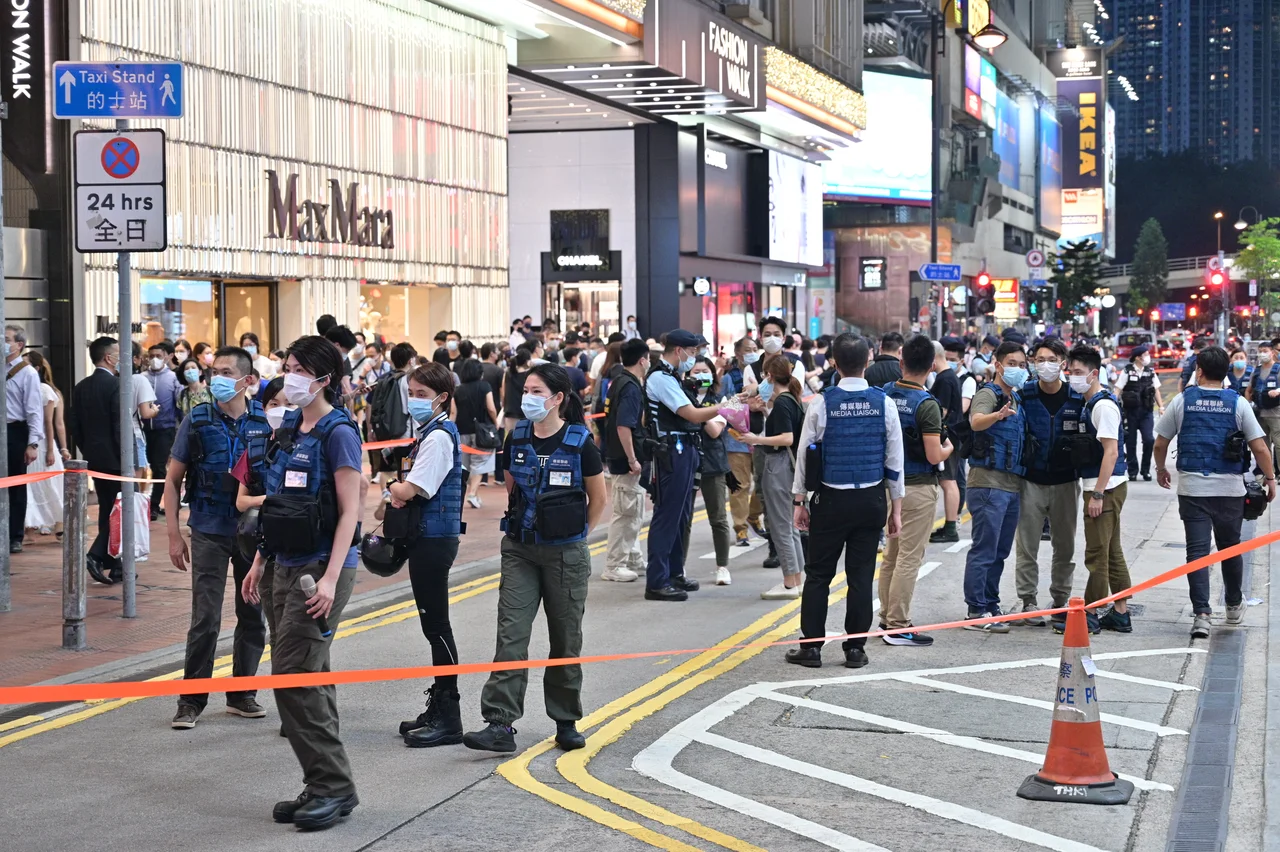

1 July Police Stabbing
The constable survived. He spent seven hours in surgery at Queen Mary Hospital, his scapula fractured and his lung pierced, while his family waited for news that his doctors could not yet give. Two days later, recovering in hospital, he learned that the man who had stabbed him was dead. 'I can't forgive him,' the officer said. 'This conveys a very wrong message to society — that one can conclude matters by ending one's own life after doing bad things.' He was right that the attack could not be neatly concluded. What happened outside the Sogo department store in Causeway Bay on the night of July 1, 2021, opened disputes about violence, grief, freedom, and responsibility that did not end with the attacker's death.
The Night of July 1
At approximately 10:05 p.m. on July 1, 2021 — the 24th anniversary of Hong Kong's return to Chinese sovereignty, a public holiday — Leung Kin-fai, 50 years old, approached a police officer near East Point Road in Causeway Bay and stabbed him. The officer fell. Three nearby colleagues drew their guns. Leung then turned a knife on himself and inflicted fatal wounds; he died at the scene. Police Commissioner Raymond Siu came to the scene personally. By 11:20 p.m., a woman had been stopped nearby carrying a utility knife and arrested; a man was taken away with his head covered. Police found a fruit knife and a sabre at the scene. They classified it as attempted murder and suicide. The government characterized it as terrorism.
What Leung Left Behind
Leung Kin-fai had no criminal record. He worked in the purchasing department of Vitasoy International and had briefly worked as an information officer at Apple Daily in 2008. He lived with his parents in San Po Kong. When police searched his belongings they found newspaper clippings, pamphlets from the 2019 protest movement, and a USB drive containing multiple suicide notes. The notes described his hatred of police, whom he accused of 'sheltering criminals' and committing 'atrocities' that the system could not check. He had chosen July 1 deliberately — the anniversary — and had settled his financial affairs in advance. Security Secretary Chris Tang said publicly that Leung had been 'radicalised,' citing material found on his computer, though he offered no further specifics. A psychology professor at a Hong Kong university, speaking to CNN, warned against simple explanations: Leung, he said, was one expression of a city that had never collectively processed what its people experienced in 2019.
Flowers as a Legal Question
In the days that followed, some Hong Kongers went to East Point Road with white chrysanthemums. The gesture — flowers at the site of a death — is ordinary across many cultures, and in Chinese tradition the seventh day after a death carries particular significance. Police responded to it as a security matter. Officers stopped and searched people carrying flowers. Littering tickets were issued to those who placed them. A secondary school student said he had been stopped four times in one day and asked 'Has someone died in your family?' before being let go, only to be stopped again. 'Grandma Wong' — Alexandra Wong, well-known from the 2019 protests — came to the site with flowers and was immediately surrounded by officers. Police warned that encouraging memorial activities was 'no different from supporting terrorism.' Four university student leaders who passed a union motion mourning Leung's death were arrested in August under the national security law and sentenced to two years each, later reduced on appeal to fifteen months.
A City Still Unresolved
The stabbing was one act by one man, but it arrived in a city where the ordinary channels for processing collective grief and political disagreement had, by mid-2021, largely closed. The annual July 1 marches that once drew hundreds of thousands had not taken place since 2020. Victoria Park, their traditional starting point, had been enclosed by police that day. Thousands of people had emigrated. The national security law had been in force for a year. In this context, the question of how to mourn — or whether mourning the attacker was itself a political act — became the argument. Chief Executive Carrie Lam cited the stabbing as a reason she would not hold town hall meetings. The reporter who filmed the attack live was visited at her home by police, had her residence searched, and had her travel documents confiscated. Paul Yip Siu-fai, director of the Centre for Suicide Research and Prevention at the University of Hong Kong, said the attack 'rang a warning bell' — not because it portended more violence, but because it revealed how inadequate the available responses had become for people in profound distress.
From the Air
Located at 22.28035°N, 114.18427°E in Causeway Bay, Hong Kong Island. The Sogo department store on Hennessy Road and the surrounding streets of East Point Road are in the heart of one of Hong Kong's densest commercial districts. Hong Kong International Airport (VHHH) is approximately 30 km to the west on Lantau Island. From the air at 3,000–5,000 feet on an approach to VHHH, Hong Kong Island's northern shore is clearly visible, with Causeway Bay's distinctive waterfront reclamation and the typhoon shelter recognizable landmarks. Victoria Park, enclosed by police on the night of the stabbing, is immediately adjacent to the district.
Nearby Stories
- Lok Ma Chau Loop 2.3 km away
- Portas do Cerco 2.3 km away
- Kweilin Incident 17 km away
- Wanshan Archipelago Campaign 34 km away
- Nanxiong Formation 115 km away
- Battle of Nanpeng Island 148 km away
- Heyuan 169 km away
- Cape Maobitou 632 km away