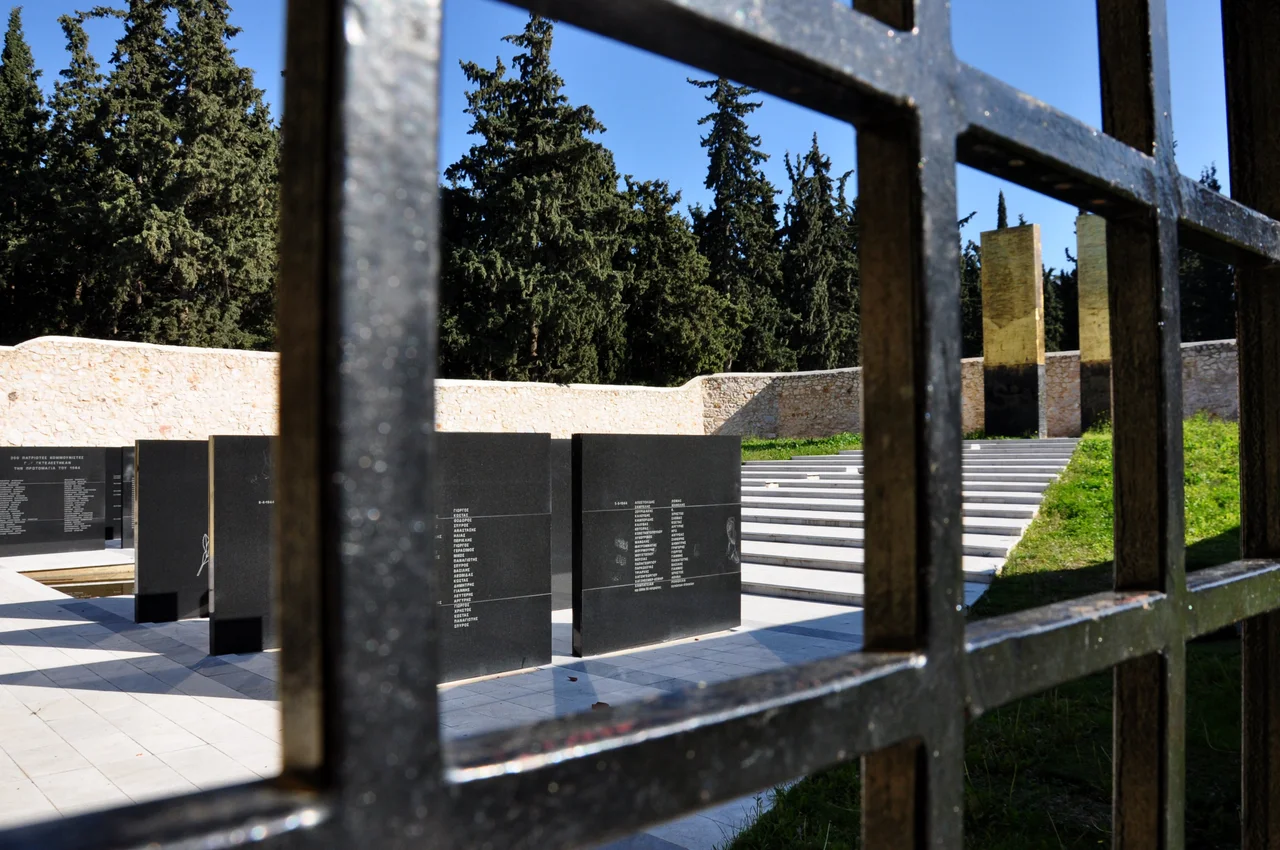

1 May 1944 Kaisariani Executions
On the morning of 1 May 1944, 200 men were loaded onto trucks at Haidari concentration camp on the outskirts of Athens and driven to the rifle range at Kaisariani. They had spent years in prison — first under the Metaxas dictatorship, then under German occupation — and most had already understood, from the farewell party held the night before in cell block 3, that they would not be returning. The German occupation authorities shot them in batches of 20, in reprisal for the killing of a German general four days earlier. The date — International Workers' Day — was not incidental.
The Years Before the Morning
The men who died at Kaisariani had long histories with imprisonment before they reached that rifle range. Greece under the Metaxas Regime, from 1936 onward, pursued communists with systematic ferocity — arresting members of the Communist Party of Greece (KKE) and sending them to the fortified prisons at Akronauplia and Corfu, or into internal exile on small islands. When the German army invaded Greece in April 1941 and the Axis occupation began, those prisoners passed from Greek to German control. Following the Italian surrender in September 1943, most of the men previously held in the Italian-run Larissa camp were transferred to Haidari, a concentration camp in the northwestern suburbs of Athens that the Germans had established as their main detention facility in Greece. By the spring of 1944, Haidari held hundreds of political prisoners — resistance members, communists, union organisers — who had survived years of captivity and now waited in the camp, uncertain of what came next.
Four Days in April
On 27 April 1944, ELAS partisans — fighters of the Greek People's Liberation Army, the resistance movement aligned with the KKE — ambushed and killed Major General Franz Krech and three other German officers at Molaoi in Laconia, in the southern Peloponnese. The German occupation authorities responded immediately with a public proclamation: 200 communists would be executed on 1 May. The proclamation also announced the execution of all men found outside their villages along the Sparti–Molaoi road. An additional claim in the German proclamation stated that, under the impact of the killings, 'Greek volunteers on their own initiative killed a further 100 communists' — a reference to the Greek Security Battalions, who collaborated with the occupation. The selection of 1 May — May Day, the international workers' holiday — as the execution date was a deliberate statement by the occupation authorities, aimed at the Greek left.
The Last Night at Haidari
On 30 April, news reached the Haidari prisoners that executions were coming. Camp commandant Fischer — SS Captain Karl Fischer — summoned the workshop foremen, all of them former Akronauplia inmates, ostensibly to ask who could replace them, since they would be 'transferred' the following day. The foremen understood what the transfer meant. That evening, the prisoners gathered in cell block 3. They said their goodbyes. What took place was, by the accounts that survived, something between a wake and a defiant farewell — men who had already endured years of imprisonment choosing to face what was coming with their comrades around them. On the morning of 1 May, Fischer held roll call and selected the 200: almost all the former Akronauplia inmates — approximately 170 men — along with former exiles from Anafi and several others imprisoned by the Germans directly.
The Rifle Range at Kaisariani
The executions took place at the firing range in Kaisariani, a district on the eastern outskirts of Athens, at the foot of Mount Hymettus. The 200 men were shot by firing squad, in groups of 20. Among them were men who had been imprisoned for nearly a decade — convicted of political beliefs that the Metaxas regime had criminalised and that the German occupation had made a capital offence. They were mostly young. Many were in their twenties and thirties. Their names are recorded in the memorials that now stand at the site: Kostas Paloukis, Stelios Sklavenitis, Grigoris Sapountzis, and nearly two hundred others. The memorial at Kaisariani became, in the decades after the war, one of the central sites of Greek commemorative culture for the resistance and the occupation. In June 1987, German President Richard von Weizsäcker chose it as the site for his act of commemoration during a visit to Greece — naming Kaisariani alongside Kalavryta, Distomo, Kommeno, Lyngiades, and Kandanos as places where the Wehrmacht had carried out massacres.
Memory and Reckoning
The 200 of Kaisariani — as they are known in Greek — have remained a live presence in the country's political memory. On 26 January 2015, Alexis Tsipras, newly elected as Prime Minister, made the Kaisariani memorial the first place he visited after being sworn in, laying roses at the site. The gesture was read as a statement about Greece's relationship with Germany at a moment of acute financial tension, but it was also a genuine act of historical acknowledgment: here, on 1 May 1944, 200 men were killed not for anything they had done, but for who they were and what they believed, on a date chosen to maximise the insult to those beliefs. In 2017, the Greek director Pantelis Voulgaris released the film To Teleftaio Simeioma — The Last Note — centred on the relationship between SS Captain Karl Fischer and Napoleon Soukatzidis, a Greek prisoner and interpreter at Haidari. The film brought the story to a new generation. The rifle range at Kaisariani is now a memorial site. It stands at the edge of Athens, at the foot of a mountain the ancient Greeks associated with honey and contemplation, and it holds the names of 200 men who spent their last night together in cell block 3.
From the Air
The Kaisariani rifle range memorial lies at approximately 37.97°N, 23.76°E, on the eastern edge of Athens at the base of Mount Hymettus. From the air at 5,000–8,000 ft, the transition from urban Athens to the rocky slopes of Hymettus is clearly visible; Kaisariani sits at that boundary. The district is approximately 5 km east of the Acropolis. Nearest major airport: LGAV (Athens International Airport, Eleftherios Venizelos), approximately 20 km to the east. The Saronic Gulf is visible to the south on clear days.
Nearby Stories
- Parnitha 3.4 km away
- Kea (island) 7.3 km away
- Sanctuary of Apollo Maleatas 11 km away
- Sousaki Volcano 12 km away
- Battle of Leuctra 14 km away
- Great Sand Beach 18 km away
- Agios Georgios (island) 23 km away
- Skyros 84 km away