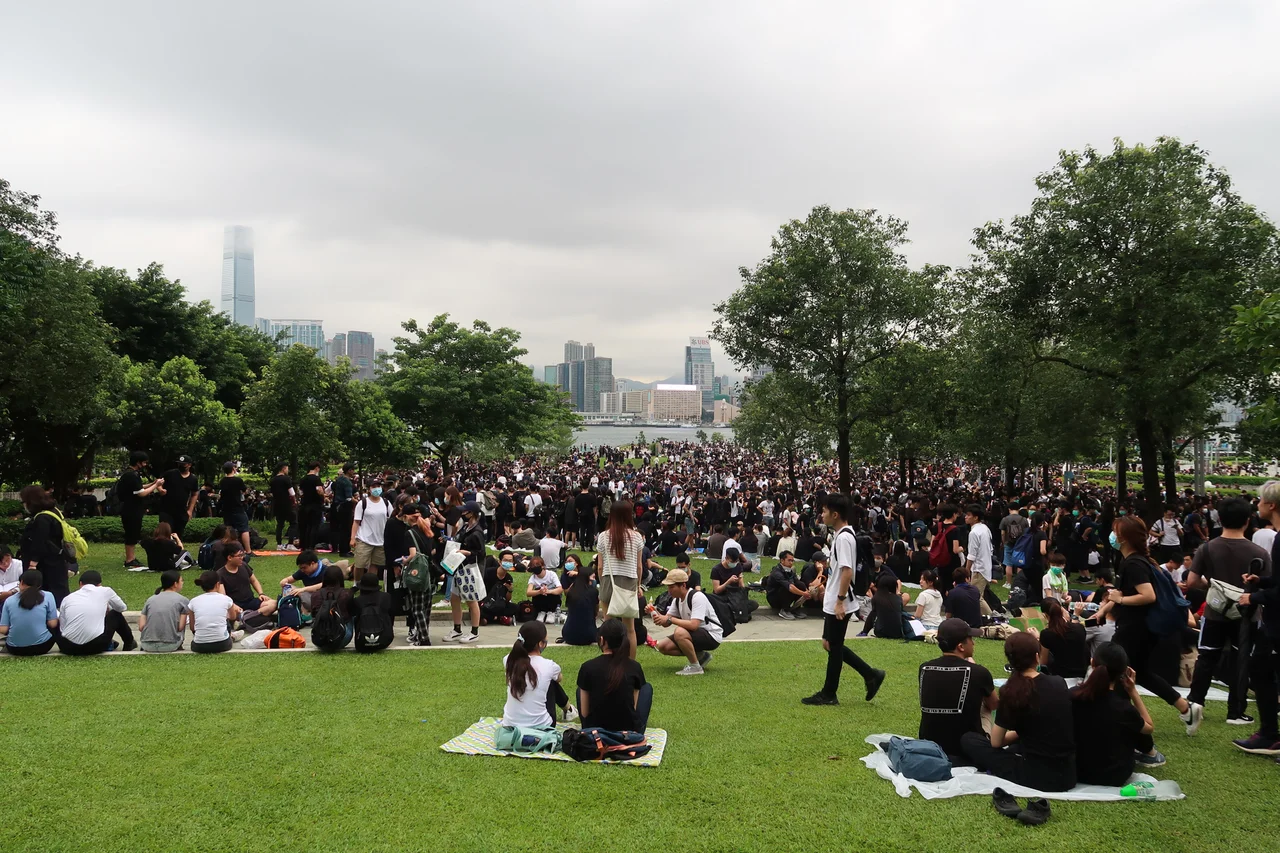

12 June 2019 Hong Kong Protest
Three days earlier, on June 9, an estimated one million people had marched through Hong Kong to demand the government withdraw a proposed extradition bill that would allow suspects to be transferred to mainland Chinese courts. Chief Executive Carrie Lam acknowledged the march, acknowledged the concerns — and announced that the bill's second reading in the Legislative Council would proceed on June 12 as scheduled. What happened on that day, outside the glass and concrete towers of Hong Kong's government district in Admiralty, became known afterward simply as '6.12': a confrontation that marked a turning point in what the city's summer would become.
The Picnic That Wasn't
The night before, a Facebook post had called on people to 'enjoy a picnic' at Tamar Park, the public green space facing the Legislative Council complex. Two thousand people came. Inside Admiralty station the following morning, police were already searching bags — mostly teenagers', according to witnesses. On June 12 itself, the Hong Kong Confederation of Trade Unions called a general strike. Hundreds of businesses closed. Crowds gathered not just at Tamar Park but across the surrounding streets, blocking routes to the LegCo building in an effort to prevent the second reading from proceeding. The bill's reading was ultimately postponed. The occupation of the streets around Admiralty lasted through the day.
Tear Gas and Contested Ground
Police fired around 150 rounds of tear gas, along with rubber bullets and bean bag rounds. Twenty-two police officers sustained injuries; 81 protesters were reported injured, with two sustaining severe injuries according to police. Thirty-two people were arrested that day, a number that would grow over the following years as courts processed cases from the 2019 movement. The police's characterization of the events shifted in the days after: the initial designation of the protest as a 'riot' was partially walked back by the police chief, who said only five people had actually been rioters. Human rights organizations, including Amnesty International, documented what they described as unlawful use of force. The dispute over what level of force was appropriate, and who bore responsibility for the escalation, was never formally resolved.
The Missing Numbers
Among the details that protesters noted that day was something that seems mundane: the officers of the Special Tactical Squad wore newly designed uniforms without identification numbers. In previous confrontations — the 2014 Occupy protests, the 2016 Mong Kok unrest, the clashes of June 9 — police uniforms had always displayed numbers. The Secretary for Security acknowledged that numbers had been removed, citing a lack of space on the new design. Critics pointed out that identification numbers are an operational requirement, and that their absence made it impossible to file complaints against specific officers. The issue became a sustained grievance, a small administrative change that concentrated, for many protesters, a larger question about whether the system was capable of holding itself accountable.
What June 12 Became
The second reading was postponed that day. Carrie Lam announced a suspension of the bill on June 15 and a formal withdrawal on September 4, 2019. But by then, the protests had long outgrown the bill itself. The five demands that crystallized over the summer — including an independent investigation into police conduct, amnesty for arrested protesters, and universal suffrage — reflected grievances that preceded June 12 and extended far beyond extradition. The date became a marker, a fixed point in memory. In the years that followed, commemorating June 12 became legally contested: as late as 2023, a man surnamed Leung was charged with rioting for his participation in that day's events. The protests themselves are history. The legal proceedings from them are not.
From the Air
Located at 22.2808°N, 114.1656°E in Admiralty, Hong Kong Island. The protest centered on the area around the Hong Kong Legislative Council complex, the Central Government Offices, and Tamar Park — a compact government precinct between the financial district and Wan Chai. Hong Kong International Airport (VHHH) is approximately 35 km to the west. On final approach to VHHH from the east, Hong Kong Island's northern shore passes below; the Admiralty district is identifiable by the cluster of government towers and the adjacent green of Tamar Park at the harbor edge. The surrounding hills of Hong Kong Island rise steeply to the south, compressing the urban density into the narrow coastal strip where the confrontations took place.
Nearby Stories
- Lok Ma Chau Loop 2.3 km away
- Portas do Cerco 2.3 km away
- Kweilin Incident 17 km away
- Wanshan Archipelago Campaign 34 km away
- Nanxiong Formation 115 km away
- Battle of Nanpeng Island 148 km away
- Heyuan 169 km away
- Cape Maobitou 632 km away