
1915 Picnic Train Attack and White Rocks Reserve
On New Year's Day in 1915, a train left Broken Hill carrying about 1,200 people toward a picnic at Silverton. There were no carriages to spare, so the Manchester Unity Order of Oddfellows borrowed forty-one open ore trucks from the Silverton Tramway Company and fitted them with rough plank seats. Men, women, and children rode out into the morning in the metal boxes that usually hauled ore, dressed for a holiday. About two miles out, beside a low embankment, two men were waiting with rifles and a flag. What happened next was over within minutes, but Broken Hill has spent more than a century trying to understand it.
The Four Who Died
They should be named, because for a long time the telling of this day reduced them to a number. Alma Cowie was seventeen, riding beside the young man she planned to marry; she was struck in the first volley and died within the hour. Alfred Millard was about thirty. William Shaw was forty-seven, on the train with his family. James Craig was sixty-nine, hit at his own home near the line as the shooting spread. Seven more people were wounded. They were not soldiers or symbols. They were a city's ordinary people, out for a summer holiday in a place where holidays were few, and they have been mourned in Broken Hill across generations. Families connected to them still remember the date, and still grieve.
Two Men and Their Grievances
The men who fired were Mulla Abdullah, around sixty, and Gool Badsha Mahomed, around forty. Both had worked as cameleers, part of the community that hauled the outback's freight before the railways. Abdullah served as a mullah at the local Ghan Town, leading prayers, officiating at funerals, and working as a halal butcher; in the weeks before, he had been prosecuted twice by a sanitary inspector over how he killed meat, a humiliation tied to his faith. Mahomed, an Afridi from the Tirah country near the North-West Frontier, had once fought in the Ottoman army, sold ice cream from a cart, and endured stones and abuse from local youths. When the Ottoman Empire entered the war and its Sultan proclaimed a holy war, the two men decided to act on what they called the Sultan's order. Mahomed left a note declaring he killed for his faith. Those were their stated reasons. They explain nothing away. The people on the train had done them no harm.
When Fear Turned on the Innocent
The attack ended at a place called White Rocks, where police and military cornered and killed both men. But the violence did not stop there, it changed targets. That evening a crowd gathered in Argent Street, convinced without evidence that Broken Hill's German community had somehow conspired in the attack. The mob marched on the German Club, stoned it, set it alight, and cut the fire brigade's hoses so it would burn to the ground. Then they turned toward Ghan Town, where the camel drivers and their families lived, meaning to do worse. Police and soldiers reached the camp first and held the crowd back. No one there had taken part in the attack. The two men had acted alone, yet across Australia the response fell hardest on people who shared only their language, their faith, or their origin. Germans and others labelled enemy aliens lost jobs, were expelled from the mines, and were interned for the duration of the war.
The Cameleers Who Built So Much
It is worth holding the wider story in view, because fear has a way of erasing it. From 1850 to 1900, more than 20,000 camels and the men who drove them came to Australia from Kashmir, Rajasthan, Punjab, Baluchistan, Afghanistan, present-day Pakistan, and beyond. Lumped together as Afghans, though few actually were, they carried wool, supplied nearly every inland mine and station, and hauled the materials for the Overland Telegraph that first connected the continent to the world. They built mosques in the outback, including the corrugated-iron mosque at Broken Hill that still stands. Some married locally, and their descendants live in Broken Hill today, active in preserving a heritage that the events of 1915 unfairly shadowed. The actions of two men were never the measure of that community, and the city's own historians have worked to keep the distinction clear.
What the Reserve Remembers
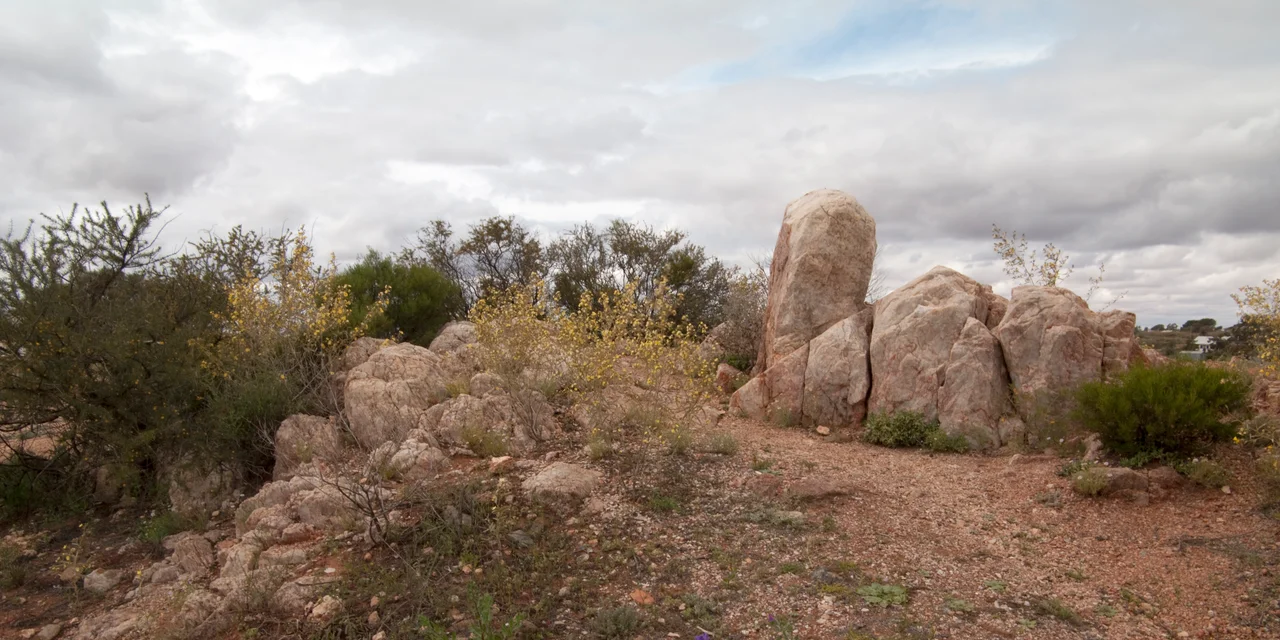
The White Rocks site, where the day finally ended, is now a fenced reserve on the edge of Broken Hill, listed on the New South Wales State Heritage Register since 2018. Interpretive panels lay out the events of 1 January 1915 alongside the local geology, and a replica ice-cream cart, built by local students in 1991, stands as a strange and sober artefact. The site is preserved not to glorify anything but to understand it. The heritage listing itself notes how this story has been retold over the years, sometimes carelessly, sometimes to stir fear of a whole religion. Broken Hill keeps the reserve as a place to remember the four who died, to reckon honestly with why it happened, and to resist the easy distortions that follow such days.
From the Air
The White Rocks Reserve and picnic train attack site sit at roughly 31.96 degrees south, 141.43 degrees east, on the northern outskirts of Broken Hill, New South Wales, along the old Silverton Tramway alignment running northwest toward Silverton. The terrain is flat arid plain near 300 metres elevation; from the air the disused tramway corridor and the city's distinctive Line of Lode ridge to the south are the key landmarks. Broken Hill Airport (ICAO YBHI, elevation 959 ft) lies about 8 kilometres southeast and is the nearest aerodrome. Desert visibility is usually very good but subject to sudden dust storms. Recommended viewing altitude 2,000 to 3,500 ft AGL to take in the reserve, the tramway line, and the historic township together.
Nearby Stories
- Mount Gipps Station 5.4 km away
- Radium Hill 33 km away
- Honeymoon Uranium Mine 35 km away
- Menindee, New South Wales 44 km away
- Mutawintji National Park 64 km away
- Kinchega Woolshed 70 km away
- Kinchega National Park 86 km away
- Mount Chambers Gorge 178 km away