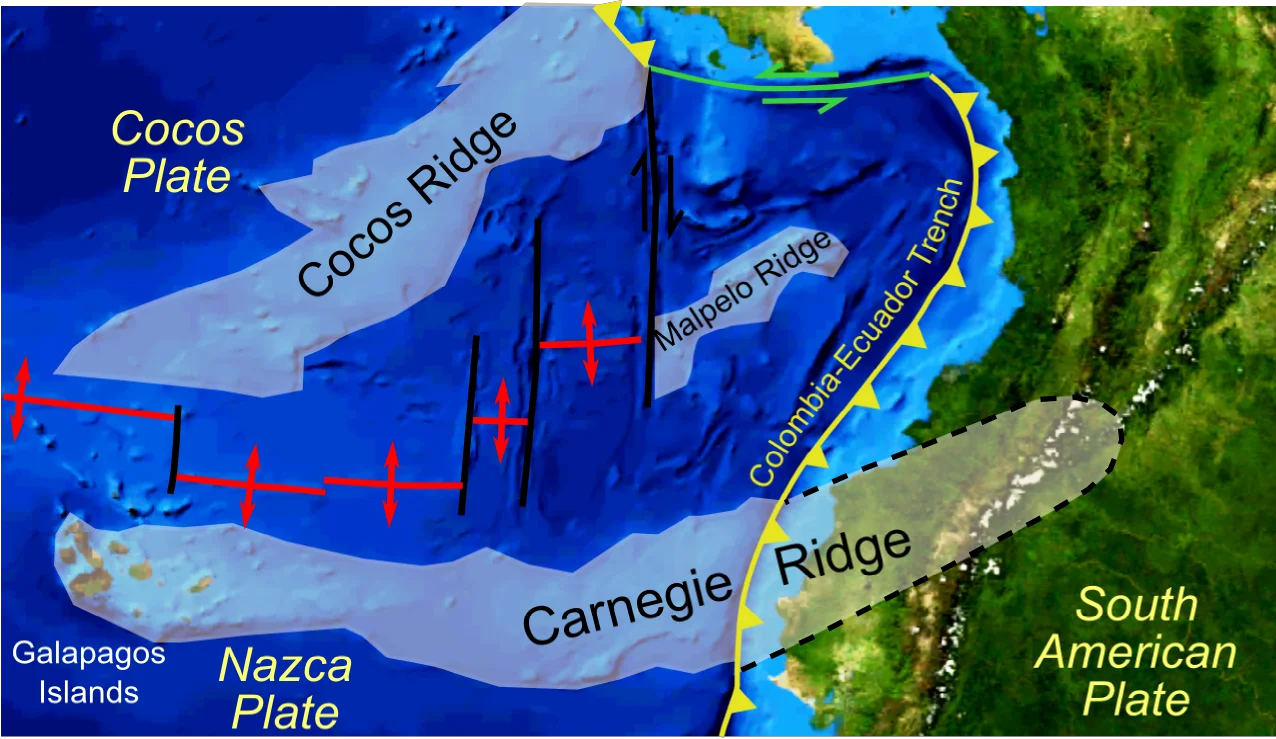

1942 Ecuador earthquake
Ecuador's largest city in 1942 was Guayaquil: a port on the Pacific estuary, built mostly on soft alluvial soil, growing fast, proud of a skyline of new reinforced-concrete buildings that the previous generation had never imagined possible. On the night of May 13, at 21:13 local time, a magnitude 7.8 earthquake ruptured the Nazca-South American plate boundary off Manabí Province, about 200 kilometres away. In Guayaquil, the soft soil did what soft soil does during strong shaking. It amplified. Buildings that the city had just learned to trust began to fall.
A Partial Return of 1906
Seismologists looking at 1942 in retrospect recognized something striking: the 1942 rupture was on almost exactly the same patch of plate boundary that had moved in the much larger 1906 earthquake. Where 1906 had broken 500 to 600 kilometres of fault in one enormous slip, 1942 broke only a portion of it - perhaps 100 to 150 kilometres - and released far less energy. This was the first clear example of a pattern that would repeat. The 1906 source zone was not a single unified segment. It was a chain of smaller patches, and after a very large earthquake reset the whole thing, those patches would start re-rupturing on their own individual clocks. The 1942 quake was the first of those re-ruptures. The 1958, 1979, and 2016 quakes were the rest.
What Loose Soil Does
The epicenter was off Pedernales in Manabí Province. The shaking near the coast was severe but the population thin. It was the soft sediments under Guayaquil - far inland from the epicenter - that produced the most dramatic damage. Most of the city experienced intensity VI to VII on the Mercalli scale: strong to very strong. But in the central, southern, and western districts, where buildings sat on loose alluvium, the intensity jumped to VIII. In a few pockets downtown it reached IX - violent. Reinforced-concrete structures of four and five stories, relatively new at the time and built to be fireproof and modern, performed far worse than expected. Three such buildings collapsed completely. Others tilted, cracked, or lost their first-floor columns. Three more had beams so badly damaged on their first floor that emergency shoring had to be installed before engineers could decide whether to repair or demolish them.
A Clinic at Pichincha and Colón
The single worst loss of life in Guayaquil occurred on the corner of Pichincha and Colón streets, where a five-story clinic collapsed. Forty people - patients, visitors, staff - were killed in that one building. In total, more than 100 of the city's fatalities were attributed to collapsed structures in the center. Across the country, the official death toll climbed past 300. Tram service stopped as cables fell. Electricity went out across much of the city, some of it deliberately cut to prevent fires in broken gas lines. Water mains leaked. Two strong aftershocks rattled the coast within hours, and during the night, thousands of people slept in public parks or in their cars, unwilling to go back inside buildings whose walls were cracked and whose trustworthiness was now in open question.
The Days After
Within a week, most of the city's water pipes were repaired. Electrical and telephone service returned in stages. The clinic at Pichincha and Colón became a site of mourning, and the collapsed buildings in the center became, quietly, case studies. Guayaquil's civil engineering community began to look more carefully at how the city's subsoil behaved during an earthquake. It took decades for modern seismic codes to reshape Ecuadorian construction, but the 1942 quake is one of the events that started the conversation. A small number of the original buildings damaged in 1942 still stand today - patched, strengthened, and in a few cases converted into offices or apartments - the masonry scars visible if you know what to look for.
A 74-Year Clock
Modern analysis has found something remarkable about the 1942 rupture. When the plate boundary broke again in April 2016 near Pedernales, the epicenter was only 42 kilometres from the 1942 one, and the magnitude was essentially identical: 7.8. The two quakes ruptured very nearly the same patch of fault, with similar slip distributions and similar tsunamigenic behavior. The interval between them was 74 years. Seismologists now treat this as a characteristic earthquake cycle for the Pedernales segment: stress accumulates for roughly three generations, then releases in a 7.8. By that arithmetic, the next event in the sequence is likely to arrive around 2090. The people of Manabí today grew up knowing that. The people of 1942 mostly did not.
From the Air
The 1942 epicenter lies offshore at approximately 0.03°N, 79.95°W, west of Pedernales, Ecuador. The most heavily damaged city, Guayaquil, is at roughly 2.17°S, 79.92°W - about 250 km south of the epicenter. The nearest major airports are José Joaquín de Olmedo International (SEGU / GYE) in Guayaquil and Manta's Eloy Alfaro International (SEMT / MEC). The Pacific coastal plain rises quickly to the Andes; the transition from Manabí lowlands to the western cordillera is very clear at cruising altitude. The same subduction zone continues to generate significant earthquakes, and the 1942 source patch is thought to have re-ruptured in 2016.
Nearby Stories
- 2016 Ecuador earthquake 5 km away
- Canoa 61 km away
- San Miguel (Ecuador) 74 km away
- Mindo 74 km away
- Valencia, Ecuador 87 km away
- Eloy Alfaro International Airport 88 km away
- Manta 118 km away
- Malpelo Plate 330 km away