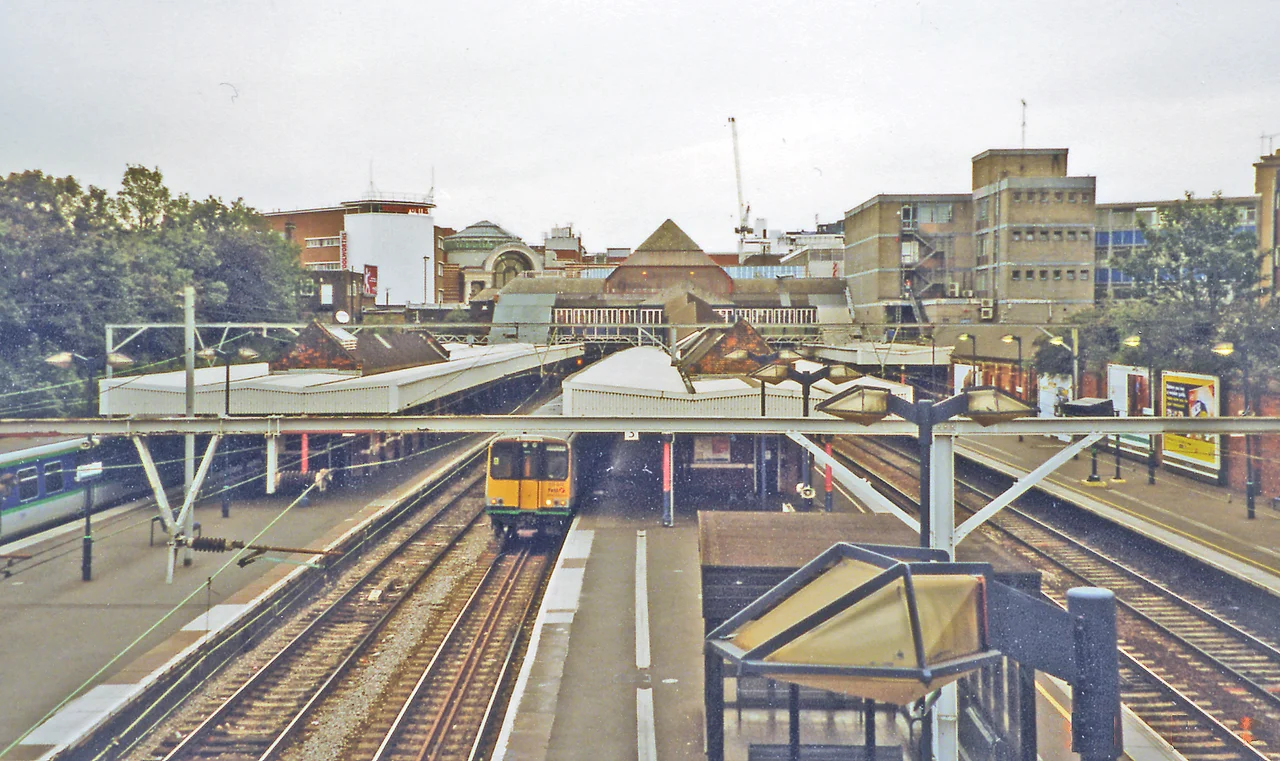

1944 Ilford Rail Crash
It was 19:20 on a Sunday evening in January 1944, in the middle of the war, in fog so dense the driver of the 14:38 from Great Yarmouth had failed to see the previous caution signals. He stopped 110 yards past a red signal he never spotted, climbed down from his cab, and walked along the trackside to the signal box at Ilford station to find out what had happened. The signalman gave him line clear after a short wait. The driver started back to his train. Then the telephone in the signal box rang: the 14:40 express from Norwich had also missed its signals and was coming through the fog at speed.
A Train You Could Not See
Wartime blackout regulations meant station lights, train lights, and platform lighting were all dimmed or shielded to deny aerial bombers any reference points. On a clear evening that was inconvenience. In dense fog on 16 January 1944 it became deadly. The Yarmouth express's driver simply could not see the colour-light signals approaching Ilford until he was almost on top of the last one, and even then it was too late to stop. His train passed the danger signal, came to a halt 110 yards beyond it, and sat there blacked out on the through line into Liverpool Street, with a station inspector and a signalman trying to work out what had gone wrong. The thing they did not yet know was that a second express was already running into the same conditions a few miles behind.
The Phone Call That Came Too Late
The Ilford station inspector, hearing of the urgent telephone call from the adjacent signal box, was sent out to place detonators on the line behind the stationary Yarmouth train. Detonators are small explosive charges clipped to the rails: a following train's wheels crush them, the bang warns the driver, and he stops. They are the last resort when a signal has been passed at danger. The inspector did not get there in time. The 14:40 from Norwich Thorpe, hauled by LNER B17 locomotive No. 2868 Bradford City, ran into the rear of the Yarmouth train at somewhere around 20 to 30 miles an hour. Both trains were busy with passengers. The Yarmouth set was nine coaches and a two-coach articulated set; the Norwich set was ten coaches and a two-coach articulated set. Two of London's busiest wartime services telescoped into each other in the dark.
Nine Lives
Nine people died in the collision. Three of them were United States Army personnel, soldiers far from home travelling on a Sunday evening through an English fog. Among the British dead was Frank Heilgers, the Member of Parliament for Bury St Edmunds, who would have been on his way back to London for the parliamentary week. Twenty-eight more people were taken to hospital. Ten others suffered shock or minor injuries. The numbers are small compared to the casualty lists the war was producing elsewhere that month, but each of those nine was a person with people waiting for them at the other end of the journey. The MP, the American soldiers, the passengers who had boarded at Yarmouth or somewhere along the line: all of them had simply got on a train.
An American Doctor on the Train
First aid was available within seconds because an American doctor and a nurse happened to be travelling on one of the trains, and a member of railway staff in the wreckage had ambulance training. They worked the injured before the official rescue arrived. Ilford civil defence personnel reached the site at 19:36, sixteen minutes after the crash. Ambulances and the civil rescue squad arrived around 19:50. A nearby US Army depot sent a medical detachment. The recovery work was hampered by the lack of light - blackout regulations applied to the rescue too - and by the same fog that had caused the collision. The last of the casualties were not recovered until 21:20, two hours after impact, in conditions where rescuers were essentially working by touch.
What the Railway Lost and Did Not
The collision blocked both through lines into Liverpool Street until 14:30 the following afternoon, nineteen hours after the crash. Two local lines on the same route were untouched, and a crossover allowed traffic to weave around the wreckage, so the impact on overall rail service was unusually small for a disaster of this size. Wartime fog claimed other British rail accidents through the same period - the blackout, the deferred maintenance, the stretched workforce all combined into a system where a single missed signal could escalate. By 1944 the LNER and its sister railways were running services that civilian peacetime safety standards would have grounded, because the war effort needed those trains running. Nine people paid the price one Sunday evening at Ilford.
From the Air
The site of the 1944 Ilford rail crash is at 51.56 degrees N, 0.07 degrees E at Ilford railway station, on the Great Eastern main line into London Liverpool Street, in the London Borough of Redbridge. London City Airport (EGLC) lies about 6 km south. Stansted (EGSS) is roughly 30 km north. The line is one of the busiest commuter routes in Britain and remains a working memorial to a wartime night that has otherwise faded from the public memory.
Nearby Stories
- Waytemore Castle 2 km away
- Prittlewell Royal Anglo-Saxon Burial 4.2 km away
- Sevenoaks 5.6 km away
- Central line (London Underground) 6.4 km away
- River Lea 9.7 km away
- Surrey 11 km away
- Mercury Theatre, Colchester 14 km away
- Faversham Munitions Explosion Memorial 14 km away