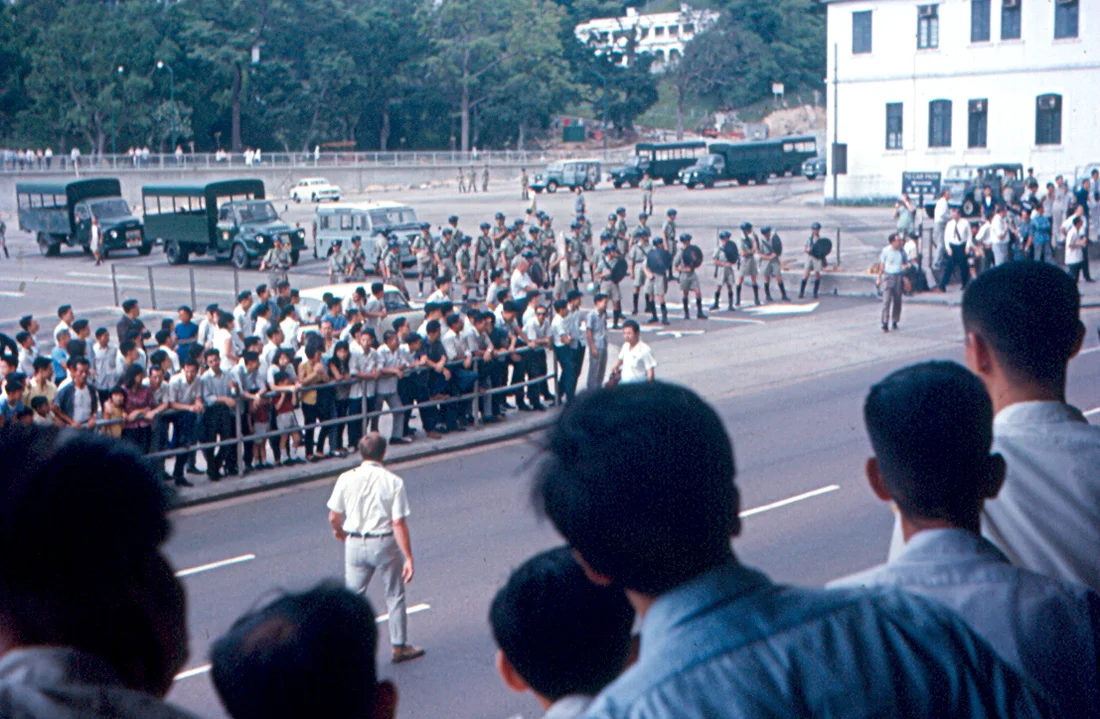

1967 Hong Kong Riots
It began with artificial flowers. At the Hong Kong Artificial Flower Works in San Po Kong, 174 of the factory's 679 workers went on strike on May 1, 1967. Management called police; police arrested picketing workers; union representatives who came to protest the arrests were themselves arrested. Demonstrations spread the next day. Within weeks, the Hong Kong that the world thought it understood — a stable colonial trading port, a refuge from mainland turmoil — had descended into something else: a city of roadside bombs, banned newspapers, fortified police stations, and contested loudspeakers on the Bank of China Building. Eight months later, when it was over, fifty-one people were dead.
The Fire Next Door
The spring of 1967 was not a quiet one anywhere near Hong Kong. Across the northern border, the Cultural Revolution was producing violence: Red Guards were conducting purges, institutions were being dismantled, and the normal order of the People's Republic was suspended in the service of ideological struggle. To the west, in Portuguese Macau, two months of pro-Communist demonstrations had just ended with the Portuguese colonial government essentially capitulating to the demonstrators' demands, ceding de facto control to the CCP's local allies. These events were not lost on Hong Kong's pro-Beijing unions and leftist organizations, who saw both inspiration and opportunity. When the labor dispute at the flower factory gave them an opening, they took it. Within days of the factory arrests, the streets of Hong Kong were filled with demonstrators carrying Mao's Little Red Book and chanting slogans. The British colonial government imposed a curfew and mobilized all available police. Seventeen leftist organizations joined forces under a newly formed Anti-British Struggle Committee.
The Propaganda Battle and the Bombs
On the roof of the Bank of China Building in Central, large speakers broadcast pro-CCP propaganda into the streets below. Colonial authorities responded by mounting larger speakers nearby and playing Cantonese opera. Posters appeared on walls reading 'Blood for Blood,' 'Stew the White-Skinned Pig,' 'Hang David Trench.' Students handed out newspapers. Slogans were painted across the city. Then, in July, the conflict crossed a threshold. Several hundred demonstrators, including members of the People's Militia from mainland China, crossed the border at Sha Tau Kok and attacked Hong Kong police. Five officers were killed and eleven wounded in the exchange of fire that followed. When direct confrontation failed, the demonstrators turned to bombs. They planted them — and decoys — across the city: outside buildings, in public spaces, wrapped to look like ordinary objects. Eight-year-old Wong Yee-man and her two-year-old brother Wong Siu-fan were killed by a bomb left outside their home, wrapped like a gift. In total, bomb disposal experts from police and the British garrison defused approximately 8,000 devices, of which 1,100 were confirmed real. Locals called them 'pineapples.'
The Killing of Lam Bun
As public opinion in Hong Kong turned against the bombers, the protest movement lost legitimacy with each civilian death, and its leaders looked for other targets. On August 24, 1967, a death squad posing as road workers waited for Lam Bun, a popular anti-Communist radio commentator, as he drove to work with his cousin. They prevented him from leaving his car and doused both men with petrol. Both were set on fire. Lam Bun died later that day. His cousin, also badly burned, died several days later. The murder of Lam Bun provoked widespread outrage across Hong Kong and discredited the leftist movement in a way that months of bombings had not quite managed. The credibility of the CCP's local allies was damaged, in the assessment of historians, for an entire generation. In December, Premier Zhou Enlai ordered the leftist groups to stand down, and the violence ended. It later became known that the commander of the PLA's Guangzhou Military Region had secretly proposed invading and occupying Hong Kong during the crisis — and that Zhou Enlai had vetoed the plan.
Counting the Dead, Counting the Changes
By year's end, fifty-one people had been killed: at least twenty-two by police, fifteen in bomb attacks, the rest in various circumstances of the unrest. Another 832 people sustained injuries; 4,979 were arrested, and 1,936 convicted. Property damage ran to millions of dollars. The British government's response to the colonial administration was to award the Hong Kong Police Force the 'Royal' prefix in 1969 — a recognition that lasted until 1997. More lasting were the social reforms that followed. Governor David Trench made reluctant concessions; his successor Murray MacLehose, who took office in 1971, launched far more sweeping changes — in housing, education, welfare, and anti-corruption — that transformed Hong Kong over the following decade and contributed to its rise as one of Asia's major economies. The 1967 crisis demonstrated, in the most costly way, that colonial stability built on unaddressed grievances was not stability at all. In 2017, at a ceremony marking the 50th anniversary, some former participants were hailed as heroes by current Hong Kong political figures and asked Beijing to formally vindicate the protests as a 'patriotic act against colonial tyranny.' The fifty-one people who died are remembered differently, by different people, as different things.
From the Air
Located at 22.2667°N, 114.15°E, centered on urban Hong Kong and the adjacent Kowloon peninsula. Key sites of the 1967 events are distributed across the city: the Bank of China Building in Central, government facilities throughout Hong Kong Island and Kowloon, and the border town of Sha Tau Kok at the northern edge of the New Territories where militia crossed in July. The San Po Kong district, where the artificial flower factory stood, is visible in eastern Kowloon. Hong Kong International Airport (VHHH) is approximately 35 km to the west on Lantau Island. The full extent of colonial Hong Kong — its harbor, its dense residential blocks, the steep green hills that confined development to the coastal margins — is best appreciated from 5,000–8,000 feet on a wide approach from the south.
Nearby Stories
- Lok Ma Chau Loop 2.3 km away
- Portas do Cerco 2.3 km away
- Kweilin Incident 17 km away
- Wanshan Archipelago Campaign 34 km away
- Nanxiong Formation 115 km away
- Battle of Nanpeng Island 148 km away
- Heyuan 169 km away
- Cape Maobitou 632 km away