.jpg)
1985 Sudanese coup d'état
In the reception area of the Khartoum Hilton Hotel, someone tore down a portrait of President Gaafar Nimeiry on 6 April 1985. Tens of thousands of Sudanese had poured into the streets of Khartoum that day to celebrate the news that had just been announced: the army had deposed Nimeiry, who was at that moment in the United States and would be turned away from his own country by his own pilot. The 1985 coup came after more than a week of civil disobedience so effective it shut down the country. The army did not overthrow the civilians. The civilians toppled the regime, and the army caught up.
Sharia and Hunger
Two years earlier, in 1983, Nimeiry had declared all of Sudan an Islamic state under Sharia law - including the non-Muslim southern majority. The Southern Sudan Autonomous Region was abolished on 5 June 1983, ending the Addis Ababa Agreement of 1972 and restarting the civil war that would eventually produce South Sudan. Nimeiry, Sudanese interviewed by the New York Times said, had begun to alienate almost every sector of Sudanese society. Non-Muslims were alienated by Sharia. Professionals were alienated by economic austerity imposed under U.S. and IMF pressure. Urban workers were alienated by rising food prices. Southern Sudan was back at war. For the president, it was Sharia; for Sudanese, it was the daily cost of bread, gasoline, and transport.
Eight Associations
On 3 April 1985, eight professional associations - doctors, lawyers, university lecturers - called for a protest and a general political strike until the abolition of the current regime. The call worked. Massive demonstrations erupted in Khartoum and around Sudan. The general strike ran from 3 to 6 April, with extraordinary effectiveness. Hospitals kept emergency services running, but the rest of the country's governance simply stopped functioning. Banks closed. Courts closed. Offices emptied. Trains stopped running. Streets filled with protesters. It was a pattern Sudanese had used once before, in 1964, when Lt. General Ibrahim Abboud's military regime was brought down by the October Revolution of that year. What Sudanese call the 1985 Revolution - the civil disobedience that preceded the coup - followed in that earlier tradition.
April 6
On 6 April, after more than a week of civil unrest, the Sudanese Armed Forces took control of the country. The coup was led by Field Marshal Abdel Rahman Swar al-Dahab, who was both Defense Minister and Armed Forces Commander-in-Chief. Nimeiry, in the United States at the time, left Washington D.C. and arrived in Cairo. At Cairo International Airport he was met by Egyptian President Hosni Mubarak, Prime Minister Kamal Hassan Ali, and Defense Minister Field Marshal Abd Al-Halim Abu-Ghazala. Nimeiry initially wanted to continue home to Khartoum. The pilot of his Boeing 707 presidential jet refused. Mubarak also counselled against the return. It would be, they told him, too dangerous. He stayed in Egypt.
A Celebrated Coup
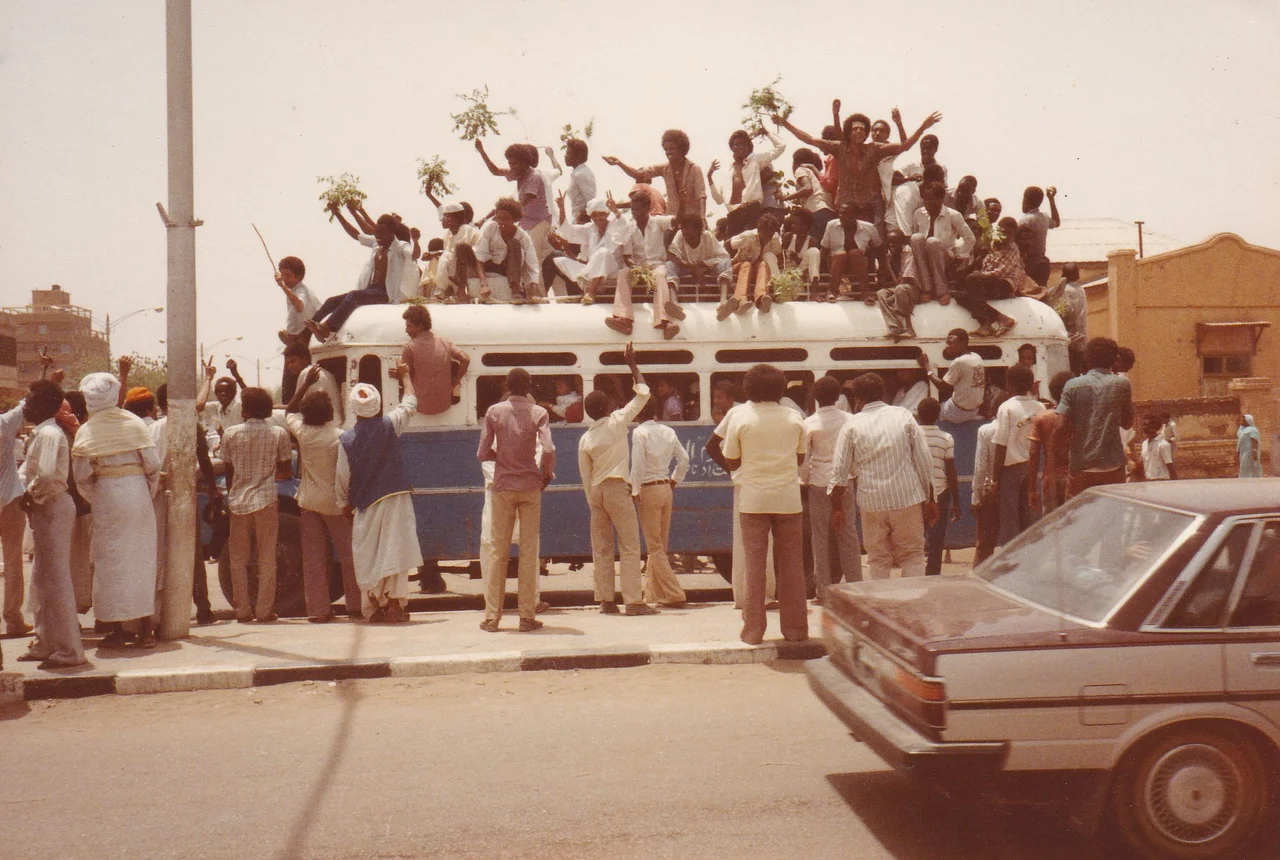
The images that reached the world showed unusual scenes for a military takeover: ordinary Sudanese celebrating. Portraits of Nimeiry were torn down - including the one in the Hilton Hotel reception area. In central Khartoum, outside the Meridian Hotel, people raised the pre-Nimeiry 1969 national flag of Sudan. Some tore images of the ousted president from 25-pound banknotes. Libya under Muammar Gaddafi - no friend of the pro-Western Nimeiry - quickly recognized the new military government. Ba'athist Syria under Hafez al-Assad welcomed Nimeiry's ouster. Swar al-Dahab, to his genuine credit, kept his promise to hold elections; they took place in April 1986. Sudan briefly returned to democracy under Prime Minister Sadiq al-Mahdi. The democracy would last until another Sudanese coup in 1989 - this one carried out by a young general named Omar al-Bashir.
From the Air
From altitude, central Khartoum's pattern of wide colonial-era avenues remains visible, converging on the presidential palace and the riverfront. The Meridian Hotel, where some of the largest 1985 celebrations were photographed, still stands in central Khartoum. The Hilton - the one with the missing portrait - still stands on the Blue Nile riverbank. The railway station from which the general strike's coordinators communicated with their counterparts across Sudan still exists. In April, the season the 1985 Revolution unfolded in, Khartoum is between cool and brutally hot; the haboob dust storms that mark Sudan's summer usually begin by late April or early May. The streets where crowds celebrated are the same streets where, thirty-four years later, crowds would again gather to celebrate the deposition of a president.
From the Air
Coordinates: 15.50°N, 32.56°E (central Khartoum). Recommended viewing altitude: FL300-FL350. Visible landmarks: Blue Nile/White Nile confluence, Presidential Palace, central Khartoum hotel district. Primary airport: Khartoum International (HSSS/KRT). Weather: hot desert; April is the transition from cool to hot season.
Nearby Stories
- Esh Shaheinab 27 km away
- Naqa 56 km away
- Mahdist War 65 km away
- Musawwarat es-Sufra 100 km away
- Gezira State 101 km away
- Northern Sudan 215 km away