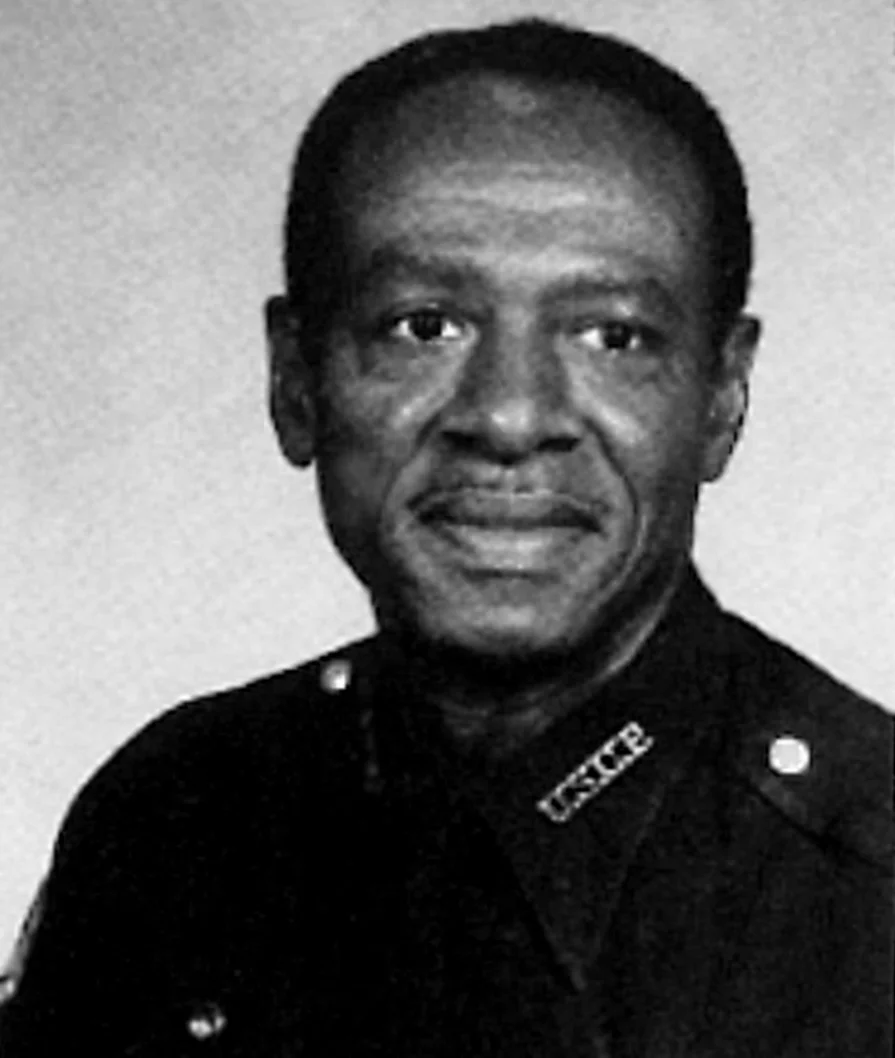

1998 United States Capitol shooting
Officer Jacob Chestnut was 58 years old, a retired Air Force master sergeant who had served two tours in Vietnam, and he had been a Capitol Police officer for nearly half his life. He was standing at the Document Door of the United States Capitol on the afternoon of July 24, 1998, when a man came up to the metal detector and shot him in the back of the head at point-blank range. Detective John Gibson was 42, a Massachusetts native and a lifelong Boston Red Sox fan, and he was assigned to the dignitary protection detail of House Majority Whip Tom DeLay. When Gibson heard the gunfire he told the office staff to take cover under their desks. He met the shooter at the door of the office. Both men shot each other. Both later died. Their bodies became the first police officers ever to lie in honor in the Capitol Rotunda. Chestnut was the first African American to receive the tribute. The man who killed them was named Russell Eugene Weston Jr., and he believed he had come to Washington to save the country from disease and a cannibal invasion.
Three Minutes
The attack lasted about three minutes from the first shot at the Document Door to Weston's arrest in DeLay's outer office. Officer Douglas McMillan, normally posted outside, was nearby retrieving keys to get a wheelchair for a visitor when Weston opened fire. McMillan returned fire immediately, hitting Weston, but the gunman was already running into the building. Weston had wounded a tourist named Angela Dickerson with a stray round during the exchange. McMillan could not pursue with his weapon drawn through the crowd. Weston turned down a short corridor and pushed through the first door he found, which led to a small suite of offices used by senior Republican representatives - then-Majority Whip Tom DeLay and Representative Dennis Hastert, who would become Speaker of the House the following January. Detective Gibson was inside. Hearing the shots, Gibson ordered the staff under their desks and stepped toward the door with his weapon out. Weston shot him once in the chest. Mortally wounded, Gibson returned fire and hit Weston four times. Other officers arrived seconds later and arrested Weston where he had fallen.
A Heart Surgeon at the Scene
Senator Bill Frist of Tennessee, who would later become Senate Majority Leader, was a board-certified heart and lung transplant surgeon before he had been a senator. He had been presiding over the Senate floor a few minutes before the shooting and was still in the Capitol. Hearing what had happened, Frist rushed to the scene. He performed emergency resuscitation on Weston, the man who had just killed two of his protectors, and rode with him in the ambulance to D.C. General Hospital. The choice was not popular with everyone, but it was the choice of a doctor confronted with a dying patient. Gibson was rushed to MedStar Washington Hospital Center, where he died in surgery. Chestnut was taken to George Washington University Hospital and pronounced dead there. Two of the four people who started the day in the Document Door corridor were gone by sunset. Weston survived. He has not stood trial in the 28 years since.
Lying in Honor
Two days after the shooting, on July 26, the bodies of Jacob Chestnut and John Gibson were carried into the Rotunda of the Capitol and placed on the Lincoln catafalque - the same wooden bier that had supported the bodies of Presidents Lincoln, Garfield, McKinley, Harding, Taft, Kennedy, Hoover, Eisenhower, Johnson, Reagan, and Ford. They were the first police officers to receive the tribute of lying in honor in the Rotunda. Chestnut was the first African American. Members of Congress and ordinary Washingtonians lined up for hours to pass the caskets. President Bill Clinton spoke at Chestnut's funeral. Military jets flew the missing-man formation overhead. Gibson was buried at Arlington National Cemetery. He had been married to the niece of Representative Joe Moakley of Massachusetts and left three children, aged 17, 15, and 14. The Boston Red Sox held a moment of silence before their game with the Kansas City Royals on August 11. A post office in Maryland was renamed for both officers. So was a building at Shaw Air Force Base in South Carolina where Chestnut had served. The Document Door itself was renamed the Chestnut-Gibson Memorial Door.
The Question of Cannibals
Russell Eugene Weston Jr. grew up in Valmeyer, Illinois, a town of 900 people in the Mississippi flood plain. He graduated from Valmeyer High School in 1974 and moved to a tiny mining town called Rimini in the Montana mountains, where neighbors found him eccentric and isolated. He believed his neighbor was using a television satellite dish to spy on him. He believed Navy SEALs were hiding in his cornfield. He was diagnosed with paranoid schizophrenia in 1992 and stopped taking his medication. Eighteen months before the shooting he moved back to Valmeyer and obsessively cut down trees in his family's yard. Two days before the shooting, at his grandmother's request, he shot fourteen cats with a shotgun. He told the court-appointed psychiatrist after the attack that he had stormed the Capitol to prevent the United States from being annihilated by disease and legions of cannibals. He was found incompetent to stand trial in 1999. A federal judge ordered him forcibly medicated in 2001, and the U.S. Court of Appeals for the District of Columbia Circuit upheld the order. In 2004 the court ruled that even with treatment Weston was not competent to be tried, and suspended but did not dismiss the murder charges against him. He remains under civil commitment at the Federal Medical Center in Butner, North Carolina. The shooting was one of the events that motivated Congress to build the Capitol Visitor Center, which finally opened in 2008 - a security buffer that did not exist when Jacob Chestnut and John Gibson stood at the Document Door.
From the Air
The United States Capitol stands at 38.89 degrees N, 77.01 degrees W on Capitol Hill in central Washington, D.C. The Capitol dome rises 288 feet above the East Front. The site is inside Prohibited Area P-56A, the most strictly restricted airspace in the country - all aircraft are barred without specific approval from the FAA and Capitol Police. The Washington Special Flight Rules Area extends out 30 nautical miles from the DCA VOR. Reagan National (KDCA) is three miles south. Andrews JBA (KADW) is six miles east. Aerial approach to the Capitol is impossible by design.
Nearby Stories
- Gunston Hall 1.1 km away
- 2023 Baltimore Shooting 4.9 km away
- Battle of Middleburg 6.6 km away
- Crownsville Hospital Center 10 km away
- Battle of Loudoun Heights 13 km away
- First Battle of Rappahannock Station 20 km away
- Howard County, Maryland 21 km away
- Harriet Tubman Underground Railroad 50 km away