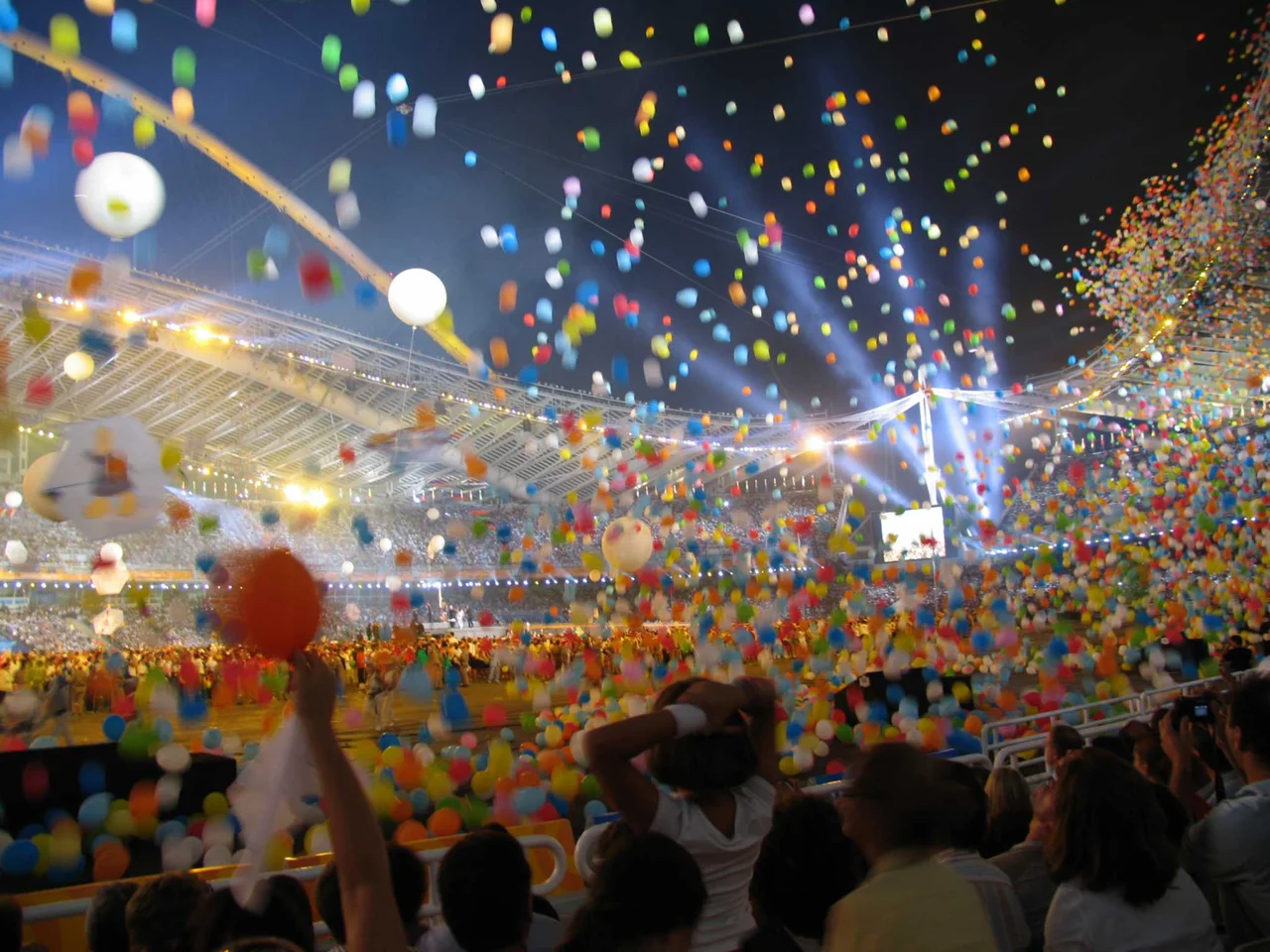

2004 Summer Olympics closing ceremony
A full moon hung over the Olympic Stadium on the night of 29 August 2004, the kind of detail organisers could not plan and could only be grateful for. For sixteen days Athens had carried the weight of doubt, the warnings that the city would never be ready, the worry over costs and security. Now, at 21:15 on a warm Attica evening, the closing ceremony began, and the dominant feeling in the stadium was relief shading into pride. The Games of the XXVIII Olympiad had come home to the country that invented them, and they had worked.
The Last Marathon Medals
Some ceremonies start with spectacle. This one began with a footnote that mattered: the final victory ceremony of the entire Games, for the men's marathon, the oldest and most storied Olympic distance. IOC President Jacques Rogge presented the medals. Italy's Stefano Baldini took gold, American Meb Keflezighi silver, and Brazil's Vanderlei de Lima bronze, the runner who had been leading late in the race when a spectator lunged from the crowd and shoved him off course. He finished anyway, blowing kisses to the stands, and the bronze felt like a verdict on grace under absurdity. Honouring the marathon last, on Greek soil, closed a loop that stretched back to the plain of Marathon itself.
Two Hundred Flags in One File
The Parade of Nations at a closing ceremony breaks the rules of the opening one. Instead of marching by country, the athletes of 202 National Olympic Committees flooded in together, the flag bearers leading in a single file in Greek alphabetical order, the teams behind them mingling without borders. Leading the procession came two figures who bridged present and future: Greek weightlifter Pyrros Dimas, a national hero, and Chinese hurdler Liu Xiang, carrying the banner of the next host. The Games were already looking forward even as Athens tried to hold the moment.
Handing the Flag East
Then came the ritual of succession. The Mayor of Athens, Dora Bakoyannis, handed the Olympic flag to Rogge, who passed it to Wang Qishan, the Mayor of Beijing. Both the Greek and Chinese flags rose; the Olympic anthem was sung in Greek as the five-ringed flag came down, bound for Turin's Winter Games in 2006 before its longer journey to Beijing in 2008. Rogge gave his speech in Greek, French, and English, and ended it simply: "Efcharistoume, Athina. Efcharistoume, Ellada." Thank you, Athens. Thank you, Greece. From a man famously sparing with praise, the warmth landed.
A Child and a Lantern
The flame did not simply go out. The great cauldron was lowered, and a ten-year-old Greek girl, Fotini Papaleonidopoulou, from an SOS Children's Village, lit a small lantern from the Olympic fire with the help of sailing gold medalists Sofia Bekatorou and Emilia Tsoulfa. The lantern passed from child to child, light carried in small hands, before the flame in the cauldron was finally blown out. Greek singers, Sakis Rouvas and Anna Vissi among them, filled the stadium with music, and the night ended not in mourning but in something closer to a village festival that happened to be watched by the world. Athens had been told it could not do this. It had.
From the Air
The Athens Olympic Stadium (OAKA) lies in the northern suburb of Marousi at 38.04 degrees north, 23.79 degrees east, its white steel arches a clear visual marker north of the city centre. Athens International Airport (LGAV) is about 25 km to the east-southeast. Recommended viewing altitude 2,000 to 4,000 feet AGL; late-summer Attica skies are typically clear with light haze over the basin.
Nearby Stories
- Great Sand Beach 5 km away
- Battle of Delium 7.7 km away
- Tower of Aliartos 9 km away
- HMHS Britannic 10 km away
- Saronic Gulf 15 km away
- Sousaki Volcano 17 km away
- Sanctuary of Apollo Maleatas 24 km away
- Skyros 66 km away