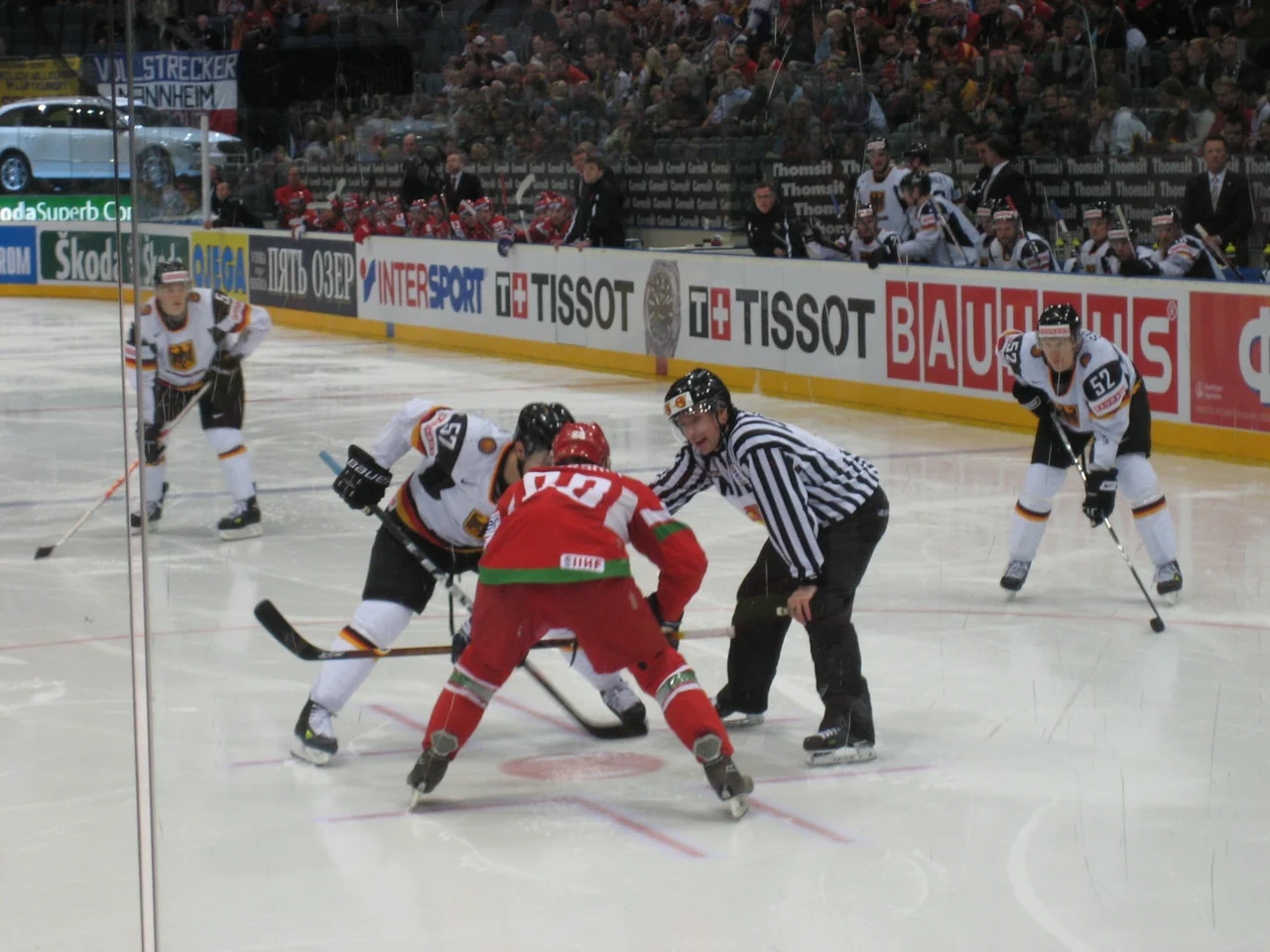

2010 IIHF World Championship: The Miracle at Mannheim and 77,803 in Gelsenkirchen
On 7 May 2010 in Gelsenkirchen, an ice rink was assembled inside Veltins-Arena, the home stadium of Schalke 04. Seventy-seven thousand, eight hundred and three people filed in to watch Germany open its world ice hockey championship against the United States. The previous attendance record for a hockey game, 74,554 fans at Michigan State in 2001, fell at the second intermission, when a Guinness World Records adjudicator named Christian Teufe announced over the PA system that they had not just broken the record, they had beaten it by more than three thousand. Then the host nation, an underdog at its own tournament, won the game 2-1 in overtime. Sixteen days of hockey were getting off to an unlikely start.
Three German Cities and a Football Stadium
The 2010 IIHF World Championship was Germany's first major hockey tournament since the format moved to sixteen nations, and the German federation went big. The main venues were Lanxess Arena in Cologne and SAP Arena in Mannheim, the country's two largest indoor rinks. The opener was placed in Gelsenkirchen's Veltins-Arena, a football stadium with a retractable pitch, so they could put more people in seats than any indoor rink could hold. Four nations had bid to host the tournament. After Slovakia and Sweden withdrew to chase later years, Germany beat Belarus 89 votes to 18 at the IIHF congress in Zurich in 2005. Five years later, 548,788 tickets were sold across the tournament, second only to the 2004 championship in the Czech Republic at the time.
The Group Stage Throws Punches
The preliminary round produced upsets in every group. Norway beat the Czech Republic in Group C, prompting an angry public statement from Jaromir Jagr about Czech stars who had skipped the tournament; the column it triggered on IIHF.com had to be taken down after IIHF president Rene Fasel intervened. In Group B, Switzerland beat second-seeded Canada for the first time in the history of the world championships. Group D was a chain reaction: Germany beat the United States, Denmark beat Finland, Denmark beat the United States, and the Americans were sent into the relegation round for the first time since 2003. Finland topped the group. By the end of the preliminary stage, almost every favorite had lost at least one game it expected to win.
The Miracle at Mannheim
Germany's quarterfinal against Switzerland in Mannheim on 18 May became the tournament's signature game. The Swiss outshot the Germans 41 to 27, hit the post twice in the scoreless first period, and pressured Dennis Endras in the German net for sixty minutes. The only goal of the game came midway through the second period when Philip Gogulla scored on the power play. Endras, who would be named tournament MVP a few days later, held the one-goal lead through the third. When the buzzer went, Germany was in a world championship semifinal for the first time since 1953. A brawl broke out at the final horn between Swiss defenseman Timo Helbling and German assistant coach Ernst Hofner, both of whom were suspended. The IIHF christened the game The Miracle at Mannheim. Germany then lost a tight semifinal to Russia, 2-1, on a Pavel Datsyuk goal with 1:50 left.
The Final in Cologne
The gold-medal game on 23 May at Lanxess Arena was a rematch of nothing: Russia and the Czech Republic had never met in a world championship final before, although the USSR and Czechoslovakia had been rivals across the 1960s, 70s, and 80s. The match exploded twenty seconds in when Jakub Klepis took a pass from Jaromir Jagr and scored on a Russian defense caught out of position. Russia took over possession for most of the first period; veteran Sergei Fedorov hit a post. In the second, Karel Rachunek fed Tomas Rolinek on a 3-on-2 and the puck went in off Rolinek's skate, ruled good. In the third, Alexei Emelin was tossed for clipping Jagr; Jagr did not return. Datsyuk pulled Russia within a goal with thirty-five seconds left on a 5-on-3. Tomas Vokoun held the line. The final score was 2-1. Czech president Vaclav Klaus and IIHF president Rene Fasel handed out the gold medals.
The Tournament That Got Watched
The 2010 worlds drew a cumulative television audience in over 100 countries and was, at the time, the most-watched IIHF tournament in history. The opening game in Gelsenkirchen still holds the record for the largest indoor ice hockey crowd ever assembled. The host nation finished fourth, its best result since the modern sixteen-nation format, and Dennis Endras became the first German player ever named tournament MVP. Hall of Fame inductions in Cologne added Vladimir Krutov, Arturs Irbe, Dieter Hegen, Rickard Fagerlund and Riikka Nieminen-Valila to the IIHF's permanent record. Wayne Gretzky, Vladislav Tretiak and Erich Kuhnhackl served as ambassadors. The official song, somehow, was Scooter's Stuck on Replay; the mascot, somehow, was Urmel on Ice, a stop-motion puppet from a 1969 German children's series. It was, by every measure that the IIHF cared about, an enormous success.
From the Air
The 2010 IIHF World Championship was hosted across three German cities. Lanxess Arena in Cologne (50.94N, 6.98E) is on the east bank of the Rhine, served by Cologne-Bonn (EDDK) 15km southeast. SAP Arena in Mannheim (49.46N, 8.52E) sits in the Rhine-Neckar region, served by Frankfurt (EDDF) 70km north. Veltins-Arena in Gelsenkirchen (51.55N, 7.07E), site of the opening-game crowd of 77,803, sits in the Ruhr area, served by Dusseldorf (EDDL) 50km southwest. From the air, Cologne's twin cathedral spires and the Rhine are the most obvious landmarks; Lanxess Arena is the dome-roofed building just east of the river. The Veltins-Arena is the large oval stadium north of central Gelsenkirchen, with the retractable roof and pitch that make it possible to lay an ice rink inside.
Nearby Stories
- Diamond Interchange: How a Simple Idea Reshapes Towns Like Julich 2.8 km away
- Dusseldorf-Unterbach 6.1 km away
- Baumwollspinnerei Ermen & Engels 11 km away
- RAF Bruggen 15 km away
- Hagen Open-air Museum 21 km away
- Belgium 130 km away
- Marcinelle Mining Disaster 173 km away
- Zwingenberg Castle 178 km away