.jpg)
When Wine Country Shook
At five fire stations in Vallejo, the bay doors opened by themselves. No firefighter touched a switch. Sensors installed a decade earlier by a private earthquake warning company had detected the first pressure waves racing through the bedrock and calculated that the destructive shear waves were less than two and a half seconds behind. In those vanishing moments, the doors rolled up and the station lights came on. Then the ground moved. It was 3:20 a.m. on August 24, 2014, and a magnitude 6.0 earthquake had just ruptured along the West Napa Fault, the Bay Area's most powerful seismic event since the 1989 Loma Prieta earthquake.
Three A.M. Along the Fault
The mainshock struck at a depth of 11.3 kilometers, its epicenter south of Napa and northwest of American Canyon. The West Napa Fault, part of the vast San Andreas system, transfers slip between a tangle of related faults in what geologists call the Contra Costa Shear Zone. This particular fault had slipped quietly for so long that it barely registered in seismic hazard forecasts, assigned a maximum rate of just one millimeter per year. The earthquake suggested the actual rate might be considerably higher. The rupture generated a Mercalli intensity of VIII, classified as "severe," strong enough to crack pavement, shatter windows, and throw objects from shelves across three counties. Governor Jerry Brown declared a state of emergency. President Obama followed with a major disaster declaration for Napa and Solano counties.
Historic Walls, Modern Damage
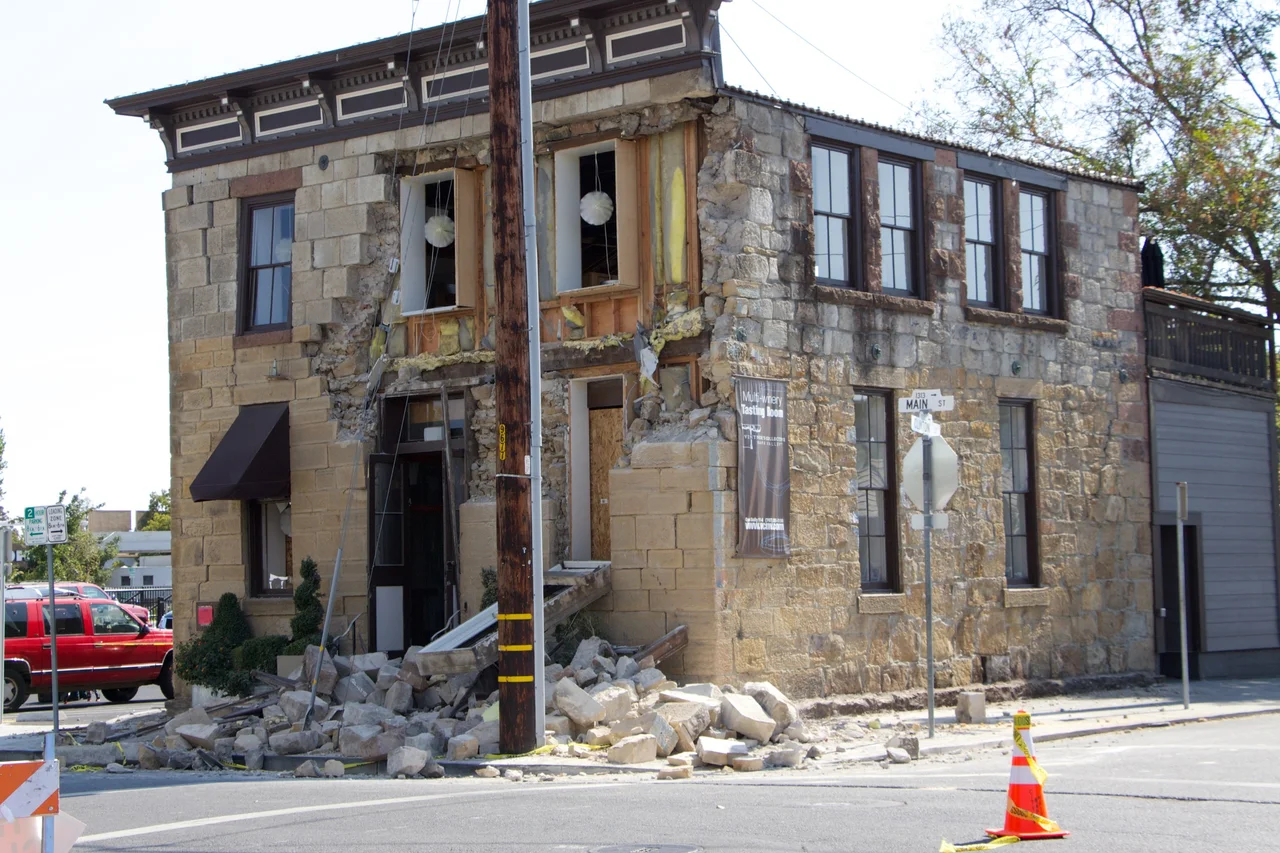
Downtown Napa's oldest buildings took the worst of it, even those that had been retrofitted for earthquake protection. The Goodman Library, the Napa County Courthouse, the Sam Kee Laundry Building, the Alexandria Hotel, the First United Methodist Church, and the First Presbyterian Church all suffered moderate to extensive damage. Every one of them was listed on the National Register of Historic Places. The Thomas Earl House, a historic residence, was badly damaged. The Uptown Theater, structurally sound but with a collapsed ceiling, was red-tagged. In Vallejo, several hundred storefront windows shattered and building walls buckled. A water main on Mare Island broke. Six major fires erupted across the region. Within days, city inspectors had tagged 613 structures: 113 red-tagged as unsafe to enter, 500 yellow-tagged for restricted use.
The Wine Toll
Napa Valley's signature industry absorbed its own particular devastation. Barrels stacked in aging caves toppled like dominoes. Bottles crashed from racks. At Trefethen Vineyards, the historic Eschol building was severely damaged. Hess Collection suffered structural harm to its winery and gallery. Across the valley, wine storage facilities reported losses that initially looked catastrophic. Early estimates put wine industry damage as high as several hundred million dollars, though a September 2014 analysis by Silicon Valley Bank revised the figure to between $80 and $100 million. The total economic damage to Napa County was estimated at $362 million by county officials, with the USGS suggesting the broader costs could reach $1 billion. About 200 people were treated for injuries at Queen of the Valley Medical Center. Two people died.
Seconds That Mattered
The earthquake became a landmark event for seismic early warning technology. The Berkeley Seismological Laboratory's experimental ShakeAlert system detected the initial pressure waves and issued a warning five seconds before the destructive shear waves reached Berkeley. The warning came too late for Napa and Vallejo, where the shaking had already begun, but it demonstrated that even a few seconds of advance notice could save lives at greater distances. The Vallejo fire station sensors, installed by Seismic Warning Systems, Inc. in 2002 and 2003, provided between 1.7 and 2.4 seconds of warning at each station, enough to automatically open bay doors before the shaking could jam them shut. Congress had already approved $5 million in December 2014 to expand ShakeAlert development, a system that would eventually cover the entire West Coast.
Rebuilding in Earthquake Country
Recovery unfolded over years, not months. The Uptown Theater reopened first, in November 2014. The First Presbyterian Church returned to its sanctuary in July 2016 after $850,000 in repairs. The United Methodist Church required $2.2 million in renovations before reopening in November 2015. A $1.75 million contract to repair the Goodman Library was awarded in January 2017. The Post Office building was deemed too expensive to save; the Postal Service sold it to a developer for $2 million. An $11.6 million courthouse restoration contract was awarded in August 2017. The earthquake also left its mark underground. Stream flows in Carriger Creek, Sonoma Creek, and five other nearby waterways surged temporarily as the shaking rearranged subsurface water pathways. In one Sonoma Valley well, the water level rose five feet overnight. The land itself was still adjusting, reminding Napa that the fault beneath the vineyards had not finished moving.
From the Air
Epicenter located at 38.21N, 122.32W, south of the city of Napa in wine country approximately 50nm northeast of San Francisco. The West Napa Fault trace runs roughly north-south through the valley floor. From altitude, the Napa Valley is a distinctive narrow green corridor between the Vaca Mountains to the east and the Mayacamas to the west. Nearby airports include Napa County Airport (KAPC) 5nm south of downtown Napa and Buchanan Field (KCCR) 20nm south. The damage zone centered on downtown Napa is visible where the valley narrows near the Napa River.
Nearby Stories
- Briones Regional Park 4.6 km away
- The Glory Hole: Monticello Dam and the Drain That Swallows a Lake 5.8 km away
- Yolo Bypass Wildlife Area 6.2 km away
- Isleton: The Half-Square-Mile Town That Made Perry Mason Famous 8.3 km away
- The Hangar That Hollywood Flew Through 9.4 km away
- From Wartime Runways to Racing Legends 13 km away
- Altamont Free Concert 26 km away
- The Farallon Islands: California's Forbidden Rock 40 km away