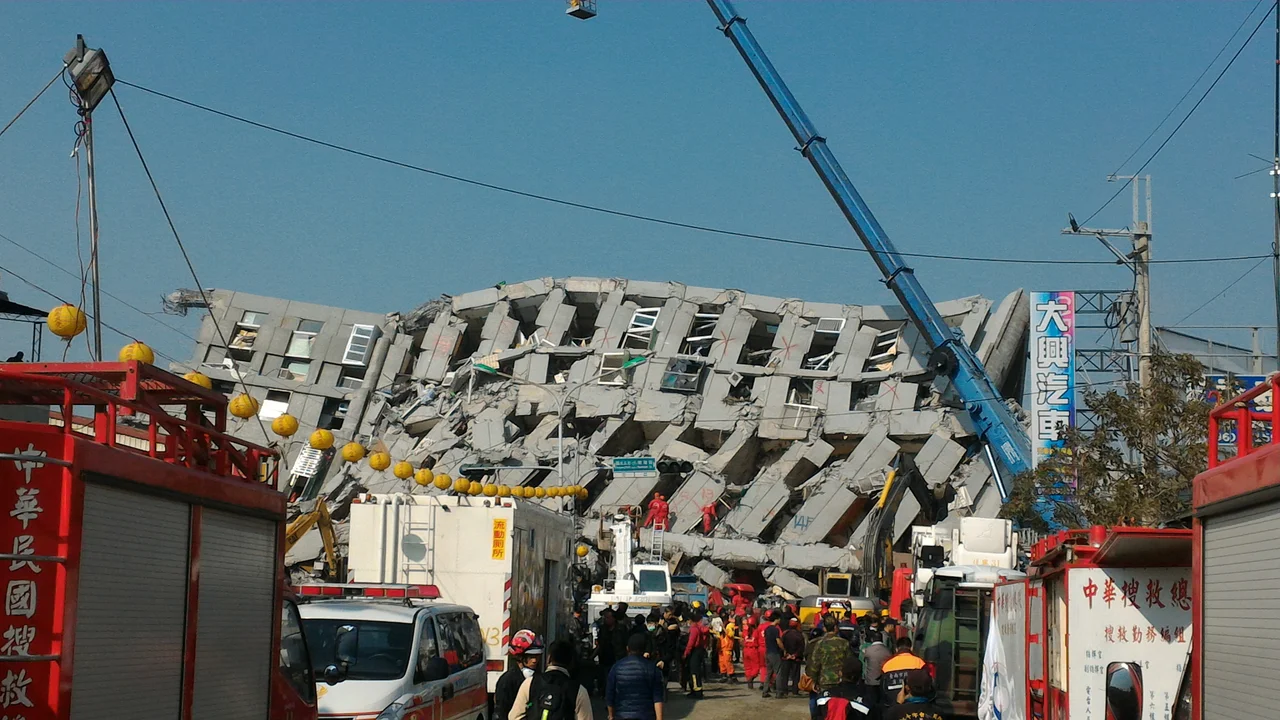

2016 Southern Taiwan Earthquake
It was 3:57 in the morning, the second day of the Lunar New Year holiday. Families were sleeping in. The magnitude 6.4 earthquake struck 28 kilometers northeast of Pingtung City in the Meinong District of Kaohsiung, at a depth of only 23 kilometers -- shallow enough to amplify the shaking at the surface to devastating effect. In Tainan, the Weiguan Jinlong building, a 17-story residential complex in Yongkang District, folded in on itself. Of the 117 people who died in the earthquake, 115 perished inside that single structure, including a six-month-old infant. It was the deadliest earthquake in Taiwan since the 1999 Jiji earthquake, killing 117 people in total, and it struck during the most important family holiday on the Chinese calendar.
The Geology Beneath
Taiwan sits on the Ring of Fire, straddling the boundary where the Eurasian plate and the Philippine Sea plate converge at approximately 80 millimeters per year. Earthquakes are not unusual here -- they are structural. But the February 2016 event was particularly destructive because of its shallow depth. The focal mechanism indicated oblique thrust faulting in the upper crust, producing a maximum intensity of 7 on Taiwan's Central Weather Administration seismic intensity scale. The worst damage concentrated in Tainan, where soil conditions and building age amplified the shaking. The Taiwan High Speed Rail suspended service between Taichung and Zuoying stations due to track damage. Taiwan Power Company reported 168,000 households without electricity. Four hundred thousand households lost their water supply. Taiwan Semiconductor Manufacturing Company reported damaged silicon wafers at its Tainan factory, though shipments were not significantly affected.
The Building That Should Not Have Fallen
The Weiguan Jinlong building did not merely collapse -- it revealed its secrets. As rescuers worked through the wreckage, witnesses reported large rectangular cooking-oil cans packed inside wall cavities, apparently used as building material to cut costs. Taiwanese media documented polystyrene mixed into the concrete of supporting beams. The building had not been defeated by the earthquake so much as by the choices of its developers, who had substituted structural integrity for profit. Investigators arrested the developer. The 397 people rescued from the rubble and the 104 hospitalized survivors owed their survival to rescuers who used life-detection sensors and deliberately avoided heavy machinery, afraid that additional vibrations would collapse what remained. The last survivors -- a woman and her niece -- were found 60 hours after the earthquake.
Rescue in the Rain
The military response was massive and immediate. The Ministry of National Defense deployed 810 personnel, 11 medical teams, 24 search and rescue teams, and 38 vehicles. Tainan Air Force Base was converted into a temporary shelter accommodating up to 1,400 people who had lost their homes. Twelve hundred beds were prepared across four locations. On February 13, a week after the quake, Tainan Mayor William Lai declared the search and rescue mission over. Beyond Tainan, 34 historical buildings across Taiwan sustained damage, 23 of them in the Tainan area. Kaohsiung's Public Works Bureau identified 314 damaged bridges, five of them unusable. The scale of infrastructure damage extended far beyond the headlines about a single collapsed tower, revealing how a shallow earthquake could stress an entire region's built environment.
What the Rubble Exposed
The response to the earthquake extended well beyond rescue operations. Japan donated one million US dollars. The United States pledged half a million. China contributed two million yuan. Domestically, donations poured in: Foxconn and the Yunglin Healthcare Foundation each gave 100 million New Taiwan dollars. The Buddhist Compassion Relief Tzu Chi Foundation dispatched more than 1,000 volunteers to 15 locations with blankets, winter bedding, clothing, and food. Hotels around Tainan offered free rooms to survivors. But the most consequential aftermath was political. President-elect Tsai Ing-wen, visiting Tainan, declared that safety checks of aging buildings and urban renewal would be her administration's top priority. The government allocated 25 billion New Taiwan dollars for reconstruction and announced it would publish maps of land across Taiwan vulnerable to soil liquefaction. The cooking-oil cans found in the Weiguan Jinlong building became a symbol not just of one developer's negligence but of an era when Taiwan's rapid construction outpaced its safety standards -- a reckoning that the earthquake made impossible to defer.
From the Air
The 2016 earthquake's epicenter was at 22.93N, 120.54E in the Meinong District of Kaohsiung, but the primary damage occurred in Tainan to the north. The Weiguan Jinlong building site in Yongkang District, Tainan, is now cleared. The area is part of the densely developed southern Taiwan plain. Nearest airports include Kaohsiung International Airport (RCKH) and Tainan Airport (RCNN). The flat terrain of the Tainan-Kaohsiung corridor is clearly visible from 5,000-10,000 feet. The Taiwan High Speed Rail line runs through this area.
Nearby Stories
- Sanhe Tile Kiln 2.2 km away
- Yakou Mountain Pass 7.2 km away
- Taimali 9.2 km away
- 2025 Tainan–Chiayi Earthquake 17 km away
- Kunci Temple 19 km away
- Dongji Island 22 km away
- South Penghu Marine National Park 41 km away
- Daya Bay 548 km away