
Taimali
The Paiwan people had a name for this place before anyone else arrived: Tjavualji, or Jabauli — the village of sunrise. The name came from a precise geographic fact: the sun rises here from the eastern sea, and at this particular bend of Taiwan's southeastern coast, with the mountains rising steeply behind and the Pacific opening wide ahead, the morning light is something specific. It arrives as a statement. Taimali Township, as it is known today, carries that original name forward in modified form — but the light that inspired it has not changed.
A Thousand Years of Settlement
The Paiwan people established Tjavualji at least a thousand years ago. Their ancestors — known in historical records as the Qian YaoKao, also called the Da Ma — chose this Pacific-facing site in what is now Taitung County, southeastern Taiwan. Qing dynasty records document the place under various written forms, but the name's origin is consistently traced to the Paiwan-language description of the sunrise. The Amis people, Taiwan's largest indigenous group, were also present in the area, and their community was formally consolidated with additional Paiwan residents in the early twentieth century under Japanese colonial administration.
Names Across Eras
The township's name has shifted with each regime. Under Japanese colonial rule, by 1920 the settlement had been given an official designation reflecting the place's traditional name, and in 1937 it was formally called Tamari Village, subordinated to Taitō Prefecture as the Japanese administrative system extended across the island. Indigenous and settler populations from Miaoli, Nantou, Changhua, Yunlin, Chiayi, Tainan, Kaohsiung, and Pingtung moved to the area during the 1940s, expanding the township's demographic mix. After Taiwan was transferred to the Republic of China in 1945, the name became Taimali Village — 太麻里村 — the Chinese characters chosen to approximate the sound of the Paiwan original.
Living on the Pacific Coast
Taimali Township today covers 96.65 square kilometers along the southeastern coast of Taiwan, with a population of approximately 10,763. One-third of residents are members of the indigenous Amis and Paiwan communities, making this a township where indigenous culture remains a visible, living presence rather than a historical footnote. The township comprises nine villages — Beili, Dawang, Duoliang, Huayuan, Jinlun, Meihe, Sanhe, Taihe, and Xianglan — spread across a terrain defined by the meeting of the Central Mountain Range and the Pacific. Mountains to the west, ocean to the east: the landscape offers almost no middle ground.
Sunrise as Identity
Taiwan selected Taimali for a nationally significant moment: on 1 January 2000, the government chose this east-facing coast as the site for the Millennium Dawn celebration, where the nation would watch the first sunrise of the year 2000 arrive over the Pacific. The Millennium Dawn Commemoration Park preserves the memory of that event. The choice made geographical sense — Taimali is positioned to receive sunlight before most of the island — but it also connected modern Taiwan to the ancient Paiwan name. The village of sunrise became, for one morning, the place where an entire country faced east and waited for the light.
What Draws Visitors Now
Taimali's tourism draws on several kinds of appeal. Duoliang Station, a former Taiwan Railway stop in the village of Duoliang, is widely regarded as Taiwan's most beautiful disused railway station — its platform perched above the tracks with an unobstructed Pacific view. Jinlun Hot Springs, tucked into the mountains west of the coast road, offer thermal waters in a setting defined by the sound of the river. The Aboriginal People Ancestor's Birthplace Stele marks the Paiwan community's connection to the land. And the millet fields associated with indigenous agriculture still define parts of the agricultural landscape, particularly in the upland areas. Provincial Highway 9 runs directly through the township, and the South-Link Line of Taiwan Railway stops at Taimali Station, connecting the coast to Taitung city and the rest of the island.
From the Air
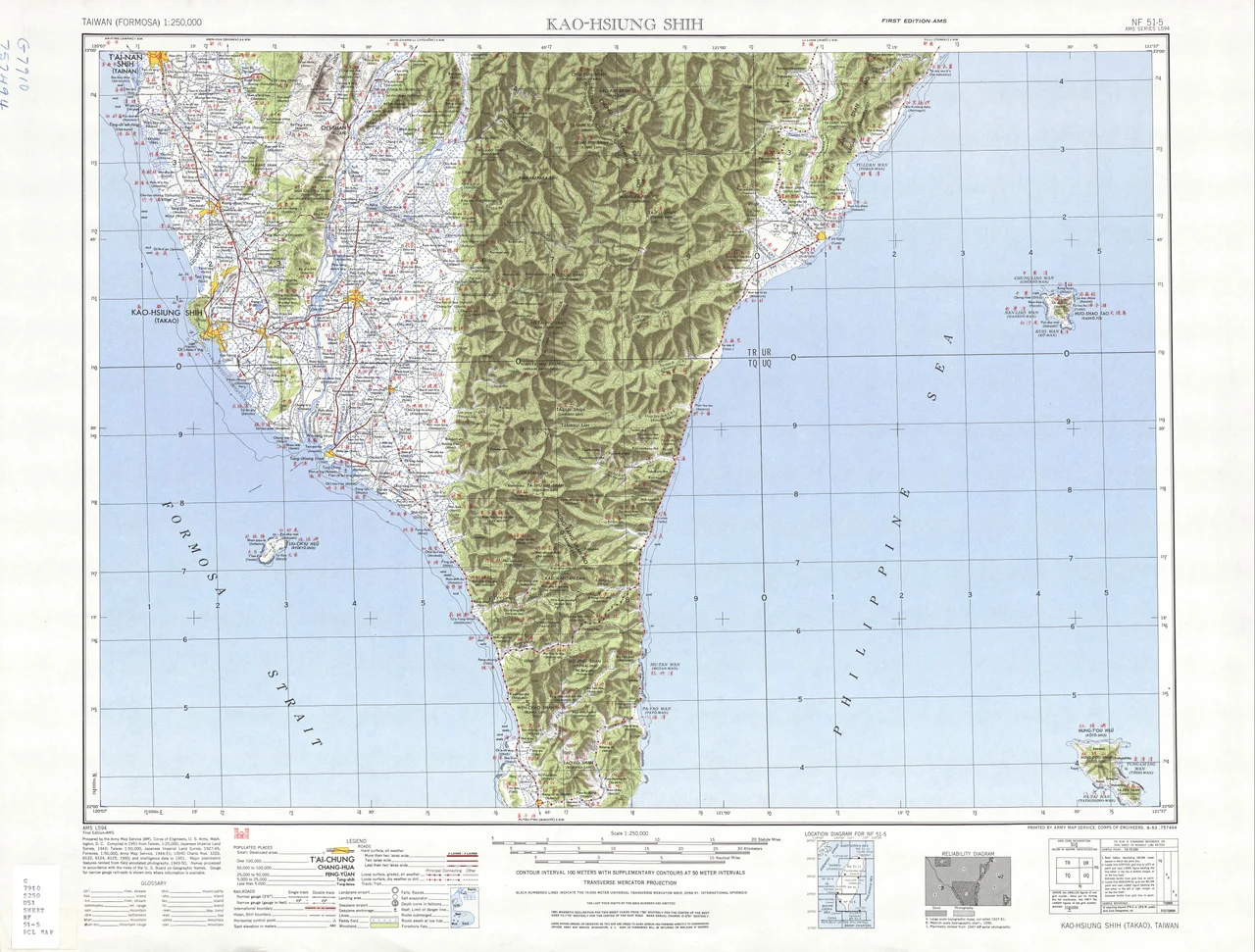
Taimali Township is centered at approximately 22.617°N, 121.000°E on Taiwan's southeastern coast, Taitung County. From altitude, the township is defined by the dramatic topography where the Central Mountain Range meets the Pacific — steep ridgelines dropping directly to the shore, with only a narrow coastal strip for roads and settlement. The nearest airport is Taitung Airport (RCFN), approximately 25 km to the northeast. Provincial Highway 9 traces the coastline through the township and is clearly visible from low altitude as the primary linear feature.
Nearby Stories
- Kunci Temple 5.9 km away
- Meinong East Gate Tower 6.2 km away
- Liudui Hakka Cultural Park 8.4 km away
- Shouka Mountain Pass 30 km away
- 1951 East Rift Valley Earthquakes 117 km away
- Mavulis Island 138 km away
- 2021 Hualien Train Derailment 181 km away
- Hong Kong 12 621 km away